How to Assign Tasks to Freelancers for Better Results

If you’re wondering how to assign tasks to freelancers effectively, think back to the last time a freelancer let you down.
You hired someone with a portfolio that checked out, gave them what felt like clear direction, and waited. What came back missed the mark.
So you sent notes, and the next version was closer, but still not it, and a few rounds later, you were editing the thing yourself at 11 pm, quietly deciding that freelancers just don’t work for your business.
The sad truth is that was probably your fault, not theirs.
The freelancer wasn’t in the meeting where you decided why this project mattered. They didn’t overhear the context that everyone on your team takes for granted. They had your brief and nothing else — and if the brief was vague, the work was always going to be vague.
The good news in that hard truth is that it puts the fix in your hands. Assigning work well is a skill, not a personality trait, and it’s won or lost at the handoff.
You’re hiring from a pool of 64 million Americans who freelanced in 2023, according to Upwork’s Freelance Forward report, so knowing how to delegate to them cleanly has quietly become one of the most useful skills you can build.
This guide walks the whole lifecycle, from breaking down the work to giving feedback that actually lands.
Quick Takeaways
- Most freelance problems are briefing problems — the freelancer wasn’t in your head, and a vague handoff guarantees a vague result.
- Define “done” before you assign: deliverables, format, deadline, and the criteria you’ll judge the work against.
- Put every instruction in one place, because scattered asks across email, Slack, and calls are how projects derail.
- Start a new freelancer on a small, paid trial task and judge brief-following and responsiveness, not just output.
- Direct the outcome, not the hour-by-hour method — it produces better work and keeps you clear of contractor-classification risk.
Why Knowing How to Assign Tasks to Freelancers Matters
When freelance work comes back wrong, the cause is almost always a vague or incomplete assignment, not a bad freelancer. They can only act on what you actually told them, and most of us tell them far less than we think.
The trap is assuming shared context that doesn’t exist.
You know the audience, the goal behind the goal, the three things your CEO hates, the reason this campaign matters this quarter. The freelancer knows none of it unless you say so.
And when the initial direction is fuzzy, that fuzziness sets the tone for everything after it: you give vague guidance, you get a vague draft, you give vague feedback, and you end up with more revision rounds than you ever budgeted for.
Freelancers have a saying about this from their side of the table, and it’s worth tattooing on your monitor: a freelancer is only as good as the brief.
That reframe is the whole game, and it’s freeing once it clicks. You don’t have a freelancer problem; you have a handoff problem. And unlike “find better freelancers,” a handoff problem is something you can fix this week. The rest of this guide is how.
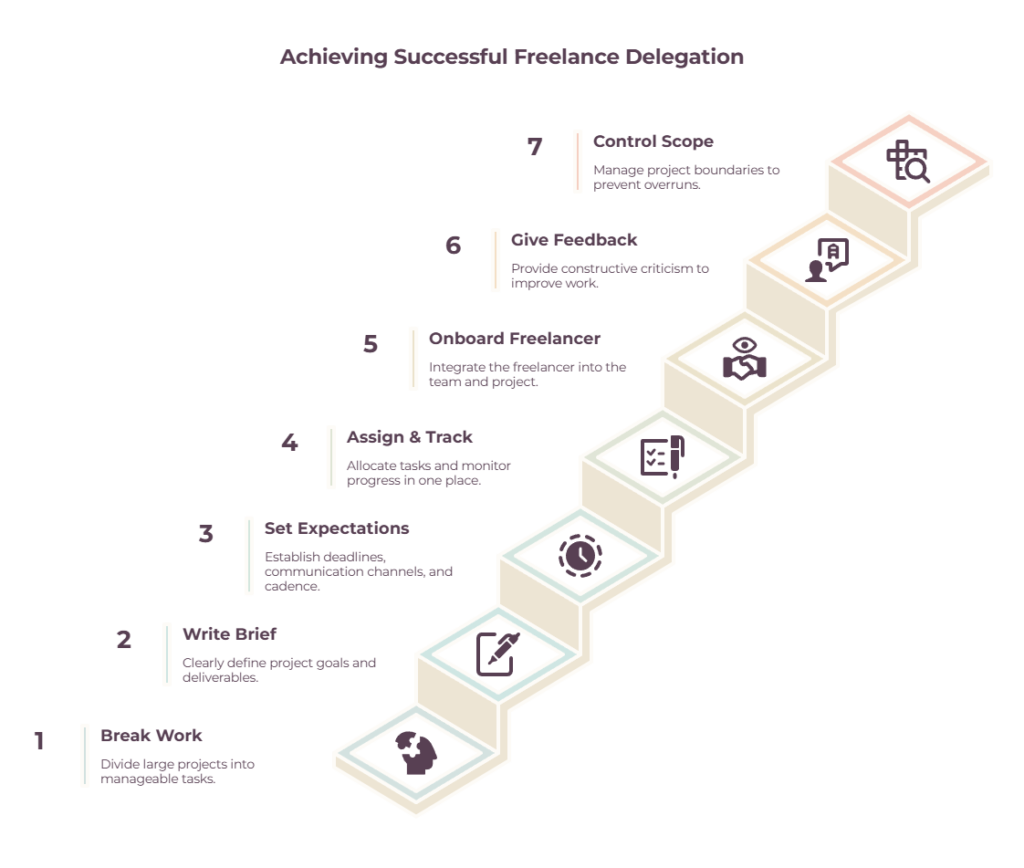
Step 1: Break the project into assignable, right-sized tasks
Before you write a single instruction, decide exactly what you’re handing off — and write down what “done” looks like for each piece.
Sprawling assignments like “manage our social media” or “improve the website” are where scope disputes are born, because they mean something different in your head than in anyone else’s.
Break the work down the way a project manager would. Three layers:
- Deliverables are the concrete outputs: a 1,500-word post in Google Docs, a homepage wireframe in Figma.
- Milestones are the checkpoints that let you both see progress: wireframes approved, first draft delivered.
- Tasks are the units of work that ladder up to those milestones.
Then right-size each piece.
When you’re nervous about quality, it’s tempting to slice the work into a dozen tiny instructions and hand them over one at a time. Resist it.
Micro-managed task lists create “work about work” for both of you, and they blur the line between a contractor running their own process and an employee following yours.
Hand off larger, outcome-shaped chunks — “own the email welcome sequence” — and let the freelancer’s expertise fill in the how.
Finally, write the acceptance criteria
The specific conditions that make each deliverable right. This is the step almost everyone skips, and it’s your single best defense against the revision spiral: it turns “I’ll know it when I see it” into something the freelancer can actually aim at.
A shared task board makes these pieces easy to lay out and assign.
Step 2: Write the brief that defines “done”
The brief is your highest-leverage document. A good one answers the five W’s, so the freelancer only has to supply the how, and it states plainly how you’ll judge whether the work succeeded.

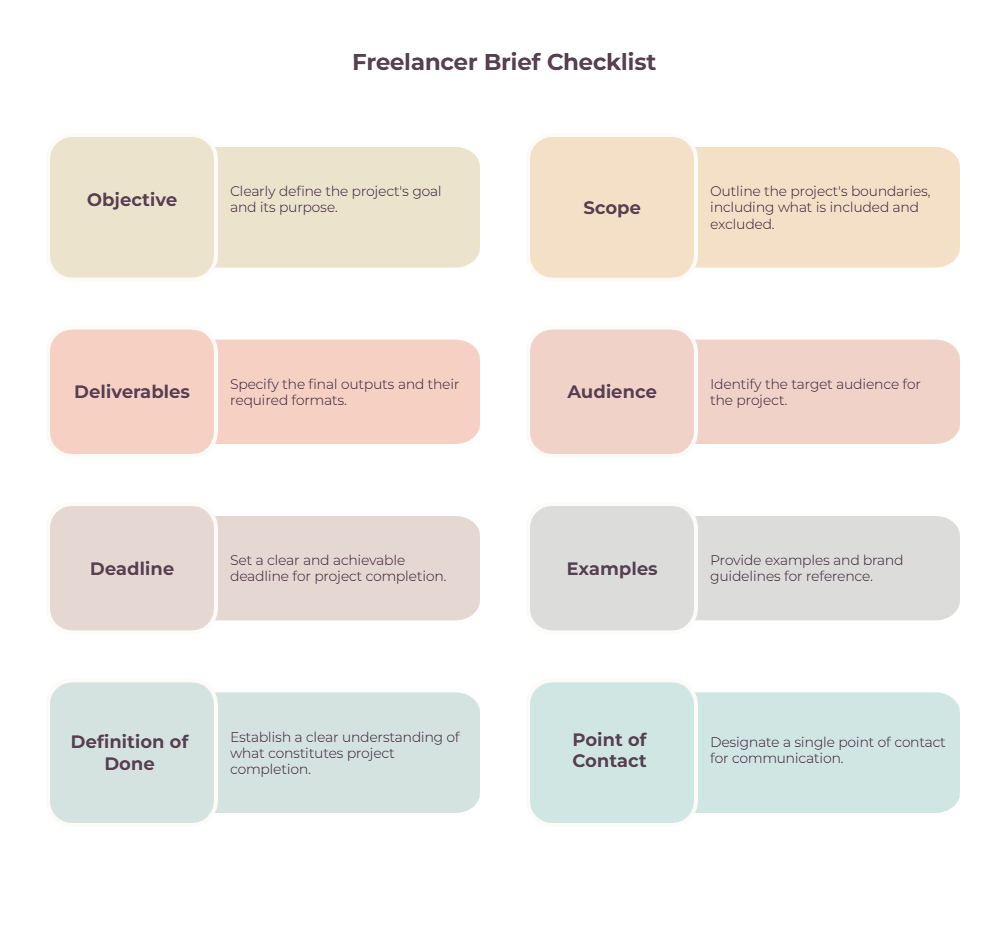
You don’t need a ten-page document. You need a complete one. At minimum, a strong freelance brief covers:
- The objective, and the “why” behind it. What business outcome is this for? A writer who knows the goal is lead generation writes a completely different piece than one who assumes it’s brand awareness.
- Scope, including what’s out of scope. Naming the exclusions is as important as naming the work.
- Deliverables and format. Exact outputs, file types, word counts, the tool it lives in.
- Audience. Who it’s for, described like real people.
- The deadline. A specific date. Never “ASAP” and never “whenever you get to it.”
- Examples and brand guidelines. Links to work you like, your tone-of-voice doc, your brand assets.
- The definition of done. The acceptance criteria from Step 1 are written where they’ll see them.
- A single point of contact. Who they ask when they’re stuck.
Skip this, and you pay for it.
One copywriter describes the predictable output of a thin brief as a mediocre mash-up of half-understood notes — the kind of thing you’d have been faster writing yourself.
There’s a hidden benefit here, too: writing the brief forces you to think. If you sit down to define the objective, the audience, and the definition of done and find you can’t, the project isn’t ready to hand off. You’ve just caught a doomed engagement before it costs you anything.
Clarity, it turns out, is a kindness you do mostly for yourself.
Step 3: Set expectations on deadlines, cadence, and channels
Deliverables specify what the freelancer what to make. Expectations tell them how you’ll work together. Set the deadlines, the check-in rhythm, and the communication channels at kickoff — not halfway through, when something’s already gone sideways.
Set deadlines with a buffer. The freelancer’s due date should never be the same day you owe the work onward to your own client or boss. Leave yourself room to review and request a fix.
Settle the communication basics. Agree on three things up front:
- Where the work lives — your project tool.
- Where quick questions go — Slack or email.
- How often you’ll sync — a predictable weekly 30-minute check-in beats five anxious pings a day.
Agree on realistic response times. Freelancers run several clients at once and work flexible hours, so expecting an instant reply to every message is a fast way to sour a good relationship. If you need them on a recurring call, say so up front so they can build it into their week, and default to async when your time zones don’t overlap.
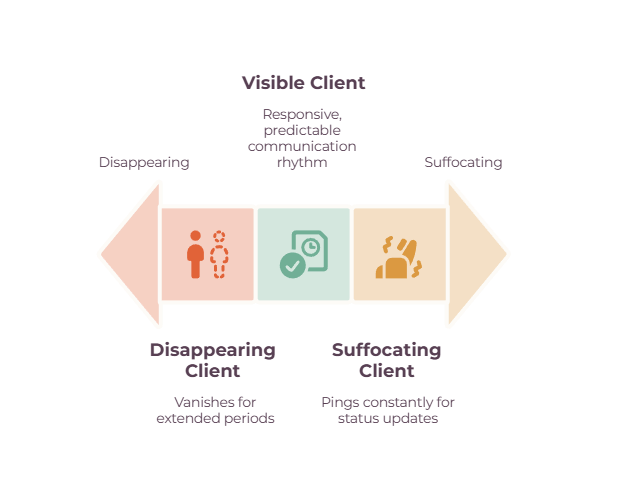
The two ways hirers wreck this
Freelancers complain about both constantly:
- The disappearing client hands over a task, then vanishes for a week, leaving the freelancer guessing.
- The suffocating client pings every hour for a status update.
Aim for the middle: visible, responsive, and on a rhythm everyone can predict.
For a deeper look at running the relationship across a whole project, our guide on managing freelance projects with clients covers it.
Step 4: How to Assign Tasks to Freelancers and Track Them in One Place
Pick one source of truth and assign the work there. Scattering instructions across email, a Slack thread, a call, and a hallway aside is the most common operational mistake there is — it leaves nobody, including you, sure what the current ask is.
Pick the tool that fits your load. For most people, the single place is a project management tool, and the right one depends on how much you’re juggling:
- Asana — clean for assigning tasks with owners and due dates, and seeing at a glance what’s done versus outstanding.
- Trello — the simplest visual board if your workflow is light.
- ClickUp and Monday — more structure when you’re coordinating several contractors at once.
- Notion — holds your briefs, SOPs, and task list in one connected workspace.
Our roundup of the best project management software for freelancers breaks these down in depth from the tooling side.
Two underused tricks
Record a short Loom instead of writing five paragraphs. For anything visual or nuance-heavy, two minutes of screen-share saves an hour of back-and-forth — and it works across time zones.
Use time tracking for visibility, not surveillance. A mid-project checkpoint lets you catch a deliverable drifting before it’s finished and wrong. Daily status-policing, by contrast, signals you don’t trust the person you hired, and drags you right back into the weeds you were trying to climb out of.
If you’re paying against milestones, a tool that ties invoicing to project stages keeps the money side aligned with the work.
Step 5: Onboard like they’ll be back
Treat even a one-off hire as a possible long-term partner. A short, deliberate onboarding pays for itself in fewer misunderstandings — on this project and every one after it.
Give context generously, access narrowly.
Hand over the things that help them do the work well: brand guidelines, examples of past work you liked, and the customer personas you already have. But scope their access to only the tools and files the job actually needs. Over-provisioning access — especially handing a contractor a company email account — creates security risk and quietly blurs the contractor-employee line you want to keep crisp.
Start with a small, paid trial task.
This is the move experienced hirers swear by. Not an unpaid “test” — a small, properly compensated piece of real work. It tells you far more than a portfolio can:
- Whether they follow a brief
- How they communicate and how fast they respond
- Whether they ask good questions
And because it’s small, it’s cheap to have someone else redo it if it misses. Pay fairly for it — that sets the tone of a partnership rather than an audition.
Document your SOPs as you go. The second time you explain anything, write it down, so the next hire inherits the answer instead of costing you the same conversation.
Once onboarding starts to spread across contracts, tax forms, access, compliance, and payments, a freelancer management platform can bring those processes into one system.
For the contract and client-relationship side of bringing someone on, the freelance management tools are worth a look.
Step 6: Give feedback that actually improves the work
Specific, consolidated, time-boxed feedback is what separates the hirers who get great work from the ones who stay frustrated. Vague notes produce vague revisions, every time.

Be specific, and always name the why.
“I don’t like this” gives the freelancer nothing to act on. “The tone here reads more formal than our brand voice — we want it conversational, like this example” gives them a target. Tie feedback back to the brief and the brand so it’s a standard, not just your mood that afternoon.
Consolidate before you send.
If three people on your side have opinions, gather them and have one person deliver a single reconciled set of notes. Nothing burns a freelancer out faster than contradictory feedback arriving from four directions.
Limit the revision rounds.
Two rounds is the common standard, and telling the freelancer up front that they’ve got two included rounds actually makes your own feedback sharper — you stop treating it as infinite. Give your most thorough feedback early, on the trial task, since it calibrates everything that follows.
And yes, sometimes you do need to cut losses — but be straight with yourself first about whether the brief and the feedback were ever clear enough to succeed against.
Step 7: Control scope before it controls you
Scope creep — the project quietly swelling past what you agreed — is usually the product of a loose original scope rather than anyone acting in bad faith. The fix is three habits:
Write the scope down.
List the deliverables and, just as importantly, what’s explicitly excluded.
Route new requests through a change process.
When a “while you’re at it” ask appears mid-project, acknowledge it warmly, then treat it as a change: priced and scheduled before any work starts. A striking number of these evaporate the moment a cost is attached.
Match pricing to how stable the work is.
Fixed-price billing rewards a tight, stable scope; hourly is fairer when you genuinely expect requirements to evolve. Forcing a fixed price onto a fuzzy project just guarantees a fight later.
For anything sizable, graduate from a brief to a signed statement of work that spells out scope, acceptance criteria, milestones, payment terms, and a clause for how changes get handled.
Frameworks worth stealing (and a note on classification)
A few named frameworks make delegation repeatable instead of improvised — and one short legal note is worth knowing before you assign anything.
Three frameworks that earn their keep
- The 7 Levels of Delegation (from Jurgen Appelo’s Management 3.0) makes the point that handing off work isn’t a binary between “do exactly this” and “figure it out yourself.” There’s a ladder from telling, through consulting and agreeing, all the way to fully delegating a decision you don’t even want the details of.
The practical move: decide consciously how much authority a freelancer has over a given area, then say it out loud. A trusted long-term designer might own visual decisions outright; a brand-new hire works to agreement first.
- RACI — for any deliverable that touches your internal team as well as a contractor, name exactly one Accountable owner, the Responsible doer, who’s Consulted, and who’s merely Informed. It quietly kills the “I thought you were handling that” failure.
- SMART (specific, measurable, achievable, relevant, time-bound) is a fast sanity check that the objective in your brief is real and not mush.
A short word on the legal side
Treat this as orientation, not legal advice — the rules genuinely are in flux and vary by state.
The same control you might be tempted to exert when assigning work is exactly what regulators look at when deciding whether your “contractor” is really an employee. The IRS weighs behavioral control — how much you direct the way and timing of the work — alongside financial control and the relationship itself.
At the federal level, the Department of Labor stopped enforcing its 2024 contractor rule in mid-2025 (reverting to an older economic-reality test) and in early 2026 proposed formally rescinding and replacing it, with no final replacement in effect as of this writing.
Several states — California, New Jersey, and Massachusetts among them — apply a stricter “ABC test.”
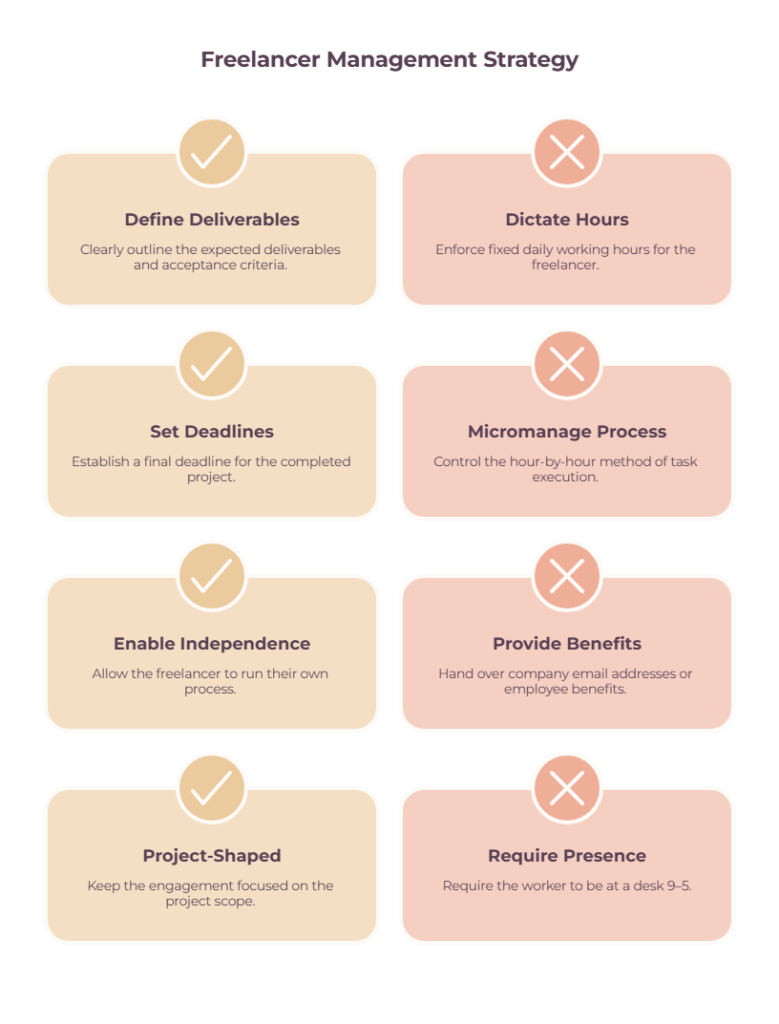
The practical takeaway lines up neatly with good delegation anyway:
- Direct the outcome and the deliverables, not the hour-by-hour method
- Avoid dictating fixed daily hours
- Don’t hand over company email or benefits by default
- Keep the relationship shaped like a project
Good delegation hygiene and good classification hygiene point in the same direction. When meaningful money or risk is involved, talk to an attorney about your specific situation.
Where to start
You don’t need to go find better freelancers—you need to learn how to assign tasks to freelancers more effectively, and that starts with the very next project on your plate.
Open a blank page and write the one-page brief from Step 2: objective and why, scope in and out, deliverables and format, a specific deadline, examples, the definition of done, and a single contact.
If you get stuck because you can’t articulate the objective or what “done” looks like, that’s not writer’s block — that’s the project telling you it isn’t ready to leave your hands yet.
Sort that out first, and you’ve prevented a failure before it happened.
Get the handoff right, and the work comes back right, usually the first time. To set up the systems underneath all this, our guides to the best project management software for freelancers and organizing the work into assignable tasks are the practical next steps.
Frequently Asked Questions
How do you write a task brief for a freelancer?
Cover the objective and the business reason behind it, the scope (including what’s excluded), the exact deliverables and format, the audience, a specific deadline, examples, and brand guidelines, the definition of “done,” and a single point of contact.
If you can’t fill in the objective or the definition of done, the task isn’t ready to assign yet.
How do you manage freelancers without micromanaging?
Direct the outcome, not the hour-by-hour method. Assign outcome-shaped tasks with clear acceptance criteria, set a predictable check-in rhythm, and use a project tool for visibility rather than policing daily status.
A single mid-project checkpoint catches problems early without hovering.
How many revision rounds should you give a freelancer?
Two included rounds are the common standard. Stating that up front actually improves your own feedback, because it pushes you to consolidate everything into one clear, complete set of notes rather than dripping changes piecemeal.
How to assign tasks to freelancers without it counting as employment?
Broadly, direct the deliverables and outcomes rather than controlling how and when the work gets done, avoid setting fixed daily hours, and don’t provide company email or benefits by default.
Classification rules vary by state and are in flux, so treat this as general information and consult an attorney for your situation.
Related guides: freelance management tools · how to manage freelance projects with clients · best project management software for freelancers · project management and invoicing software · freelancer task management tools · freelancer management platform explained