Freelance Finance: Best Practices for Building a Secure Financial Future

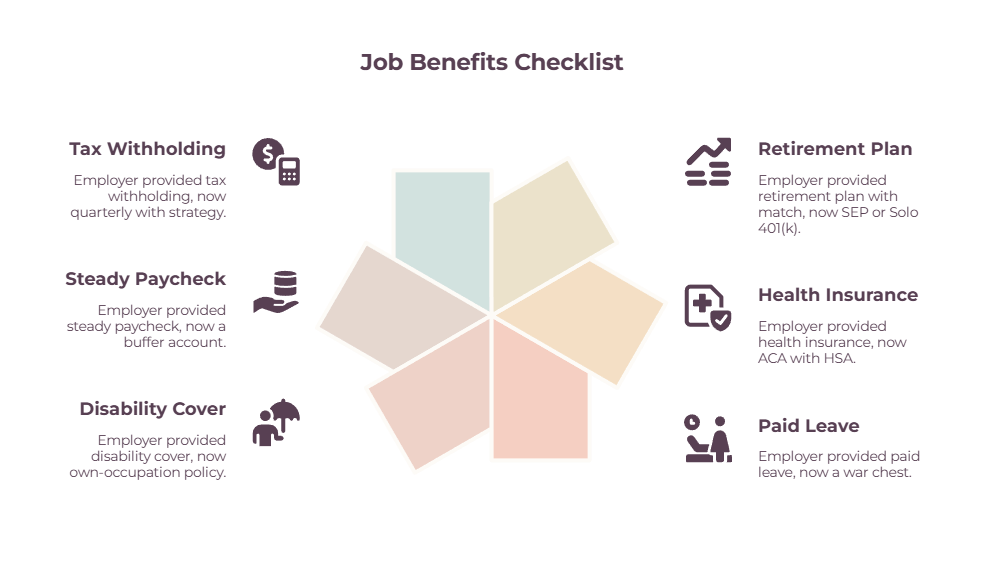
Freelance finance starts with a realization: when you leave a salaried job, you also leave behind the financial infrastructure someone else used to manage for you. That includes retirement plans, health insurance, paid leave, and a predictable paycheck.
You probably never noticed how much financial machinery was running quietly on your behalf.
Then you went freelance, and all of it vanished at once.
That’s the job of financial planning when you work for yourself: you become your own CFO. Every piece of infrastructure a job used to provide, you now rebuild by hand — the retirement plan, the insurance, the cushion that covers a slow season, the strategy that keeps your tax bill from ballooning.
It’s a lot. But only about 13% of solo self-employed people use any retirement plan, against roughly 72% of employees at larger firms (Pew, 2019), which tells you how many freelancers never get around to it. Doing the planning at all puts you ahead of most.
Quick Takeaways
- Financial planning is the multi-year layer above month-to-month budgeting — goals, retirement, insurance, and wealth, not just cash flow.
- You have to be your own CFO: rebuild the retirement plan, insurance, and paid leave that a job used to provide.
- Only about 13% of solo self-employed people use a retirement plan, versus roughly 72% of employees at larger firms.
- Contribute to a Roth in lean years and pre-tax in strong years; with variable income, that timing is worth serious money.
- Disability insurance is the most-skipped freelancer coverage, and it guards the one thing everything depends on: your ability to work.
This guide stays at the planning altitude. For the day-to-day money system underneath it, the links point you down to the detail.
What freelance finance actually means
Financial planning is the long game: goals, retirement, insurance, and wealth built over years. It sits on top of the month-to-month money management you’ve hopefully already got under control.
There’s a difference between running your money and planning your future, and most freelancers only ever do the first.
Running your money is the monthly work. It means separating business and personal accounts, paying yourself from a buffer, setting aside money for taxes, and keeping your books current, ideally with dedicated accounting software built for freelancers.
If that’s still shaky, start with our guide to managing finances as a freelancer and come back here, because planning sits on top of those habits, not instead of them.
Planning is the layer above. It asks where you’re going over five, ten, thirty years, and what you’re building toward. It’s the part with no deadline forcing your hand, which is exactly why it gets skipped.
Nobody sends you a reminder to open a retirement account or buy disability insurance. You have to be the one who notices the gap an employer used to fill, and fill it yourself.
That’s the CFO’s job, and the rest of this guide is the list of holes to patch.
Start with goals and a net-worth number, not a budget
Planning begins with where you want to end up. Set personal financial goals separate from business goals, and track your net worth, not your income, as the truest measure of progress.
Freelancers tend to fixate on revenue because it’s the number that moves. But revenue isn’t wealth, and a big year with nothing kept is just a busy year.
The number that tells you whether you’re getting ahead is net worth: everything you own minus everything you owe, checked quarterly.
With no steady salary to anchor to, that single number is your scoreboard.
Keep your business goals and personal financial goals in separate columns. “Hit $120k in revenue” is a business goal. “Have six months of expenses saved and $50k invested” is a personal goal. The second is the one that determines whether you can sleep.
Translate revenue targets into take-home targets. What reaches your personal account after taxes and business costs is what builds a life. Then set goals across three horizons:
| Horizon | Examples | What it funds |
| Short term | A war chest, a big equipment purchase | Stability and the next slow season |
| Medium term | A house, a sabbatical | The big life moves |
| Long term | Retirement, the freedom to stop chasing every client | Eventually working because you want to |
The horizons decide where the money goes next.
Build your own retirement plan, and save more than an employee would
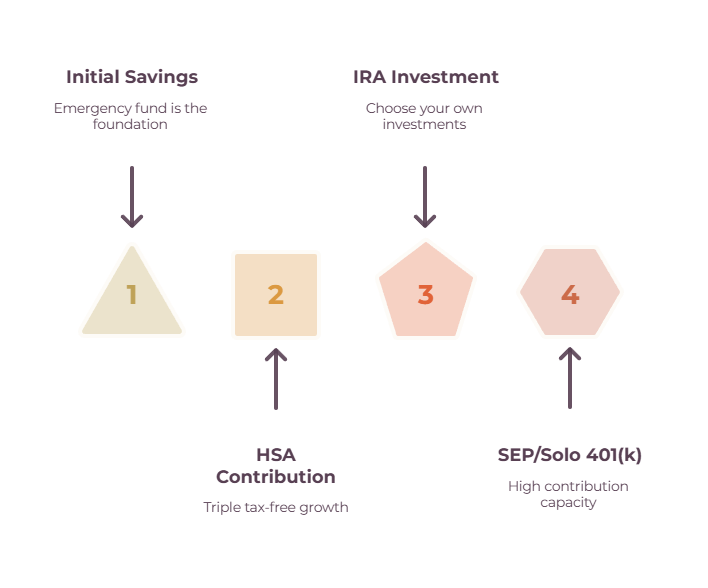
With no employer match, you have to save more on your own. Follow a deliberate order: cash buffer first, then an HSA, then an IRA, then a SEP or Solo 401(k), and finally a taxable account.

That order matters because each tier does a different job. Once your emergency fund is solid, an HSA (if you’re on a high-deductible health plan) is the most tax-advantaged account in existence: money goes in pre-tax, grows tax-free, and comes out tax-free for medical costs.
Next, an IRA, where you control the investments. Then, the big self-employed plans, where the bulk of the capacity lives. Anything beyond that goes into a regular taxable brokerage.
Between the two main self-employed plans, the choice usually comes down to how aggressively you want to save versus how simple you want it:
| Plan | 2026 capacity | Best for | Roth option? |
| Solo 401(k) | Defer $24,500 as employee + employer contributions, up to $72,000 combined | Saving aggressively at a lower income (you contribute as both employee and employer) | Yes |
| SEP-IRA | Up to 25% of net earnings (≈20% after the math), max $72,000 | Simplicity — one lump-sum contribution at tax time, good for unpredictable income | No |
| IRA | $7,500 | A simple starting point alongside either plan | Yes (Roth IRA) |
The Solo 401(k) usually wins for a one-person business trying to save aggressively, because you hit the ceiling at a far lower income than a SEP requires, and it allows Roth contributions. The SEP-IRA wins on pure simplicity.
(Figures are per the IRS for 2026; worth confirming current figures before you act on them.)
Use your variable income to your advantage
Here’s the move generic advice misses: with income that swings, time your Roth and pre-tax contributions to the year. In a lean year, your tax bracket is low, so a Roth contribution (taxed now, free later) is a bargain.
In a high-earning year, lean pre-tax to cut the bigger bill. Filling the bracket deliberately, year by year, is a freelancer’s advantage that employees with fixed salaries never get to use.
Turn taxes into a multi-year strategy, not an April scramble
Compliance is paying what you owe on time. Planning is legally owing less over a span of years, by timing income, using retirement contributions as a lever, and knowing when a business structure change pays off.
The monthly tax mechanics — the 25–30% set-aside, the quarterly payments — live in our bookkeeping for the self-employed guide. Planning is the layer above that, and it thinks in years rather than quarters.
You can time when income lands and when you buy equipment, bunch deductions into a single year to clear a threshold, and use a large retirement contribution in a strong year to drop your taxable income (sometimes enough to keep you under an income cliff that affects health subsidies).
Two levers are worth knowing. The QBI deduction lets many freelancers deduct up to 20% of qualified business income, and it was made permanent for 2026 with a new $400 minimum for anyone with at least $1,000 of active business income.
And the S-corp election becomes a serious tax-planning move once your net profit is consistently high — the common rule of thumb is somewhere around $50,000 to $80,000, depending on your costs.
As an S-corp, you pay yourself a reasonable salary subject to the 15.3% payroll tax, and take the rest as distributions that avoid it.
The catch is cost and complexity: payroll, a separate return, and more bookkeeping. It changes your payroll tax, not your income tax, and below that profit threshold, the savings rarely cover the overhead.
The salary also has to be genuinely reasonable, or the IRS can reclassify your distributions. This is the point where a CPA earns their fee, which brings us to the last section.
Replace the benefits you lost: insurance and risk

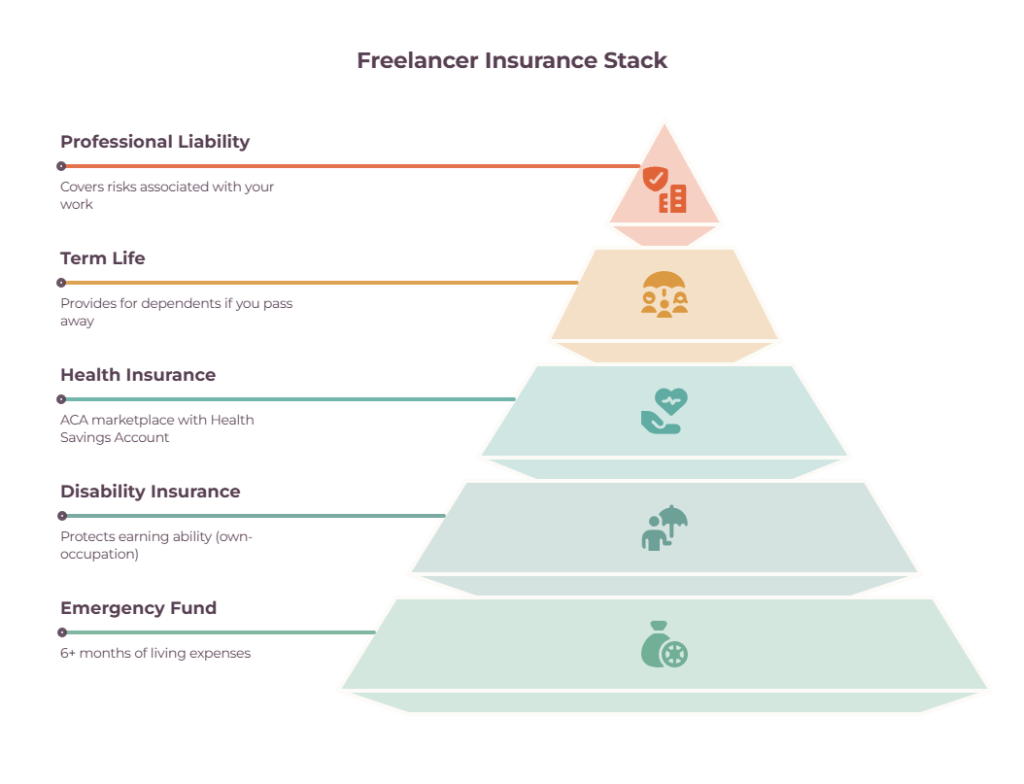
A job bundled your insurance invisibly. Now you buy it yourself, and the coverage most freelancers skip — disability insurance — is the one protecting the thing everything else depends on: your ability to work.
Disability insurance is the one nobody plans for.
The Social Security Administration estimates a 20-year-old worker has a one-in-four chance of developing a disability before retirement age, and for a freelancer, a disability means income stops entirely — no sick leave, no short-term coverage, nothing.
A long-term policy typically costs 1% to 3% of your income and replaces around 60% of it, sometimes up to 80%.
Pay attention to one distinction: an “own-occupation” policy pays out if you can’t do your specific job, while a cheaper “any-occupation” policy only pays if you can’t do any job at all. For a skilled freelancer, own-occupation is usually worth the extra cost.
The rest of the stack:
- Health insurance is now a planning decision, not a form you fill out on your first day. Most freelancers buy through the ACA marketplace, and for 2026 the enhanced pandemic-era subsidies expired, so marketplace premiums have risen sharply — budget for a bigger number and check the current subsidy rules.
- HSA. If you carry a high-deductible plan, an HSA doubles as a stealth retirement account.
- Term life insurance if anyone depends on your income.
- Professional liability / E&O cover if your work carries that risk.
- A larger emergency fund — six months or more — is the foundation all of this sits on. The basics of building it are in the day-to-day pillar guide.
Smooth a lumpy income across years, not just months
A monthly buffer keeps the lights on. A multi-year war chest keeps the business alive through a bad season or the loss of an anchor client.
Most freelancers build a buffer to smooth income within a year — the fat months covering the lean ones.
Planning extends that thinking across years. A war chest is a deeper reserve, separate from your emergency fund, that lets you survive a brutal stretch without panic-taking work at half your rate. The freelancers who weather downturns are the ones who saw them coming and stockpiled in the good years.
Two structural moves reduce the swings in the first place. Recurring revenue — retainers, ongoing contracts, anything that bills monthly — cuts the variance that makes planning feel impossible; our guide to keeping track of invoices helps you manage the recurring side.
And watch client concentration like a risk you’re managing, because it is one. When any single client is more than roughly 20% to 30% of your revenue, their bad quarter becomes your crisis.
Diversify your client base the way you’d diversify investments, and forecast the dips early with a cash flow tool so a slow stretch is a plan, not a surprise.
Invest to build lasting wealth
Once your tax-advantaged accounts are working, a plain taxable brokerage is where freelance wealth actually compounds. The trick to irregular income is to make the investing automatic.
Retirement accounts have annual caps.
If you’re earning well and want to build wealth beyond them, a standard taxable brokerage account is the next stop — low-cost index funds or ETFs, held for the long run. There’s nothing freelancer-specific about the investments themselves; the challenge is purely behavioral.
Freelancers chronically under-invest, and it’s not usually a money problem. Employees get auto-enrolled and never think about it again, while you have to decide to invest, every time, out of income that arrives unpredictably. Decision fatigue wins.
The fix is to remove the decision: set a rule that a fixed percentage of every client payment sweeps into investments automatically, the same way you already move your tax money.
People are far more likely to save when it happens without them — auto-enrolled workers participate at dramatically higher rates than those who must opt in (BlackRock’s emergency-savings research).
Automate it once, and the lumpy income stops being an excuse.
Plan for the big life events: a house, time off, scaling
A freelancer’s hardest money moments are predictable — buying a house on 1099 income, taking unpaid leave, stepping back to scale. Plan for them before they arrive, because the systems aren’t built for you.

The mortgage is the classic trap.
Every deduction you smartly claimed to lower your taxes also lowered the income a lender will count, so a profitable freelancer can look broke on paper and get denied.
Most lenders want two years of tax returns showing stable or rising income, so if a house is on your horizon, think twice about aggressively minimizing income in the two years before you apply.
Where standard loans won’t work, bank-statement and other non-QM loans qualify you on deposits rather than taxable income, usually at a higher rate.
The other events are about cash, not credit. With no paid parental or medical leave, your time off is funded entirely by what you’ve saved — the war chest from earlier is what buys you a month with a newborn or a recovery without income.
A sabbatical works the same way: it’s a savings goal with a date on it.
And scaling — your first subcontractor or employee — is a financial decision before it’s a hiring one, because payroll, higher taxes, and new insurance all follow. Plan the money side first.
When to hire a CPA or a fee-only financial planner
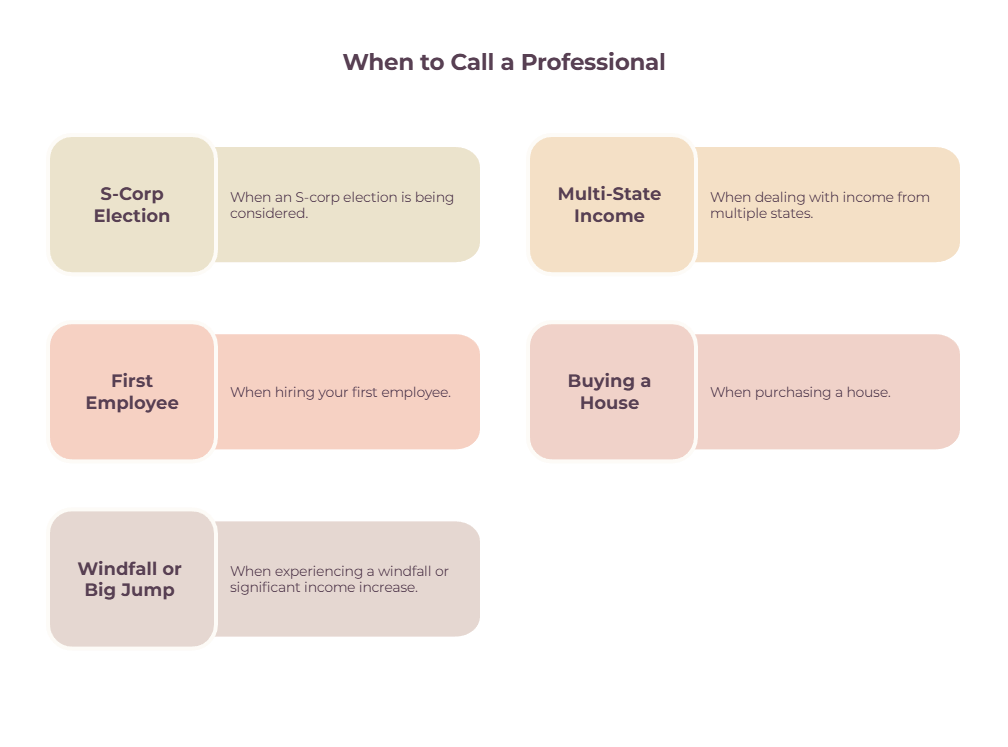
DIY works until the complexity or the stakes outgrow it. Bring in a CPA when your taxes get complicated, and a fee-only fiduciary planner when the decisions get big enough that good advice pays for itself.
The triggers are concrete: an S-corp election, multi-state income, your first employee, a house purchase, or a windfall are all moments where a professional saves you more than they cost. Below that, good software and these guides will carry you fine.
When you do hire, the words matter. A fee-only planner is paid only by you and is held to a fiduciary standard, meaning they’re legally bound to act in your interest. A “fee-based” or commission planner can earn from selling you products, which muddies the advice. For freelancers, fee-only is the safer default.
Costs vary: roughly $300 an hour for one-off advice, around $3,000 for a full standalone plan, or a few thousand a year for an ongoing retainer (per industry survey data; verify current ranges).
To find one, the NAPFA and XY Planning Network directories list fee-only fiduciaries, and XY Planning specializes in advisors who work with younger and self-employed clients.
Your next step
You don’t have to patch every hole this quarter.
The point of seeing them laid out is that you can pick the one that’s most exposed and start there. For most freelancers, that’s retirement (the gap compounds every year you wait) or disability insurance (the risk that could end everything overnight).
Set up one of those this month, and you’ve already done what most never get to.
From there, the planning becomes a habit rather than a panic. Keep the day-to-day system running underneath it — our pillar guide to managing freelance finances covers that — and lean on the right finance software to automate the parts you shouldn’t have to think about.
This guide is general information, not financial, tax, or legal advice. Contribution limits, subsidy rules, and tax thresholds change and depend on your situation — confirm current figures with the IRS or a qualified professional before acting.
Frequently Asked Questions
How much should a freelancer save for retirement?
A common rule of thumb is 10–15% of income, but freelancers should aim higher because there’s no employer match to top it up. The deliberate order is an HSA (if eligible), then an IRA, then a SEP or Solo 401(k), then a taxable brokerage for anything beyond the caps.
Can a freelancer get a mortgage with 1099 income?
Yes, but it’s harder. Lenders typically want two years of tax returns showing stable income, and the deductions that lower your taxes also lower the income they’ll count. If a home purchase is coming, ease off aggressive write-offs in the two years before you apply, or look at bank-statement loans that qualify you on deposits.
Should I form an S-Corp as a freelancer?
Usually, only once your net profit is consistently above roughly $50,000–$80,000. An S-corp can cut payroll tax by splitting income into salary and distributions, but it adds payroll, a separate tax return, and bookkeeping. Below that threshold, the costs tend to outweigh the savings. Run the numbers with a CPA.
Do freelancers need disability insurance?
For most, yes — it’s the most overlooked coverage and protects your single biggest asset, your ability to earn. A long-term policy runs about 1–3% of income and replaces roughly 60% of it, sometimes up to 80%. Choose own-occupation cover, which pays if you can’t do your specific job, over cheaper any-occupation policies.