How to Manage Finances as a Freelancer: Best Practices

You thought you knew how to manage finances as a freelancer. Then reality hits. Nothing drives the lesson home faster than a five-figure tax bill landing on money that looked like your savings.
As one freelancer on Indie Hackers put it: “I felt quite rich one day and poor as hell the next. The only thing that happened was that my IRS direct debit went through.”
That whiplash isn’t a sign you’re bad with money. It’s a sign nobody ever set up the system an employer used to run quietly in the background: the withholding, the steady paycheck, the benefits deducted before you ever saw the cash.
There are 64 million freelancers in the US now, about 38% of the workforce (Upwork, 2023), and most of them are rebuilding those pieces by trial and error.
The good news: it’s a known set of steps, and they work in order. Do them in sequence, and the money anxiety mostly goes quiet.
Quick Takeaways
- The fix for freelance money stress isn’t a budgeting app, it’s a sequence — set these things up in order, and the panic fades.
- Set aside 25–30% of every payment for taxes the day it lands, in a separate account you don’t touch.
- Self-employment tax is 15.3% on top of income tax — the bill W-2 work hid from you.
- Quarterly estimated taxes are due April 15, June 15, Sept 15, 2026, and Jan 15, 2027; miss them, and the IRS charges interest.
- Build 6–12 months of expenses, not the usual 3 — irregular income needs a deeper cushion.
This guide is the map. Each step links to a deeper how-to when you want the detail, but the order is the point. Start at the top.
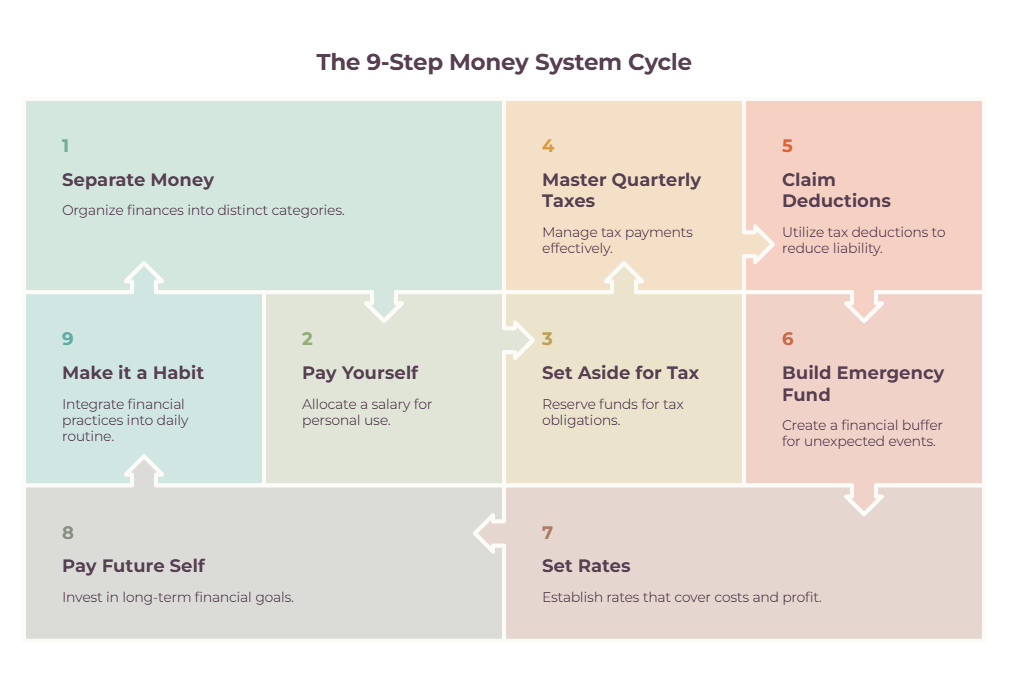
Step 1: Separate your business and personal money
Open a dedicated business checking account and a separate card before you do anything else. Take a few minutes to compare bank accounts first, since fees, transfer limits, integrations, and other features can vary significantly between providers. Every other step in this guide sits on top of that one decision.
When your business income and your grocery spending run through the same account, three things break at once. Your bookkeeping becomes a guessing game.
Your deductions get murky because you can’t prove which Amazon order was printer paper and which was the cat litter. And if the IRS ever asks questions, “they were all mixed together” is the worst possible answer.
A separate account fixes all of it for free.
Run every dollar a client pays you into a business checking account, and pay for everything business-related from the business card. Your bank feed quietly becomes your expense tracker, and the personal-versus-business argument disappears.
You don’t need an LLC to do this.
Most freelancers start as sole proprietors and report on Schedule C, and a sole proprietor can open a business account just fine.
A single-member LLC is taxed exactly the same way by default (you still pay full self-employment tax), but it adds a layer of liability protection that’s worth discussing with an accountant once you’re earning steadily.
That’s a conversation for a pro who knows your situation, not a decision to rush in week one.
Step 2: Pay yourself a salary from a buffer account
Stop spending money the moment a client pays you. Pool your income in one account and pay yourself a fixed monthly “salary” based on your leanest months. That’s how you turn lumpy income into a steady paycheck.
Irregular income is the problem underneath every other freelance money problem.
Unpredictable earnings are consistently the freelancer’s number-one money headache (Found’s self-employment research), and the reason a normal budget fails is simple: it assumes a number that shows up on the same day every month, and yours doesn’t.
So build your own withholding. Look at your last year (or your best guess) and find your three lowest-earning months. The average of those is roughly what you can count on, and that’s your salary.
Pay yourself exactly that much from your business account on the first of every month, no matter what came in. In fat months, the surplus stays put and builds a buffer. In lean months, that buffer covers the gap. You’ve smoothed the line yourself.
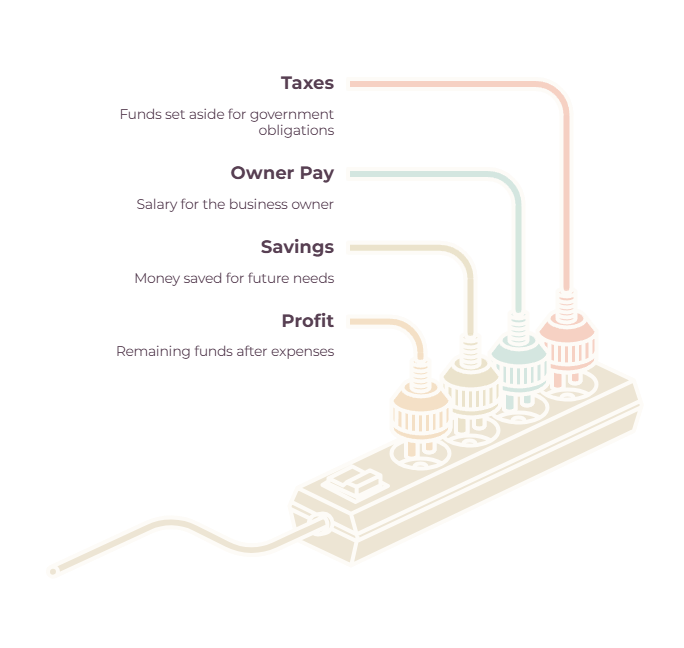
A lot of freelancers run this through a simple four-account split: money lands in an income account, then gets divided into taxes, owner pay, and a savings or profit bucket. You can automate the whole thing with rules at most banks.
The mechanics matter less than the principle: money you haven’t assigned a job to is money you’ll accidentally spend. If cash-flow timing is your weak spot, a cash flow management tool can forecast the dips before they hit.
Step 3: How much should you set aside for taxes?
Move 25–30% of every payment into a separate tax savings account the day it arrives, and treat it like it was never yours.

The number that blindsides nearly every new freelancer is self-employment tax: 15.3% of your net earnings, split as 12.4% for Social Security and 2.9% for Medicare, and it sits on top of regular income tax.
When you had a job, your employer paid half of that and withheld the rest before your paycheck hit. Now it’s all yours. (Small mercy: the tax applies to 92.35% of your net earnings, not the full amount, and you deduct half of it later.)
Add federal income tax on top, plus state tax in most states, and a quarter to a third of your income is spoken for before you’ve paid rent. So claim it before you can spend it.
The day a client payment lands, move 25–30% straight into a tax-only savings account — closer to 30–40% if you’re in a high-tax state like California or New York, or if you’re in a higher bracket.
One veteran freelancer puts it this way: filling the tax account first makes it feel like the money was never really yours, so you never mourn it.
Automate the transfer if your bank allows it.
The freelancers who get wrecked at tax time are almost always the ones who meant to set the money aside later. There is no later. For the day-to-day habit that keeps this accurate, see our guide to bookkeeping for the self-employed.
Step 4: Master quarterly estimated taxes
If you expect to owe $1,000 or more in federal tax for the year, the IRS wants its money four times a year, not once every April.
This is the rule that catches people who did everything else right. The US tax system is pay-as-you-go, and without an employer withholding for you, the IRS expects you to send estimated payments yourself.
For 2026, the deadlines are April 15, June 15, September 15, 2026, and January 15, 2027. They’re not evenly spaced. That’s not a typo (the “quarters” really are uneven), so put all four in your calendar now.
You pay using Form 1040-ES, and the easiest way to send it is IRS Direct Pay or your IRS Online Account, both free. (One 2026 note: new individual filers can no longer open an EFTPS account, so Direct Pay is the simplest route.) To figure each payment, take your set-aside balance and your projected income, or lean on last year’s return as a baseline.
The thing that protects you from penalties is the safe-harbor rule.
Pay at least the smaller of 90% of what you’ll owe this year, or 100% of what you owed last year (110% if your prior-year income topped $150,000), and the IRS won’t charge an underpayment penalty even if you end up owing more at filing.
Miss the mark, and they add interest, recalculated every quarter. It’s not catastrophic, but it’s a pointless tax on disorganization. The records you’ll need to estimate accurately come straight from your contract and expense tracking system.
Step 5: Don’t leave deductions on the table

Every legitimate business expense you track cuts both your income tax and that 15.3% self-employment tax, which makes a freelance deduction worth noticeably more than the same expense would be to a salaried employee.
That’s the part people miss. A deduction doesn’t just lower the income you’re taxed on; for the self-employed, it shrinks the SE tax base too. Tracking a $1,000 expense can save you a lot more than $100.
The ones freelancers most often forget:
- Home office. The big skipped one, usually out of audit fear, that’s mostly myth. If you use part of your home regularly and exclusively for work, the simplified method gives you $5 per square foot up to 300 square feet — a clean $1,500 with no extra forms.
- Half of your self-employment tax comes off your income automatically.
- Health insurance premiums are deductible (more on that in Step 8).
- Mileage for business driving is 72.5 cents a mile in 2026, as long as you keep a log.
- Equipment, software subscriptions, the business share of your phone and internet, and professional fees — all deductible.
Don’t overlook the tax rules beyond expenses
Then there’s the QBI deduction, which lets many freelancers deduct up to 20% of their qualified business income on top of everything else. It was set to expire after 2025 and is now permanent, with a new minimum deduction of $400 for anyone with at least $1,000 of active business income.
One 2026 change worth knowing: the threshold for a client to send you a 1099-NEC (the form for contract work) rose from $600 to $2,000. Don’t misread it.
Fewer forms in your mailbox doesn’t mean less income to report — all of it is taxable whether a 1099 shows up or not.
(Separately, the 1099-K threshold for payment apps like PayPal and Stripe reverted to $20,000 and 200 transactions, so those are rarer too.)
It just means your own tracking matters more.
A proper expense tracking setup handles the receipt rules and mileage logs that make these deductions stick.
Step 6: Build a bigger emergency fund than you think you need

Freelancers should aim for 6 to 12 months of expenses saved, not the standard 3. Irregular income means the gap between paychecks can run long, and it rarely sends a warning.
The usual personal-finance advice assumes a steady job you’d have to lose to need savings. Your income can dry up for two months without anyone firing you. A client delays, a contract ends, a slow season arrives.
That’s why the freelancer cushion runs deeper. Three months is the floor. Six to twelve is the sweet spot, and the more variable your income, the further toward twelve you want to be.
Building it on lumpy income feels impossible until you make it automatic and small. Start with $25 a week into a separate high-yield savings account, kept apart from your tax money so you never confuse the two.
Then sweep your good months: any month you earn above your salary number, send a slice of the surplus straight to the fund. You’ll be surprised how fast the windfall months do the heavy lifting once you stop spending them.
Count both your business costs and your personal baseline when you set the target. The fund has to cover your whole life, not just your invoices. A cash flow tool makes those surplus months easy to spot.
Step 7: Set rates that cover your costs, and get paid on time

Most freelancers undercharge by 30 to 50% because they price like a salaried employee. You have to build taxes, benefits, and unbillable hours into your rate, then protect it with clear payment terms.
The math trap is seductive. You earned $75,000 at a job; there are 2,080 working hours in a year, so $36 an hour feels right. It isn’t, for two reasons.
First, you can’t bill 2,080 hours.
Between finding clients, admin, and the unpaid middle of running a business, most freelancers bill closer to 1,000 or 1,500 hours a year.
Second, that old $75,000 actually cost your employer closer to $100,000 once they covered payroll taxes, health insurance, and everything else. Now you cover all of it.
So work backward.
Add your target take-home, your business expenses, and the taxes from Step 3, then divide by the hours you can realistically bill. The number that comes out is your floor, not your aspiration.
Plenty of freelancers wish they’d charged more from the start; almost none regret it.
Getting paid is the other half. Ask for a deposit on larger projects, set clear terms like net-15 or net-30, write a late fee into your contract, and follow up the day an invoice goes overdue rather than stewing for a month.
The mechanics (how to write the invoice, what to say in the email, how to track what’s outstanding) live in our guides on how to invoice as a freelancer, keeping track of invoices, the best invoicing tools, and a ready-to-send invoice email sample.
Step 8: Pay your future self (retirement and the benefits you now buy)
No employer is matching your 401(k) or splitting your health premium anymore. You build both yourself now, and the tax code gives you solid incentives to do it.
Retirement first, because the self-employed options are more generous than most people expect:
| Plan | 2026 limit | Best for |
| SEP-IRA | Up to 25% of net earnings (≈20% after the SE-tax math), max $72,000 | Simplicity — open in minutes, fund up to your tax deadline |
| Solo 401(k) | $24,500 employee + employer profit-share (up to $72,000 total) | Saving more on a lower income |
| Roth / Traditional IRA | $7,500 | A simple starting point |
A SEP-IRA is the simplest: contribute up to 25% of your net earnings (which works out to roughly 20% once you run the self-employment math), open one in minutes, and fund it right up to your tax deadline.
A Solo 401(k) often lets you put away more at lower income levels, because you contribute both as “employee” and as employer on top. And a plain Roth or traditional IRA is a fine starting point if those bigger numbers feel like a lot.
Which one fits depends on your income and how much you want to shelter, so it’s worth a short conversation with a pro.
Don’t forget the benefits you now fund yourself
Health insurance is the other benefit that’s now your job. With no employer plan, the ACA Marketplace is where most freelancers shop, and premiums are based on the income you project for the year.
The good news is the self-employed health insurance deduction, which lets you deduct 100% of your premiums for yourself and your family above the line — up to your business’s net profit, and not for any month you could have joined a spouse’s or employer’s plan.
The catch for 2026: the enhanced pandemic-era subsidies expired at the end of 2025 and haven’t been extended, so Marketplace premiums have jumped sharply — KFF estimates the average subsidized enrollee’s payment could more than double.
Budget for a bigger number than last year, and if you carry a high-deductible plan, an HSA adds another tax-advantaged place to save.
Step 9: Make it a weekly money habit
Spend 30 minutes on your finances every Friday, and you’ll never again face the April reconstruction project that ruins so many freelancers’ springs.
A year of receipts is a nightmare. A week of receipts is a coffee break. The whole system above only works if you touch it regularly, and a short weekly ritual is what keeps it alive.
Pick a day (Friday afternoon works, when your brain’s already winding down) and run the same short loop:
- Log the week’s income and expenses.
- Move your tax percentage into the tax account.
- Glance at which invoices are still outstanding.
- Check your runway number (how many months your savings would cover).
That’s it. Done weekly, it never grows teeth. The right software does most of the lifting here. See our roundups of accounting software for freelancers and the best options for solo consultants, plus a receipt scanner so a photo at the table is all the filing a receipt ever needs.
Your first 30 days: a starter plan
Here’s the whole system compressed into four weeks so that you can start today instead of someday.
| Week | Do this |
| Week 1 | Open a business checking account and get a separate card. Move your freelance income there and start paying business costs from it. |
| Week 2 | Open a tax savings account and a separate emergency fund. Set up automatic transfers: your tax percentage off every payment, and $25 a week to savings. |
| Week 3 | Put the four quarterly tax dates in your calendar with reminders, and start a simple expense tracker. |
| Week 4 | Audit your rate against the Step 7 math, then do your first 30-minute Friday review. |
If you do nothing else this month, do Week 1 and the tax transfer from Week 2. Those two alone prevent the disasters that sink most first-year freelancers.
How to manage finances as a freelancer – The bottom line
The goal was never to turn you into a finance person. It’s to build the system once, so money stops being the thing that wakes you at 3 am.
The feast-or-famine whiplash, the surprise tax bill, the sick feeling of not knowing whether you can afford a slow month — none of that is a character flaw. It’s just the absence of a structure that someone else used to run for you.
Sequence beats willpower. Separate your accounts, pay yourself a proper salary, claim the tax money before you can spend it, and the rest follows.
Pick one step, ideally Step 1, and set it up this week. Then start with our accounting software guide to choose the tool that runs quietly behind all of it.
This guide is general information, not tax or legal advice. For decisions about entity structure, deductions, or your specific tax situation, talk to a qualified accountant.
Frequently Asked Questions
How much should I set aside for taxes as a freelancer?
Set aside 25–30% of every payment, and move it into a separate tax account the day you’re paid. Go higher (30–40%) if you live in a high-tax state or earn enough to land in a higher bracket. It’s easier to get a little back than to scramble for a shortfall.
Do freelancers really have to pay quarterly?
Yes, if you expect to owe $1,000 or more in federal tax for the year. The 2026 deadlines are April 15, June 15, September 15, 2026, and January 15, 2027. Pay through IRS Direct Pay or your IRS Online Account, and use the safe-harbor rule to avoid penalties.
How do you budget with irregular income?
Pool your income in one account and pay yourself a fixed monthly salary based on your three lowest-earning months. Surplus from good months builds a buffer that covers the lean ones, so you live on a steady number even though your income isn’t.
How much should a freelancer have in savings?
Aim for 6 to 12 months of expenses, kept separate from your tax money. That’s deeper than the usual 3-month rule because freelance income can pause without warning. Build it with small automatic transfers plus a sweep of your better months.