The Best Cash Flow Projection Template for Freelancers

You finish the best project of the year — a $9,000 build — and feel rich for about a week. Then it’s the 28th, rent is due, your quarterly tax payment is coming, and the account is nearly empty. The invoice for that $9,000? Net 60. It won’t land until August. That’s where a cash flow projection template becomes useful — it shows the difference between money you’ve earned and money that’s actually available right now.
On paper, you had a great month. In the bank, you’re still scraping by.
For a ton of freelancers, this gap is a massive problem. It’s not so much a profit problem as a timing problem.
Profit tells you what you earned. Cash flow tells you what’s actually in the account the week the bill is due. For a freelancer, those two numbers can point in completely opposite directions.
So the real question isn’t “am I making money this month?” It’s “Will there be money in the account when I need it?” A cash flow projection answers that — and it’s not corporate finance. It’s a one-page early-warning system you can build this afternoon.
This guide gives you a cash flow projection template built for how freelancers actually get paid — irregular income, late clients, and taxes you owe but haven’t paid yet — plus exactly how to fill it in.
Quick Takeaways
- A cash flow projection maps cash in against cash out, month by month, so you spot a shortfall weeks ahead instead of the morning it hits.
- It’s not the same as profit. A Net-60 invoice is “earned” today but lands as cash two months later — projections track when the money actually moves.
- Project 12 months for the big picture; drop to a rolling 13 weeks when cash is tight and every week counts.
- The freelancer twist: build on your lowest reliable month, log income by when it will actually clear, and give tax its own line — set aside around 25–30% of every payment.
- A spreadsheet is genuinely enough. The free template below takes about 15 minutes a month to keep current. Want it automated instead? See our cash flow management tools for freelancers.
What is a cash flow projection — and how is it different from profit?
A cash flow projection is a forward estimate of the cash moving in and out of your business each month, usually over the next 12 months, giving you a running bank balance so you can see when you’ll be flush and when you’ll be short.

Profit is an on-paper number; cash flow is what’s actually in your account.
Here’s the trap in one example.
You finish a $9,000 project in June.
Your costs that month are $3,500.
On paper, you made $5,500. But the client is on Net 60, so the cash arrives in August — and in June, your balance drops by $3,500 while your profit-and-loss statement says you’re thriving.
That’s how a “good month” empties your account.
This isn’t rare.
A Bonsai analysis of freelance invoicing data found 29% of invoices are paid at least a day late, and a 2026 Jobbers report put the average time from invoice to money-in-hand at 39 days.
That’s more than a month where your profit exists everywhere except your bank account.
Projection or forecast — what’s the difference?
For a one-person business, effectively nothing; use whichever word you like. The textbook distinction is that a forecast predicts the most likely path based on your current trend, while a projection models a “what-if” scenario.
As a freelancer, you’re doing a bit of both every month, so don’t get hung up on the label.
If the “profitable but broke” feeling is familiar, the deeper fix is a system, not just a sheet — our guide to cash flow management tools for freelancers walks through the four-account method that pairs perfectly with this template.
The freelancer cash flow projection template, row by row
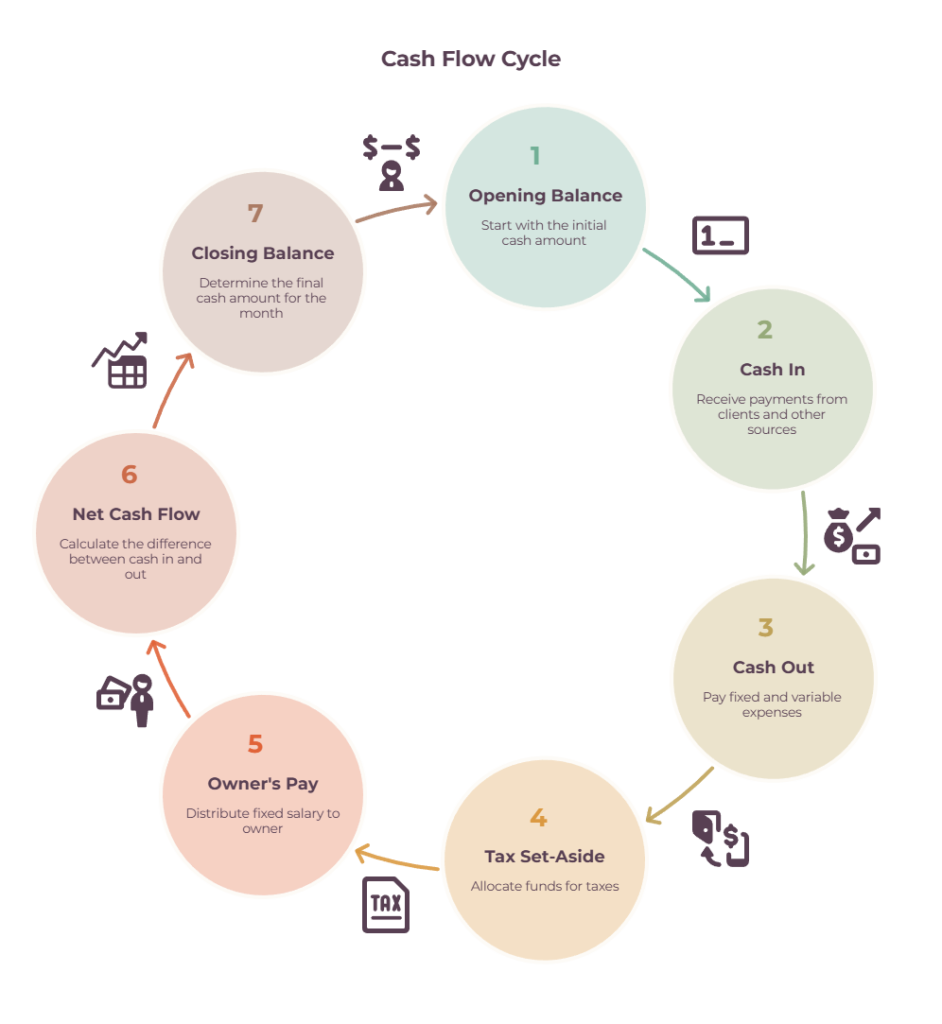
Every cash flow projection has six moving parts: an opening balance, money in, money out, a tax set-aside line, net movement, and a closing balance — and each month’s closing becomes the next month’s opening.
Here’s the whole thing laid out, with realistic freelancer numbers so it doubles as a worked example.
| Row | June | July | August |
| Opening balance | $4,000 | $3,540 | $1,264 |
| Cash in — client payments (clearing this month) | $6,500 | $4,200 | $8,000 |
| Cash in — other (deposits, retainers, side income) | $500 | $0 | $1,000 |
| Total cash in | $7,000 | $4,200 | $9,000 |
| Cash out — fixed (rent, software, insurance) | $2,200 | $2,200 | $2,200 |
| Cash out — variable (contractors, supplies, travel) | $800 | $600 | $900 |
| Tax set-aside (28% of cash in) | $1,960 | $1,176 | $2,520 |
| Owner’s pay (your fixed salary) | $2,500 | $2,500 | $2,500 |
| Total cash out | $7,460 | $6,476 | $8,120 |
| Net cash flow (in − out) | −$460 | −$2,276 | +$880 |
| Closing balance | $3,540 | $1,264 | $2,144 |
Look at July. Two months ahead of time, the sheet is already telling you the account will dip to around $1,264 — tight, but survivable, and now you can do something about it in May instead of panicking in July. That’s the entire point.
The Numbers That Make Your Cash Flow Projection Work
A few rows do the heavy lifting and deserve a closer look:
➡️ Opening balance is simply the cash you have on day one of the month. For your very first month, use your current reconciled bank balance — the real number, not the one in your head.
After that, each month’s closing balance rolls down to become the next month’s opening, which is what makes the projection a connected chain rather than twelve disconnected guesses.
➡️ Cash in — client payments are the row freelancers get wrong most often. Log each payment in the month it will realistically clear, not the month you send the invoice. If you bill a Net-30 client on June 20th, that cash belongs in July, not June.
➡️ Tax set-aside gets its own line on purpose. Money sitting in this row is not yours to spend — it belongs to the IRS. Putting it on the page (rather than mentally) is what stops a quarterly payment from blindsiding you.
➡️ Owner’s pay is the fixed amount you pay yourself, the same every month regardless of whether you had a feast month or a famine one. More on how to set that number next.
➡️ Grab the editable version: download the freelancer cash flow projection template (Google Sheets / Excel) — the totals, net, and closing rows calculate themselves, so you only fill in the blue cells.
How to handle irregular income and late-paying clients in your projection
Build the projection on your lowest reliable month, not your average — then log each client payment in the month it will realistically clear, not when you invoice. That single adjustment turns a hopeful budget into an honest forecast.

Four moves to make a freelance projection trustworthy
➡️ Income: use your lowest reliable month, not the average.
Averaging is exactly what makes feast-or-famine income dangerous — it quietly assumes the busy months will keep coming. Anchor your expected income and your owner’s pay to a month you’re confident you can repeat, and let the good months top up your buffer instead of inflating your baseline.
➡️ Late payers: project the landing date, not the invoice date.
Remote’s 2025 late payment report found 85% of freelancers are paid late at least some of the time, and just over 1 in 5 are paid late more than half the time.
Plan for it. If a client habitually pays two weeks past due, slide that payment into the month it actually arrives — and for chronic offenders, build in a small cushion rather than betting on the due date.
➡️ Taxes: give them a line before they give you a heart attack.
Self-employment tax alone is 15.3% of your net earnings (12.4% Social Security plus 2.9% Medicare), and that’s before income tax. Setting aside around 25–30% of every payment covers most freelancers; push toward 30–35% if you’re earning above roughly $80,000 or living in a high-tax state.
The money goes on the tax row and out of your head.
➡️ Runway: read the closing-balance row as months of survival.
Your closing balance isn’t just a number — it’s how long you could coast if the work dried up tomorrow. Aim to keep at least three months of expenses in reserve, build toward six, and hold a separate one-to-two-month cushion specifically for late-paying clients.
When the projection shows that buffer thinning, you’ve got advance warning to chase invoices or pull in new work.
How many months should a cash flow projection cover?
Project 12 months out for planning and to catch seasonal dips — the December slump you can see coming back in October — and switch to a rolling 13-week view when cash is tight and you need week-by-week precision. Update it monthly, so it always reflects reality.

Twelve months is the standard horizon, and three to twelve is the useful range. “Rolling” just means that each month you drop the month that’s passed and add a new one to the end, so you always have a full year in view.
When things get genuinely tight, zoom in: a 13-week (one-quarter) projection in weekly columns shows you precisely which week the squeeze lands, which is the level of detail you need to decide whether to chase an invoice today or next Tuesday.
Where to get a cash flow projection template (free options)
You don’t have to build one from scratch — the freelancer template above is ready to copy, and SCORE, Xero, and BILL all offer solid generic templates if you’d rather start from a corporate version and trim it down. Here’s the honest rundown:
- Our freelancer template — the only one of these built around freelance income, with the tax set-aside and owner’s-pay rows already in place. Start here.
- SCORE’s 12-month cash flow template — a free, no-frills spreadsheet from the SBA-backed nonprofit. Solid, if business-generic.
- Google Sheets — start blank or search the template gallery; the upside is that it auto-saves, and you can open it on your phone.
- Xero’s cash flow projection template and BILL’s version — both free and well-built, but written for businesses with accounts-receivable and accounts-payable departments, so you’ll delete a few rows.
A fair warning on the generic ones: they assume a “normal” business with steady receivables and no self-funded taxes. You’ll spend more time stripping out rows that don’t apply than you would filling in a template built for you in the first place.
And if spreadsheets just aren’t your thing, don’t force it. Apps like Relay and Found automate the account-splitting and tax set-aside for you — our cash flow management tools for freelancers roundup compares the options worth paying for.
How to actually use your cash flow projection (the 15-minute monthly check-in)
Once a month, update your opening balance to the real bank figure, adjust which client payments are landing when, and read the closing-balance row forward — if any month turns red, you’ve got weeks to act instead of days. The habit matters far more than the spreadsheet.

The whole ritual fits one sentence: current bank balance, plus the income you’re confident will clear, minus your known costs, minus your tax set-aside, equals the cash you can actually use.
Do that on the first of the month with a coffee, and you’ll never be surprised by your own account again.
When a future month shows red, you have real levers — and weeks to pull them. Chase the slow invoice now. Ask a new client for a deposit. Move a Net-30 client to Net 15. Push a non-urgent software renewal a month down the road.
None of those are emergency moves when you see the gap coming; they’re just admin. That’s the difference a projection makes: it turns what would have been a nasty surprise into a problem you quietly handled in advance.
For the pieces that sit on either side of this — keeping clean books and getting paid faster — see our guides to bookkeeping for the self-employed, accounting software for freelancers, and how to invoice as a freelancer.
Frequently Asked Questions
What is a cash flow projection template?
It’s a spreadsheet that estimates the cash coming into and going out of your business each month, then calculates your running bank balance so you can see shortfalls before they happen.
A freelancer-specific template adds rows for irregular client payments, a tax set-aside, and the fixed salary you pay yourself.
What’s the difference between a cash flow forecast and a projection?
For a solo freelancer, the two terms are used interchangeably. Strictly speaking, a forecast predicts your most likely cash position based on your current trend, while a projection models a specific “what-if” scenario — but both do the same core job of estimating future cash in and out.
How many months should a freelancer’s cash flow projection cover?
Twelve months is the standard horizon, and it’s enough to catch seasonal dips you’d otherwise miss. When cash is tight, switch to a rolling 13-week (one-quarter) view in weekly columns so you can see exactly which week a shortfall lands.
How much should I set aside for taxes in my projection?
Around 25–30% of every payment works for most freelancers, since self-employment tax alone is 15.3% of net earnings before income tax. If you earn above roughly $80,000 or live in a high-tax state, set aside closer to 30–35%, and keep it on its own line so it’s never mistaken for spendable cash.
Can I just use a spreadsheet instead of software?
Yes. For most freelancers, a simple monthly spreadsheet is genuinely enough and takes about 15 minutes to update.
Dedicated cash flow forecasting software is worth considering once you’re juggling several clients with staggered payment timelines and want your forecasts updated automatically.
What’s the best free cash flow projection template for freelancers?
The best fit is one built around freelance income — irregular pay, a tax set-aside, and owner’s pay — like the template in this guide. Generic free templates from SCORE, Xero, and BILL also work, but you’ll need to strip out rows designed for larger businesses.
Related guides: accounting software for freelancers · bookkeeping for self employed · cash flow management tools · how to invoice as a freelancer · cash flow forecasting software