
Federal Mileage Rate 2026: New Rates You Need to Know

You drove to three client meetings, a job site, and the supply store last month — but what are those miles actually worth under the current federal mileage rate?
Here’s the short version: 72.5 cents a mile for business miles driven January through June 2026, and 76 cents from July onward — the IRS bumped it mid-year, which it almost never does.
That mid-year split is the tricky bit.
Miles on either side of July 1 are worth different amounts, so a year’s driving isn’t one simple multiplication anymore, and reimbursements set in January are now underpaying.
It’s also money most freelancers leave behind. Not because the rate is complicated, but because nobody logs the trips — and a mile you didn’t write down is a deduction you can’t claim.
Below: all three 2026 rates, the full history back to 2020, what counts as a business mile, and how to work out your deduction with the split.
What is the federal mileage rate for 2026?

The 2026 federal (IRS standard) mileage rate for business use is 72.5 cents per mile from January 1 to June 30, 2026, and 76 cents per mile from July 1 to December 31, 2026 — the IRS raised it mid-year to reflect rising fuel costs. Here are all three 2026 rates:
| Period | Business | Medical | Charitable |
| Jan 1 – Jun 30, 2026 | 72.5¢ / mile | 20.5¢ / mile | 14¢ / mile |
| Jul 1 – Dec 31, 2026 | 76¢ / mile | 23.5¢ / mile | 14¢ / mile |
The charitable rate stays at 14 cents because it’s fixed by law, not by the IRS. If you drive for work, the business rate is the one you’ll use.
Quick Takeaways
- The 2026 business mileage rate is 72.5¢ per mile (January–June) and 76¢ per mile (July–December) — a rare mid-year increase.
- The charitable rate stays at 14¢ (it’s fixed by statute), while the medical rate is 20.5¢, then 23.5¢.
- The moving rate applies only to active-duty military and, from 2026, certain intelligence community employees — for everyone else it’s still gone.
- Freelancers use the business rate to claim a mileage deduction: business miles × the rate for that period.
- Keep a mileage log — mileage is one of the biggest deductions freelancers miss, simply because they never recorded the trips.
Why the 2026 mileage rate changed mid-year
The IRS set the 2026 business rate at 72.5 cents from January, up 2.5 cents from 2025, then raised it again to 76 cents from July 1 in response to rising fuel prices — only the second mid-year change in a decade.
So the rate you use depends on when you drove: 72.5 cents for miles in the first half of the year, 76 cents for miles in the second half.
Mid-year changes are unusual.
The IRS normally sets the rate once, in December, for the whole of the following year, and it stays put. The last time it moved mid-year was 2022, when fuel costs spiked.
If you’re claiming or reimbursing mileage for 2026, the practical upshot is that you need to know which side of July 1 each trip fell on, because the two halves are worth different amounts.
Federal mileage rate history (2020–2026)
Here’s how the IRS standard mileage rate has moved over recent years, including the mid-year changes in 2022 and 2026. The charitable rate has stayed at 14 cents throughout because Congress fixes it in law, and the IRS can’t adjust it.
| Year | Business | Medical / Moving | Charitable |
| 2020 | 57.5¢ | 17¢ | 14¢ |
| 2021 | 56¢ | 16¢ | 14¢ |
| 2022 (Jan–Jun) | 58.5¢ | 18¢ | 14¢ |
| 2022 (Jul–Dec) | 62.5¢ | 22¢ | 14¢ |
| 2023 | 65.5¢ | 22¢ | 14¢ |
| 2024 | 67¢ | 21¢ | 14¢ |
| 2025 | 70¢ | 21¢ | 14¢ |
| 2026 (Jan–Jun) | 72.5¢ | 20.5¢ | 14¢ |
| 2026 (Jul–Dec) | 76¢ | 23.5¢ | 14¢ |
The trend is broadly upward, tracking the rising cost of running a vehicle — the business rate has climbed from 57.5 cents in 2020 to 76 cents by the end of 2026.
If you’re amending a past return or checking an old reimbursement, use the rate for that specific year (and half-year, where it split).
What the federal mileage rate covers

The business rate covers driving for work, the medical rate covers travel for medical care, and the charitable rate covers driving for volunteer work.
The business rate is the highest because it reflects the full cost of running a vehicle, not just fuel. Each is meant for a different kind of driving.
The business rate is built to cover both the variable costs of driving (fuel, tires, maintenance) and the fixed costs of owning a vehicle (depreciation, insurance), which is why it’s the largest.
The medical rate covers only the variable costs, so it’s much lower, and it applies to driving for medical treatment.
The moving rate is the same figure as the medical rate, but since the 2018 tax law, the moving-expense deduction has been limited to active-duty members of the armed forces.
That’s widened for 2026: the IRS now states that employees or new appointees of the intelligence community moving in 2026 or later “may also be treated as if they are members of the Armed Forces for purposes of moving expenses.” For everyone else, it’s still gone.
And the charitable rate sits at 14 cents because it’s set by statute rather than adjusted for costs, which is why it hasn’t moved in decades.
How freelancers use the mileage rate
If you’re self-employed and drive for work, you can deduct those miles using the standard mileage rate — your business miles multiplied by the rate — or, alternatively, the actual-expense method.
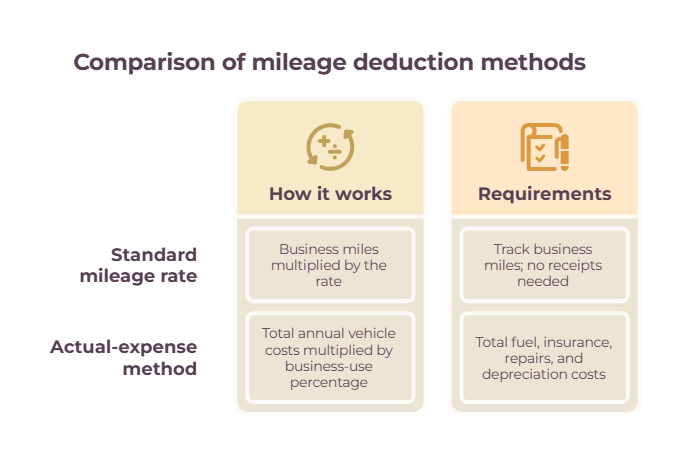
The standard rate is simpler; the actual method can be worth more if your vehicle costs are high. For most freelancers, the standard rate is the easy, sensible choice.
The two methods work differently. With the standard mileage rate, you just track your business miles and multiply by the rate — no receipts for fuel or servicing needed.
With the actual-expense method, you total up everything it costs to run the vehicle for the year (fuel, insurance, repairs, depreciation) and claim the business-use percentage.
One rule to know: if you want to use the standard rate for a car, you generally have to choose it in the first year you use that car for business. It’s worth doing the math both ways once and picking the bigger deduction.
Just as important is knowing what counts as business miles. Driving to a client meeting, a job site, the bank, or to pick up supplies all count; your regular commute from home to a fixed workplace does not.
If you have a qualifying home office, trips from there to work locations can count, which is common for freelancers.
(This is general information, not tax advice — the rules have edge cases, so check your situation with an accountant. Our guide to freelance tax deductions covers more.)
How to calculate your 2026 mileage deduction
Multiply your business miles by the rate for the period. Because 2026 has two rates, split your miles at July 1 — miles before it are worth 72.5 cents each, miles from it are worth 76 cents. It’s straightforward once your miles are logged.
Here’s a worked example. Say you drove 1,000 business miles in the first half of 2026 and 800 in the second half:
- Jan–Jun: 1,000 miles × $0.725 = $725
- Jul–Dec: 800 miles × $0.76 = $608
- Total deduction: $1,333
That’s the appeal of the standard rate: once you’ve got the mileage, the calculation is a minute’s work. In a normal single-rate year, you’d just multiply all your business miles by the one figure.
How to track your mileage
Keep a simple log of every business trip — the date, the purpose, and the miles — because the IRS expects a record, and any miles you don’t track are deductions you lose. A spreadsheet or a mileage app both do the job. The record is what turns “I drive for work sometimes” into a real, defensible deduction.
A mileage log doesn’t need to be fancy. Just include things like the date, where you went and why, and the miles.
You can keep it in a spreadsheet — our expense tracking template can hold a mileage tab alongside your expenses — or use a mileage app that tracks trips automatically using your phone’s GPS, which many of the tools in our expense tracking software roundup include.
Whichever you choose, log trips as you take them rather than guessing at year-end; reconstructed mileage is where deductions quietly get lost. For the bigger picture, see how to track expenses.
The takeaway
The 2026 federal mileage rate is 72.5 cents a mile through June and 76 cents from July, with the charitable rate steady at 14 cents.
For a freelancer who drives for work, those miles add up to one of the easiest deductions to claim — and one of the most commonly missed, purely because the trips weren’t logged.
Keep a simple record, apply the right rate for the period, and check IRS.gov for any further updates before you file.
Frequently Asked Questions
What is the federal mileage rate for 2026?
The 2026 IRS standard mileage rate for business is 72.5 cents per mile from January 1 to June 30, and 76 cents per mile from July 1 to December 31. The medical rate is 20.5 cents, then 23.5 cents, and the charitable rate is 14 cents all year.
What was the mileage rate in 2025 and earlier years?
The business rate was 70 cents in 2025, 67 cents in 2024, and 65.5 cents in 2023. In 2022 it split mid-year, from 58.5 cents to 62.5 cents. The full history from 2020 to 2026 is in the table above. Use the rate for the specific year (and half-year) you’re claiming.
Why did the 2026 mileage rate change in July?
The IRS raised the business rate from 72.5 cents to 76 cents from July 1, 2026, to reflect rising fuel costs — only the second mid-year change in a decade. Miles driven January to June are claimed at 72.5 cents; miles from July onward at 76 cents.
How do I calculate my mileage deduction?
Multiply your business miles by the rate for the period. For 2026, that means splitting at July 1: miles before it at 72.5 cents, miles from it at 76 cents. For example, 1,000 miles in the first half plus 800 in the second is (1,000 × $0.725) + (800 × $0.76) = $1,333.
Should I use the standard mileage rate or actual expenses?
The standard rate is simpler — you just track miles and multiply. The actual-expense method (totaling your real vehicle costs and claiming the business-use share) can be worth more if your costs are high.
Note that to use the standard rate for a car, you generally must choose it in the first year you use the car for business. Work it out both ways once and pick the bigger deduction.
Is my commute deductible?
No. Your regular commute from home to a fixed workplace isn’t deductible business mileage. Driving to client meetings, job sites, the bank, or to collect supplies does count. If you have a qualifying home office, trips from there to other work locations can also count.
Related guides: how to track expenses · expense tracking template · expense tracking software · freelance tax deductions · accounting tips for freelancers