How to Manage Freelance Projects with Clients: Best Playbook

Most freelancers wondering how to manage freelance projects hit the same problems: scope creep, late payments, revision spirals, vanishing clients. None of it is bad luck. It’s missing process.
The freelancer who gets burned by scope creep on project three and fixes it by project five didn’t get better at design or development. They learned how to manage freelance projects with a system.
This guide shows you how to manage freelance projects with a system that prevents all of it.
Five stages cover the full lifecycle of a freelance project: discover, contract, kick off, deliver, close out.
Each stage has a specific job, and each one protects your cash flow when it’s done right. The deposit confirms commitment. The scope of work defines what “done” means. The kickoff alignment prevents mid-project surprises. Milestone invoices keep money flowing during the work. And the close-out turns one project into the next.
To actually run this system consistently, most freelancers rely on dedicated tools that structure the workflow end-to-end — here’s how to choose the best freelance management tools.
Quick Takeaways
- Most freelance project failures are process failures — scope creep, late payments, and revision spirals are preventable with the right system
- Five stages cover the full lifecycle: discover, contract, kick off, deliver, close out
- A 50% deposit, a 2-round revision cap, and a one-page Communication Charter prevent the majority of problems freelancers complain about
- In New York, Illinois, and California, freelance protection laws require written contracts above $250–$800 and mandate payment within 30 days
- Track your time even on fixed-fee projects — it’s the only way to know whether the project was profitable
How to Manage Freelance Projects: Qualifying the Client First
Ask five questions on the discovery call: What does success look like 90 days after this ends? What prompted you to look for help now? Have you worked with a freelancer before and what did or didn’t work? What’s your budget range and is it approved? Who else has approval authority? The answers tell you whether the project is real, the client is ready, and whether you should walk away.
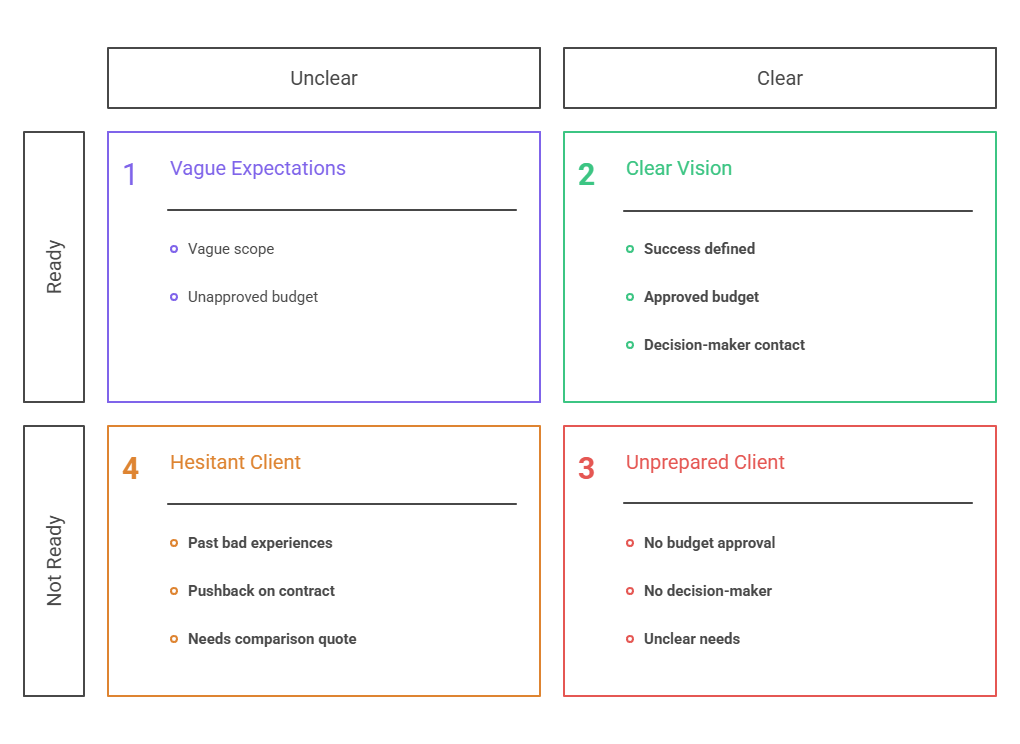
The discovery call should be 15–30 minutes with the actual decision-maker. Not a junior coordinator who’ll relay your questions.
The person who signs off on the work and approves the invoice. If you can’t get on a call with that person before the contract, expect approval bottlenecks during the project.
Those five questions do real work.
“What does success look like?” reveals whether the client has clear expectations or vague hopes.
“Have you worked with a freelancer before?” surfaces whether they understand the relationship.
“Who else has approval authority?” tells you whether you’ll face a single point of contact or design-by-committee.
Walk away from: vague scope with pressure to quote immediately, pushback on a deposit or contract, “we just need a quote to compare,” a history of cycling through freelancers, and urgency without an approved budget. If the project doesn’t feel like a clear yes after the discovery call, it’s a no.
How to Manage Freelance Projects with the Right Contract and SOW
Eight clauses: scope of work with quantified deliverables AND explicit exclusions, payment schedule with deposit, timeline with client-side dependencies, revision limits (2 rounds is standard), IP ownership transferring on final payment, confidentiality, termination/kill fee, and a late fee clause. The AIGA standard is 1.5% per month, and it’s enforceable in all 50 states.
Those clauses are easier to standardize with a reusable freelance contract template, which you can adapt for each client instead of rebuilding the agreement from scratch.
The SOW is where most projects are won or lost. “Design a website” is a project description.
“Design a 5-page marketing website (Home, About, Services, Portfolio, Contact) with 2 rounds of revisions, mobile-responsive, delivered as Figma files and development-ready assets by [date]” is a scope of work.
The difference is enforceability. And scope creep fills whatever space the SOW leaves blank, so list exclusions explicitly. If you’re designing the website but not writing the copy, say so.
The deposit is a commitment filter. 50% upfront is standard for project-based work. Larger projects use milestone splits like 50/25/25 or thirds. Non-refundable once work begins.
Clients who push back on deposits are telling you something about how they’ll treat invoices later.
In New York, Illinois, and California, freelance protection laws now require written contracts above certain thresholds ($800 in NY, $500 in IL, $250 in CA) and mandate payment within 30 days. Penalties include double damages and attorney’s fees.
The Freelancers Union Contract Creator is a solid free starting point.
How to Manage Freelance Projects from the Kickoff Call
With a 45-minute kickoff call and a one-page Communication Charter. The kickoff aligns on goals, walks through the SOW out loud (especially exclusions), confirms the timeline, and establishes who’s the single point of contact on each side. The Communication Charter documents response times, which channel is for what, and business hours.

The kickoff call agenda: introductions and decision authority, recap of goals and the definition of “done,” a verbal walkthrough of the SOW (especially exclusions and revision limits), the timeline with client-side dependencies and due dates, the communication plan, the feedback and approval process, and risks with named owners.
The Communication Charter is the most underused tool in freelance project management.
It’s a one-page doc that establishes:
- Your business hours
- Expected response times (yours and theirs)
- Which channel is for what purpose (email for decisions, chat for quick questions, calls for complex discussions)
- How status updates will work
- The feedback process (one consolidated set of comments per round, delivered within 5 business days).
Confirm it at kickoff. Reference it when a client texts at 11 PM or sends feedback in six separate emails over a week.
After the call, send a kickoff recap email confirming every decision and action item with deadlines and owners. That email becomes the project’s single source of truth. If anyone disputes a decision later, it’s in writing.
How to Manage Freelance Projects When Scope Creep and Delays Hit
With a weekly status update, a scope-change process, and the willingness to pause work when the client isn’t holding up their end. Send a weekly status email (what’s done, what’s next, what you need from the client by when). Treat anything outside the SOW as a change order with a quoted cost and timeline. Cap revisions at 2 rounds with additional rounds billed hourly.
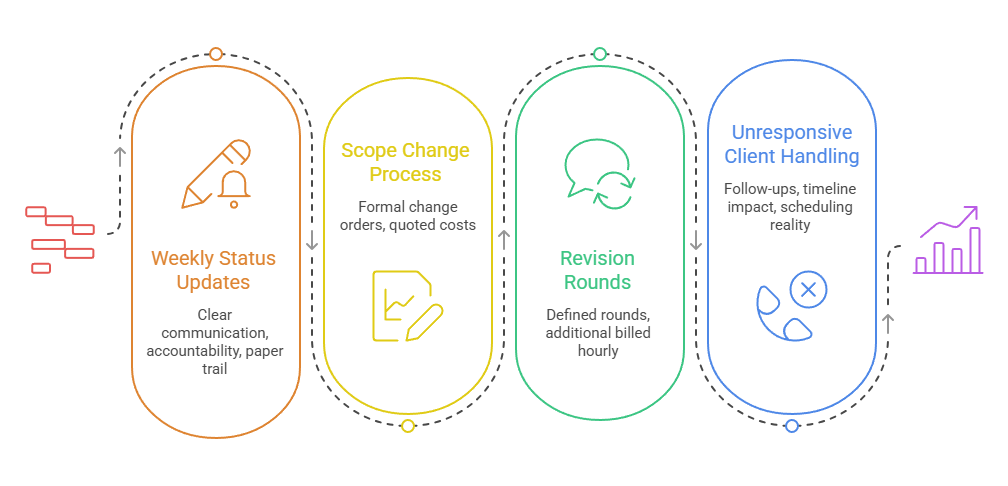
Most projects fail during delivery. This section covers the three failure modes and the process that prevents each one.
The weekly status update
Send it every Monday, formatted simply: project status (on track, at risk, or off track), what was completed this week, what’s in progress, what you need from the client with a specific deadline, and any risks or blockers.
If you’re running several client projects at once, our guide to the best freelancer management tools for multi-project workflows covers how to keep deadlines, priorities, and project status visible across all of them.
The “needs from you” section creates accountability and a paper trail. If the client goes silent, you can point to three weeks of status updates showing whose delays caused what.
Scope creep
When a client asks for something outside the SOW, don’t say no. Say “happy to — and this is what it adds.” Quote the cost and timeline impact specifically. Give them a clean choice: approve the change order or stick with original scope. Pause work on affected portions until they decide in writing.
Here’s the script:
Hi [Name], happy to take this on. Flagging that [the request] sits outside our original scope (which covered X, Y, Z). I'd estimate it adds about [hours/$amount] and pushes delivery to [new date]. I've attached a quick change order — sign it back and I'll fold it in. If you'd rather stick with original scope and revisit later, totally fine. Just let me know.
The tone is warm. The boundary is firm. And the change order creates a paper trail that protects both sides.
Revision rounds
Two rounds is the industry standard. One round equals one consolidated set of feedback delivered within 5 business days. Tweaks to an approved direction count as a revision. A new direction, new deliverables, or “the CEO had a different idea” is new work requiring a change order.
State this in the contract and reference it calmly when the line blurs. If the client needs a third round:
Flagging that our SOW includes 2 rounds and we've now completed 3. Happy to fold these in — this round would be billed as additional revisions at [$X/hr], estimated at [hours/$total].

Two options: approve the additional round and I'll start today, or stick with the current version and we'll consider the project complete.
Unresponsive clients
Follow up twice with specific deadlines. On the second follow-up, state the timeline impact plainly:
To hold the original delivery date, I'd need [item] by Friday. If that's not workable, I'll push delivery to [new date] and slot in other work.
That’s not a threat. It’s a scheduling reality, and it protects your calendar from being held hostage by a client who isn’t responding.
Milestone invoicing
Don’t wait until project completion to send an invoice. Bill at milestones tied to deliverables, not dates. If the client causes delays, your cash flow isn’t punished.
Our guide to tracking invoices covers the weekly system that catches unpaid invoices before they become 60-day problems, and our invoice email samples cover the full follow-up lifecycle from first send to final demand.
How to Manage Freelance Projects Through Close-Out and Into the Next One
With a handoff package, a same-day final invoice, a testimonial request within two weeks, and a 30-minute self-review. The close-out is where most freelancers leave money on the table, not by undercharging, but by failing to capture the referral, the testimonial, and the lessons that make the next project more profitable.

The handoff package
Deliver everything as a single packaged set: final approved deliverables, source files (only if your contract licenses them; IP transfers on final payment), a short usage guide if relevant, and a “delivered vs. SOW” recap showing exactly what was completed against what was scoped. Hand back any credentials or access.
Final invoice timing
Send the final invoice the same day you deliver the final files. Not the next week. The same day. Net 15 or Due on Receipt. Withhold IP transfer until paid. This must be in your contract.
Testimonial request
Within 1–2 weeks of project completion, after final payment clears. Give prompts instead of asking for a blank-page review: “What was the situation before we started? What changed? What would you tell another business owner considering hiring someone for this?” Two or three sentences is plenty. Send their response back for approval before posting.
Post-project self-review
Spend 30 minutes within a week of close-out asking: Did hours come in at, over, or under my estimate? What scope creep happened and why didn’t the contract prevent it? What client behavior should I screen for next time? Which templates or clauses should I add?
Track your time even on fixed-fee projects. It’s the only way to know your effective hourly rate per client and price the next one accurately. Those time logs feed directly into your bookkeeping and reveal which clients and project types are genuinely profitable.
Repeat-business nurturing
A 30-day post-launch check-in. A quarterly “saw this and thought of you” email. Pitch retainers only after a successful project, framed around outcomes the client already said they care about. The best freelance revenue is repeat revenue, and the close-out is where it starts.
When You Manage Freelance Projects, The System Is the Strategy
The playbook isn’t complicated: qualify before you commit, scope before you start, align before you build, document while you deliver, and close out in a way that opens the next door.
Every stage protects your cash flow. The deposit confirms commitment before you write a line or open a file. The SOW prevents scope creep by defining what “done” means.
Milestone invoices keep money flowing during the work instead of piling up at the end. And the final invoice lands the same day the files do, because freelancers who wait a week to invoice wait a month to get paid.
Build the system once. Refine it project by project. And stop solving the same problems twice.
The tools help, but the process is what actually gets you paid.
Frequently Asked Questions
How do freelancers manage clients?
Successful freelancers manage clients through a clear process rather than constant improvisation. This includes qualifying prospects before accepting projects, using written contracts and scopes of work, setting communication expectations during kickoff, providing regular status updates, and following a structured close-out process when the project ends.
How do freelancers interact with clients?
Email, video calls, project management tools, and messaging platforms are usually the standard methods. The most effective approach is to establish communication rules early, including response times, preferred channels, meeting schedules, and how feedback should be delivered.
How do you prevent scope creep in freelance projects?
The best defense against scope creep is a detailed scope of work that clearly defines deliverables, revision limits, timelines, and exclusions. When clients request work outside the original agreement, freelancers should treat it as a change order with an updated price and timeline rather than simply absorbing the extra work.
How many revision rounds should freelancers include?
Two rounds of revisions is the standard for most freelance projects. Defining revision limits in both the contract and scope of work helps prevent endless feedback cycles and makes it easier to charge for additional revisions when necessary.
When should freelancers invoice clients during a project?
Freelancers should collect a deposit before work begins, with 50% upfront being the standard, and use milestone invoicing throughout larger projects rather than waiting until final delivery. Tying invoices to deliverables helps maintain cash flow and reduces the financial impact of project delays.
Related guides: freelance management tools · how to keep track of invoices · invoice email sample · best freelancer management tools for multi-project workflows · freelance contract template