How to Stay Focused When Working From Home: Best Practices

Learning how to stay focused when working from home starts with noticing how quickly small distractions can take over. You sit down to work.
Then you decide to “just quickly” move the laundry — and forty minutes later, you’re deep-cleaning the fridge and wondering where the morning went.
Or you open Slack “just to check,” and the next thing you know, it’s lunchtime, and you’ve written two emails and nothing else.
Working from home, it’s easy to water the plants, order an alarm clock off Amazon, and open Instagram twice before finishing a single sentence. Come on, lock in, you tell yourself.
Truth is, you’re not being lazy. Working at home has a ton of benefits, but it’s also an ambush. At home, the interruptions never stop, and each one costs far more than the minute it seems to take.
Let’s reframe it because it’s not about being hard on yourself and summoning godlike discipline. It’s not about weak willpower; it’s the scientific fact that every interruption costs you around 23 minutes to fully recover from, and at home they come at you all day long.
Focus isn’t a personality trait you’re missing. It’s a system you build. And for a freelancer, that system is worth real money, because unfocused hours are unpaid hours.
To stay focused working from home, remove distractions at the source: set up a work-only space, keep your phone in another room, turn off notifications, work in focused 25-minute blocks, and set clear boundaries with the people you live with.
The single biggest lever is your phone. Below is why it’s so hard — and exactly what to do about it, with a real example for each tactic.
This is the focus deep-dive from our full guide to productivity tools for freelancers.
Quick Takeaways
- Every interruption costs about 23 minutes to fully refocus — which is why “just a quick check” is never quick.
- The biggest single lever is your phone — put it in another room, not face-down on the desk.
- Build focus into your environment and schedule (a work-only space, set hours, a start ritual) so it doesn’t rely on willpower you may not have.
- Work in focused blocks, single-task, and choose 1–3 most-important tasks each day.
- You’ll still lose focus sometimes — the real skill is getting back fast, not never slipping.
Why is it so hard to focus when working from home?

It’s hard because home is full of interruptions and has none of the office’s built-in structure — and every interruption is expensive. Research from UC Irvine found it takes an average of 23 minutes and 15 seconds to fully return to a task after being pulled away, so even a “quick” distraction quietly costs you half an hour.
That’s the 23-minute tax, and at home, you pay it over and over, every time you even think about doing something else.
It gets worse because you don’t even jump straight back to the original task. In Gloria Mark’s UC Irvine research, people typically did two other things before returning to the work they’d been interrupted from.
And there’s a mental cost too: when you switch tasks, part of your attention stays stuck on the last one — a phenomenon Sophie Leroy named “attention residue”.
So even once you’re “back,” you’re not fully back.
Now add the home part.
There’s no boss walking past, no commute to mark the start and end of the day, no colleagues quietly modeling “we’re working now.” All the structure that the office used to provide, you have to build yourself.
Don’t worry, that’s not a character flaw. It’s just the job that comes with working from home. The good news: it’s a fixable, practical problem, and the rest of this guide is the fix.
How to stay focused while working from home

The trick isn’t summoning more willpower — it’s removing distractions at the source, so focus becomes the default instead of a daily battle. Here are the tactics, organized by where the distraction actually comes from. Start with the one that’ll help you most (for most people, that’s the phone).
Set up a work-only space (and give yourself a “fake commute”)
Work in one spot that your brain associates only with work — even if it’s just one end of the kitchen table — so sitting down there becomes a cue to focus. The physical separation does real mental work.
The setup is simple: pick a dedicated desk or corner, and use it only for work, not for eating or scrolling. Then recreate the commute you lost.
Get properly dressed and take a five-minute walk around the block or make a coffee before you start — a small ritual that tells your brain the workday has begun.
The example: the freelancer who works from bed with the TV on, then can’t understand why they can’t concentrate. Their brain associates that space with rest, so it keeps trying to rest. Move to a work-only spot, and half the battle disappears.
Set real work hours and a shutdown ritual
Start and end your workday at roughly the same time every day, and close it with a deliberate shutdown ritual, so work has clear edges instead of bleeding into your whole life.
Structure you can predict is structure you can focus inside of — and maintaining a steady workflow as a solo freelancer is much easier when your workdays follow a consistent rhythm.
Pick your hours and protect both ends.
A start cue (that fake commute) gets you in; an end-of-day routine — closing the laptop, writing tomorrow’s top tasks, physically leaving the desk — gets you out, so you’re not half-working all evening and starting each morning already drained.
The example: “I’ll start properly once I’ve tidied the kitchen” — and suddenly it’s 11 am, half the day gone before any real work began. A fixed start time kills that negotiation before it starts.
Get your phone out of reach

Put your phone in another room or a drawer during focus blocks — not face-down on the desk, where it’s still pulling at you. This is the single highest-impact change most people can make.
Face-down isn’t enough, because you know it’s there and every buzz costs you the 23-minute tax.
Physical distance is what works: out of sight, out of reach, ideally out of the room. If you need it for two-factor codes or calls, put it on silent across the room so that grabbing it takes real effort.
Some people may even go as far as to use one of those plastic, indestructible containers that have a lock timer, meaning you can’t actually get access to your phone until the timer expires.
This may work for you.
The example: the “quick” Instagram check between two tasks that turns into twenty minutes of scrolling — and then another twenty to claw your focus back. One glance, most of an hour gone. Move the phone, and the glance never happens.
Kill digital distractions
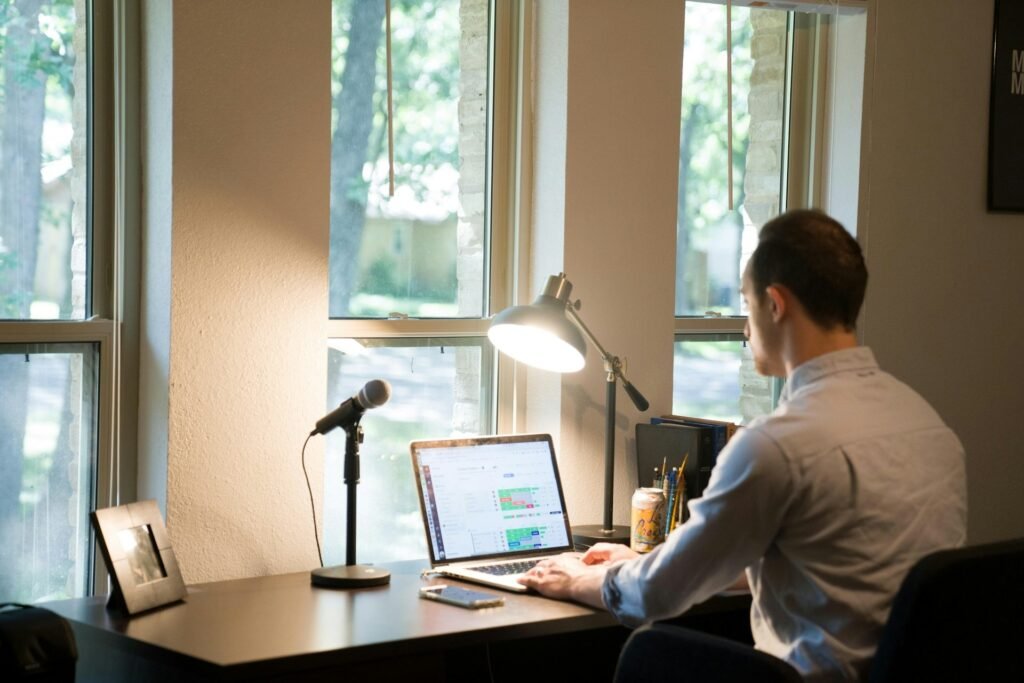
Turn off every non-essential notification, check email and messages in two or three batches a day instead of continuously, and block distracting sites during deep work. Your inbox is someone else’s to-do list; don’t let it run your morning.
Switch off notifications for email, Slack, and social apps so nothing pings you out of focus. Then batch: process email at, say, 12 and 4 rather than reacting all day.
For the sites you can’t resist, a blocker like Freedom, Cold Turkey, or Forest fences them off during your focus blocks — see our roundup of free productivity tools for the best free options.
The example: you’re deep in a design when a client Slack message pings — “no rush!” — and the whole session evaporates, even though you didn’t need to reply for hours. Notifications off, checked on your schedule, and that session survives.
Work in focused blocks and do one thing at a time
Work in focused 25-minute blocks with short breaks (the Pomodoro technique), stick to one task at a time, and choose just 1–3 most-important tasks for the day. Single-tasking sidesteps the attention residue that quietly wrecks multitasking.
Set a timer for 25 minutes, work on one thing, take a five-minute break, repeat. Committing to just 25 minutes makes starting easy, which is usually the hard part.
And because switching tasks leaves residue, resist the urge to “multitask” — pick your handful of priorities (the 1-3-5 rule is a good frame) and finish one before the next.
The example: seven tabs open, flicking between a proposal, email, and a half-written invoice, feeling busy and finishing none of them. One task, one timer, and things actually get done.
Set boundaries with the people you live with
Tell the people you live with about your focus hours and give them a clear signal for “don’t interrupt,” so you’re not pulled out of deep work five times a morning. They’re not mind readers; a quick conversation saves everyone the friction.
Agree on your core focus times and a visible cue — headphones on means don’t interrupt unless it’s urgent. Frame it kindly: it’s not that you don’t want to talk, it’s that a two-minute question costs you twenty minutes of refocusing.
The example: the partner or housemate who pops in with “just a quick question” five times before lunch — each one a fresh 23-minute tax. One honest chat about signals fixes most of it.
Manage your energy, not just your time
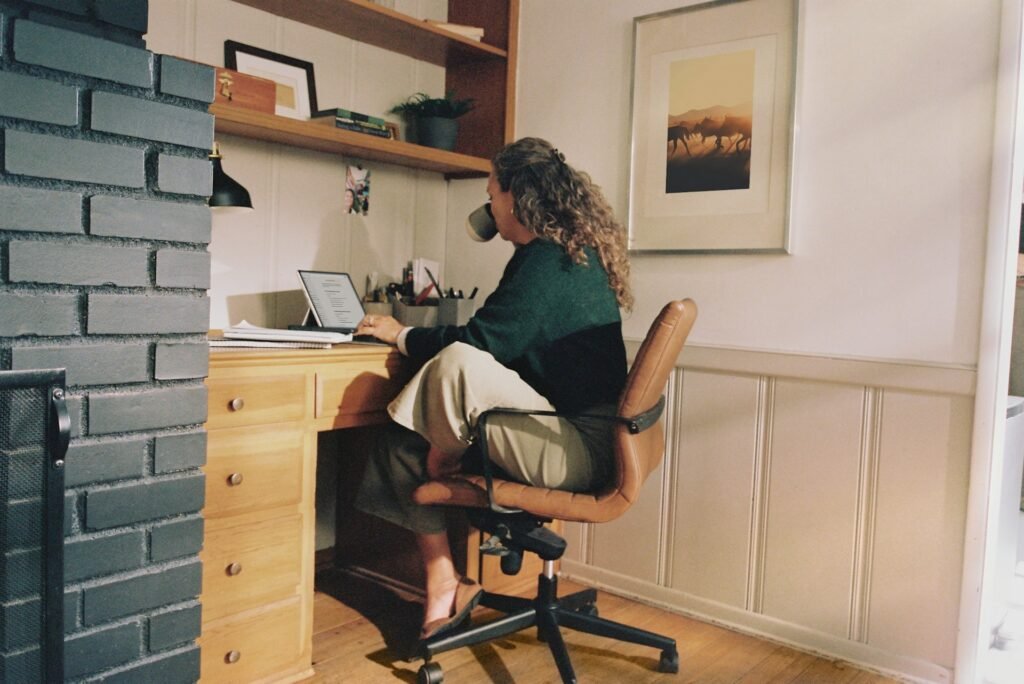
Schedule your hardest, most focus-heavy work for your natural peak hours, and take real breaks to refuel — because focus runs on energy, not just hours at the desk. Fighting your own rhythm is a losing game.
Notice when you’re sharpest — for many people it’s mid-morning — and guard that window for your most demanding work, leaving admin and email for the low-energy troughs.
Then take breaks that actually restore you: lunch away from the screen, a walk outside, not just switching from work tabs to social tabs.
The example: grinding away on a big task at 3 pm when your brain clearly clocked out at 2 — slow, error-prone, miserable. Move that task to your morning peak, and it takes half as long.
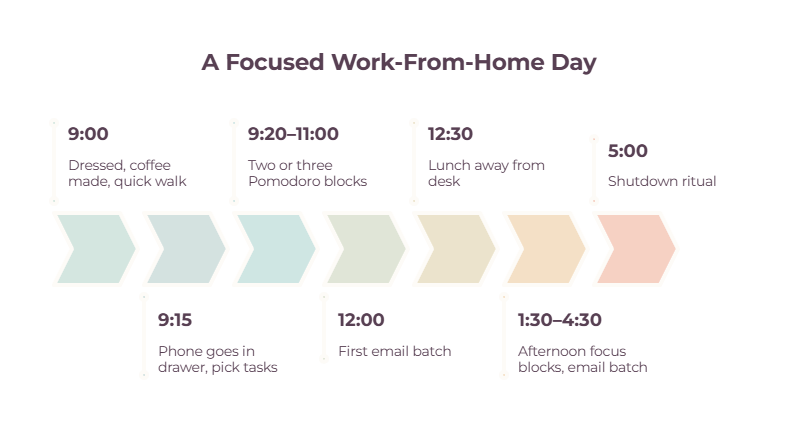
What a focused work-from-home day actually looks like
Put the tactics together, and a focused day is simple: a start ritual, phone away, a couple of deep-work blocks on your most important task, batched email, a real lunch, and a clean shutdown. Here’s one version.
➡️ 9:00 — Dressed, coffee made, a quick walk around the block. Workday officially begins.
➡️ 9:15 — Phone goes in a drawer. Pick the day’s 1–3 most-important tasks.
➡️ 9:20–11:00 — Two or three Pomodoro blocks on the single biggest task, notifications off.
➡️ 12:00 — First email batch of the day. Reply, triage, close it.
➡️ 12:30 — Lunch, away from the desk and the screen.
➡️ 1:30–4:30 — Afternoon focus blocks; the second email batch around 4.
➡️ 5:00 — Shutdown ritual: write tomorrow’s top tasks, close the laptop, leave the desk.
You don’t have to adopt all of it at once. Pick one piece, run it for a week, and add the next.
What to do when you lose focus anyway
You will lose focus sometimes — everyone does. The skill isn’t never slipping; it’s getting back quickly, and a short reset does that far better than grinding through in a fog. Don’t treat one lost hour as proof you’re hopeless.
When you catch yourself drifting, take a genuine five-minute transition break — do something different from both the task you left and the one you’re avoiding: stand up, stretch, step outside.
That small reset helps clear the mental residue and gets you back faster than white-knuckling it.
Then just start the next block. And go easy on yourself while you’re at it; beating yourself up about a distracted hour tends to make the next hour worse, not better. Self-compassion isn’t soft — it’s the faster route back to focus.
The bottom line
You don’t need more willpower to focus at home — you need fewer interruptions and an environment built for the job. The 23-minute tax is real, but it works in your favor once you stop paying it: protect your attention, and the focused hours compound.
Start with the change that’ll help most (usually the phone), add another next week, and let the system carry the weight your willpower shouldn’t have to.
Frequently Asked Questions
How do I stay focused working from home?
Remove distractions at the source rather than relying on willpower: set up a work-only space, keep your phone in another room, turn off notifications and batch your email, work in focused 25-minute blocks, and set boundaries with the people you live with.
Start with the phone — it’s usually the biggest single win.
Why can’t I focus when I work from home?
Because home is full of interruptions and lacks the office’s built-in structure — no commute, no colleagues, no set rhythm — and every interruption is costly. Research shows it takes an average of 23 minutes to fully refocus after being pulled away, so even small distractions add up fast.
How do I stop getting distracted by my phone?
Put it out of reach, not just face-down on the desk — ideally in another room or a drawer, on silent. Face-down isn’t enough because you still know it’s there. Making it take real effort to grab your phone is what actually breaks the habit of the “quick” check that costs you 20 minutes.
How long can you actually focus for at a time?
Sustained deep focus tends to run in blocks of roughly 25 to 90 minutes before you need a real break, which is why techniques like Pomodoro (25 minutes on, 5 off) work well. Trying to focus for hours straight usually backfires — you drift, and the quality drops.
What’s the best technique for focusing while working remotely?
There’s no single best one, but the Pomodoro technique — 25 minutes on one task, then a 5-minute break — is the easiest to start and pairs well with getting your phone out of the room. Combine it with a work-only space and batched email, and you’ve covered most of the battle.
What do I do when I keep losing focus?
Take a genuine five-minute break doing something different from your work — stand up, stretch, step outside — to clear your head, then restart with a single small task. Don’t spiral over a lost hour; just begin the next block. Getting back quickly matters far more than never slipping.
Related guides: productivity tools for freelancers (methods and tools) · best free productivity tools (free focus apps) · maintain a steady workflow as a solo freelancer · time management for freelancers