
Freelance Payment Methods: The Best Easy Ways to Save

The invoice says $3,000. The notification says paid. The deposit says $2,894.81. That gap is exactly why freelance payment methods matter.
Nobody made a mistake. You picked that $105 three months ago, when you set up the invoice and left card payment switched on, and you’ve been paying it on every invoice since without seeing it.
That’s the thing about payment methods for freelancers: the decision gets made once, quietly, during setup, and then it charges you forever. Most guides to this rank the apps. The useful question is which rail the money travels on, who chooses it, and what that choice costs on the invoices you actually send.
The cheapest way to get paid through a payment processor is a bank debit, not a card.
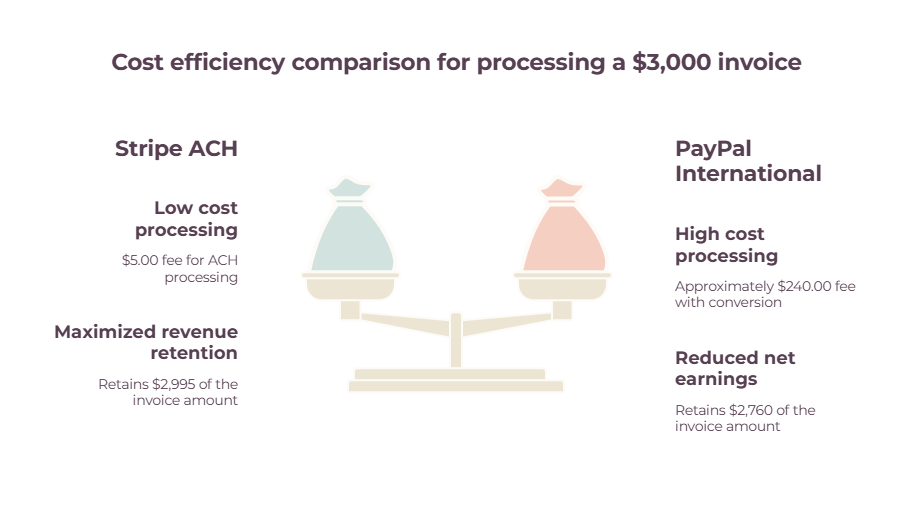
On a $3,000 payment, Stripe’s ACH fee is capped at $5.00 while the same amount paid through PayPal checkout costs $105.19. Across thirty payments a year, that single setting is worth just over $3,000.
Quick Takeaways
- Funding type beats brand. Every major rail charges roughly 1% for a bank debit and roughly 3% for a card, so which company you use matters less than which button your client presses.
- Cheapest verified domestic rail: Stripe ACH at 0.8%, capped at $5.00, plus 0.4% if you send it through Stripe Invoicing. Most expensive: Payoneer when the payer uses a credit card, up to 3.99% + $0.49.
- International is where it bites. A PayPal invoice billed in the client’s currency stacks 3.49% + 1.50% + a 3% conversion spread, around $240 on $3,000, against roughly $13 through Wise.
- Upwork won’t publish its rate. Its own terms call the freelancer service fee a variable fee “calculated using proprietary algorithms.”
- The IRS 1099-K threshold is over $20,000 in more than 200 transactions, not the $600 figure still circulating. It governs the form, never whether the income is taxable.
What do freelance payment methods cost on a $3,000 invoice?
On a $3,000 payment the fee ranges from $5.00 to $120.19, depending entirely on how the client pays. Bank debit through Stripe costs $5.00 on the rail itself, or $17.00 if you send it as a Stripe invoice.
The same amount paid by credit card through Payoneer costs $120.19. Every figure below was read at the provider’s own pricing page in September 2026.
Here’s the whole argument in one table. Same invoice, same work, nine different ways to collect it.
| Payment method | Fee on $3,000 | You keep |
| Stripe, ACH Direct Debit | 0.8%, capped at $5.00 → $5.00 | $2,995.00 |
| PayPal Invoicing, Pay by Bank | 1%, capped at $10.00 → $10.00 | $2,990.00 |
| Wave, bank payment (ACH/EFT) | 1%, no cap → $30.00 | $2,970.00 |
| Payoneer, ACH bank debit | 1% → $30.00 | $2,970.00 |
| Stripe, domestic card | 2.9% + 30¢ → $87.30 | $2,912.70 |
| Wave, credit card | 2.9% + $0.60 → $87.60 | $2,912.40 |
| PayPal Invoicing, card or Apple Pay | 2.99% + $0.49 → $90.19 | $2,909.81 |
| PayPal Invoicing, PayPal or Venmo checkout | 3.49% + $0.49 → $105.19 | $2,894.81 |
| Payoneer, payer uses a credit card | up to 3.99% + $0.49 → $120.19 | $2,879.81 |
The spread between the top and bottom rows is $115.19 on one invoice.
Every fee above was read at the vendor’s own pricing page in September 2026. These schedules move (PayPal’s was last updated on 1 September 2026), so re-check before you commit.
How do you choose a freelance payment method?

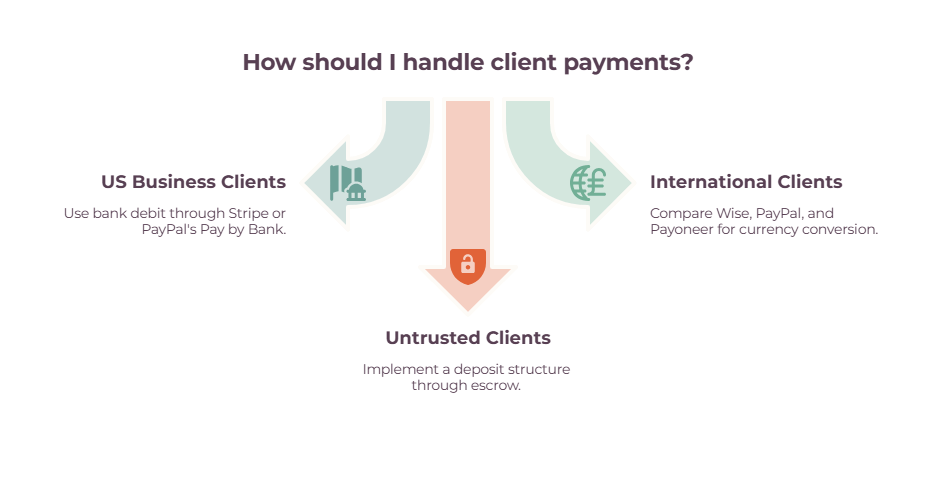
Choose by where your clients are and how they pay, not by brand. US clients paying from a business account want a bank debit at roughly 1%. International clients make the currency conversion spread the main cost. A client you don’t trust yet is a deposit problem, not a fee problem.
Three questions cover almost every freelancer, and you only need to read one section after this.
Are your clients in the US, or abroad? Do they pay from a business bank account, or a card? And have you been burned by this kind of client before?
➡️ Path one — US business clients. Your answer is a bank debit on the invoice, through Stripe or PayPal’s Pay by Bank. Skip to the ACH section; the international stuff won’t apply to you.
➡️ Path two — international clients. The currency conversion spread will cost you more than the processing fee. Go to the Wise, PayPal and Payoneer comparison.
➡️ Path three — a client you don’t trust yet. Fees aren’t your problem. Deposit structure is. Go to the escrow section.
Does the payment method change the fee?
Yes, and it’s the largest single lever you have. The same PayPal invoice costs 1% if the client pays by bank and 3.49% if they pay through PayPal checkout. On $3,000, that’s $10.00 against $105.19. The client picks the method, so set the default in your invoice settings.
Your invoicing platform decides which payment options you can offer in the first place, so it’s worth comparing invoicing tools if your current setup doesn’t support the cheaper rails you want to use.
Change one thing, and you’ve captured most of the available savings: make bank payment the default on your invoices.
The same PayPal invoice costs 1% or 3.49% depending on which button the client clicks, and you control which one they see first.
Look at what happens across all four providers when the funding type changes:
| Provider | Bank debit | Card |
| Stripe | 0.8%, $5.00 cap | 2.9% + 30¢ |
| PayPal Invoicing | 1%, $10.00 cap | 2.99% + $0.49 |
| Wave | 1%, no cap | 2.9% + $0.60 |
| Payoneer | 1% | up to 3.99% + $0.49 |
Nobody’s brand advantage survives that. The companies are within a point of each other on either rail; the gap that matters is the one between the two columns.
The caps are what make this worth acting on. Stripe’s ACH fee stops growing at $625.
Above that, it’s $5.00 whether the invoice is $700 or $70,000. A card fee never stops growing. On a $12,000 project, that’s $5.00 against $348.30.
What is the cheapest way to get paid as a freelancer?

A bank debit is the cheapest way to take payment through an integrated processor, at 0.8% to 1% against roughly 3% for a card. Stripe caps its ACH fee at $5.00 and PayPal caps Pay by Bank at $10.00, so large payments cost almost nothing to collect.
A direct bank transfer or Zelle costs nothing at all, without the invoicing and dispute handling a processor gives you.
Bank debits run 0.8% to 1%, and two of the four providers cap the fee outright, which is what makes large payments almost free to collect.
How much does Stripe ACH Direct Debit cost?
Stripe charges 0.8% for ACH Direct Debit, capped at $5.00 per transaction. The cap means the fee stops growing above $625, so a $700 payment and a $70,000 payment both cost $5.00 to collect.
Sending that request through Stripe Invoicing adds 0.4% per paid invoice on Starter, or 0.5% on Plus — so a $3,000 invoice collected by ACH costs $17.00 all in, not $5.00.
The best-value option verified?
Stripe charges 0.8% with a $5.00 cap on ACH Direct Debit, and Stripe Invoicing sits on top of that rather than replacing it — Stripe’s own page states that Invoicing “has no fixed fees or setup costs, but Stripe Payments pricing will apply,” at 0.4% per paid invoice on Starter and 0.5% on Plus.
Collect by payment link and you pay the $5.00 alone.
The catches are small but need mentioning.
Post-payment invoices, generated automatically after a one-time purchase, cost 0.4% of the transaction total capped at $2.00. Using your own domain on the payment page is $10.00 a month.
How much does PayPal Pay by Bank cost?
PayPal charges 1% for Pay by Bank, capped at $10.00 per transaction, compared to 3.49% + $0.49 for a standard PayPal checkout payment. On a $3,000 invoice, that’s $10.00 instead of $105.19. It’s the single change worth making if your clients already pay you through PayPal.
If your clients already pay you through PayPal and you’d rather not move everyone, this is the change to make today.
Pay by Bank is 1% capped at $10.00 per transaction, against 3.49% + $0.49 for a standard PayPal checkout payment. On $3,000, that’s $10.00 instead of $105.19.
How much do Wave bank payments cost?
Wave charges 1% per bank transaction with a $1.00 minimum and no cap, and the Starter plan itself is free. The missing cap is what decides it: a $10,000 invoice costs $100 through Wave against $45 through Stripe.
There’s also a second fee most people find by accident.
Pulling money out of your Wave balance early costs 1% of the amount withdrawn, minimum $1, on top of the processing fee. Waiting for the standard payout costs nothing.
That makes Wave’s advantage a little more narrow.
Because its invoicing is free, whereas Stripe’s adds 0.4%, Wave comes out cheaper on invoices between roughly $83 and $833 — below that, the $1 minimum costs you more than Stripe’s percentage, and above it, Stripe’s $5.00 cap pulls away.
A $500 invoice costs $5.00 through Wave and $6.00 through Stripe; a $3,000 invoice costs $30 through Wave and $17.00 through Stripe.
Is Zelle free for freelancers?
Zelle charges nothing, and 99.40% of linked consumer accounts charge no fee either, per Zelle’s own Q1 2026 survey of participating institutions. Two limits apply: both sides need US bank accounts, and Zelle states that payments cannot be reversed. Per-payment limits are set by your bank, not by Zelle.
Zelle itself charges nothing, and per its own Q1 2026 survey of participating financial institutions, 99.40% of linked consumer checking and savings accounts charge no fee to send, receive or request money. It’s available in over 2,400 bank and credit union apps, and payments to enrolled users typically land within minutes.
Two limits decide whether it works for you. Both sides need US bank accounts, so it’s domestic only. And Zelle states plainly that “Zelle payments cannot be reversed.”
That cuts both ways.
There’s no chargeback mechanism on a Zelle payment, so a client can’t claw the money back the way they could with a card payment, which is worth real money on a big project.
Your client also has no recourse if something goes wrong, which is exactly why some finance teams refuse to use it. Per-payment limits are set by each bank rather than by Zelle, so check yours before you promise a client it’ll work.
How much do card payments cost a freelancer?

Card payments cost a freelancer 2.9% to 3.99% plus a fixed fee, and no provider caps them, so the cost rises with every dollar invoiced. Stripe charges 2.9% + 30¢, PayPal checkout 3.49% + $0.49, Payoneer up to 3.99% + $0.49. On $3,000, that’s $87.30 to $120.19.
Cards run 2.9% to 3.99% plus a fixed fee, and no provider caps them, so the cost scales straight up with the size of the invoice.
| Provider | Card rate |
| Stripe, domestic | 2.9% + 30¢ |
| Wave | 2.9% + $0.60 |
| PayPal Invoicing, card or Apple Pay | 2.99% + $0.49 |
| PayPal Invoicing, PayPal or Venmo checkout | 3.49% + $0.49 |
| Wave, Amex | 3.4% + $0.60 |
| Payoneer, payer uses a credit card | up to 3.99% + $0.49 |
The fixed fee is the part comparison posts skip, and it’s the part that eats small invoices. Wave’s 60¢ is double Stripe’s 30¢. On $3,000, that’s invisible. On a $50 retainer top-up, it’s more than half a percent of the whole thing.
Stripe also stacks surcharges worth knowing about: +0.5% for manually entered cards, +1.5% for international cards, and +1% if currency conversion is required. Three of those at once turns 2.9% into 5.4%.
None of which means you should refuse cards. Cards clear faster, and some clients truly cannot pay another way.
A 3% fee on an invoice that settles in two days beats a 1% fee on one that settles in three weeks when rent is due Friday. Just don’t make it the default and then forget you did.
Which freelance payment methods are cheapest for international clients?

Wise Business is the cheapest way to take international payments, at $6.11 for a USD wire plus conversion from 0.23%.
PayPal is the most expensive because the invoicing fee, a 1.50% international fee and a 3.00% conversion spread all stack on the same payment when you bill in the client’s currency.
On $3,000, that’s roughly $13 against $240.
The processing fee isn’t the expensive part of an international payment. The currency conversion spread is, and it’s the line freelancers never check because it doesn’t appear as a fee at all; it’s baked into the exchange rate.
What does a $3,000 international invoice cost on Wise, Payoneer and PayPal?
A $3,000 international invoice costs around $13 through Wise, between $0 and $30 through Payoneer, and around $240 through PayPal when you convert inside PayPal.
The $227 gap between Wise and PayPal comes almost entirely from the currency conversion spread, which never appears as a line item because it’s built into the exchange rate.
| Method | What you pay | Roughly |
| Wise Business | $6.11 for a USD wire, or free on a domestic-rail payment in a supported currency, plus conversion from 0.23% | $13 |
| Payoneer | Free into a receiving account in your local currency; 1% (minimum $1) in a non-local currency | $0–$30 |
| PayPal | 3.49% + $0.49, plus 1.50% international invoicing, plus a 3.00% conversion spread | $240 |
That’s a difference of around $227 on a single invoice. Ten international invoices a year and the choice of rail is worth more than most freelancers’ entire software budget.
How much does Wise Business cost to receive payments?
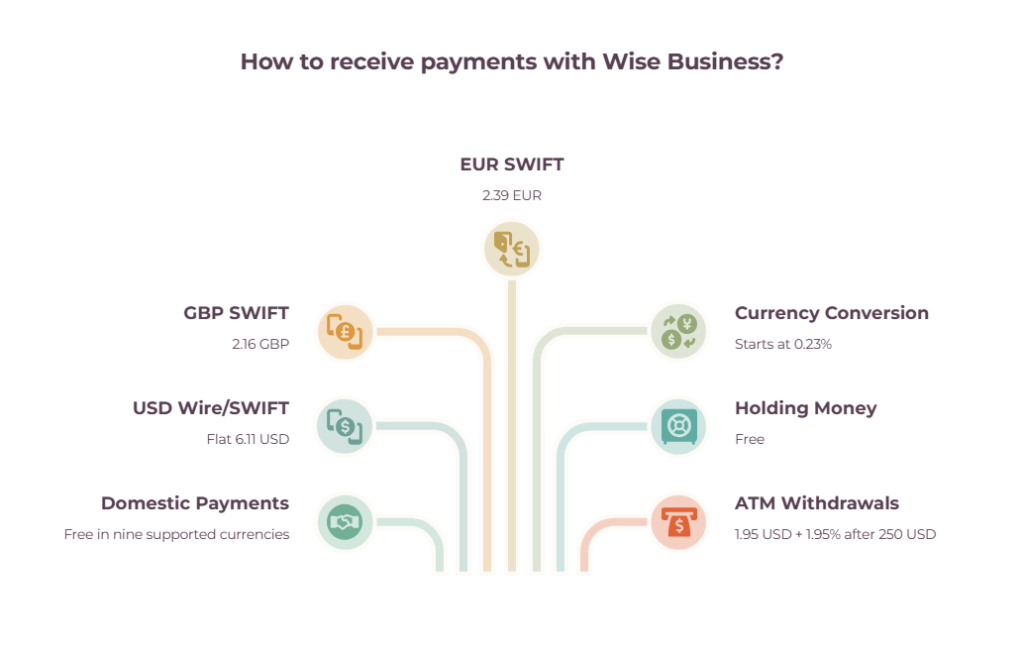
Wise Business charges a one-time 31 USD for account details in 22 currencies, then receiving domestic payments in nine supported currencies is free. A USD wire or Swift payment costs a flat 6.11 USD. Converting starts at 0.23%, and holding money in the account costs nothing.
Wise charges a one-time 31 USD for account details that let you receive in 22 currencies. After that, receiving domestic (non-wire) payments in AUD, CAD, EUR, GBP, HUF, NZD, PHP, SGD and USD is free.
A USD wire or SWIFT payment costs a flat 6.11 USD; GBP SWIFT is 2.16 GBP and EUR SWIFT is 2.39 EUR.
Converting starts at 0.23% and varies by currency. Holding money costs nothing, and spending in the same currency on the Wise card is free. ATM withdrawals are 1.95 USD + 1.95% once you pass 250 USD in a calendar month.
How much does Payoneer charge to receive payments?
Payoneer is free to receive into a receiving account in your local currency and free from another Payoneer balance. A non-local currency costs 1% with a 1.00 USD minimum, a card-paying client costs up to 3.99% + 0.49 USD, and ACH bank debit from a US payer costs 1%.
Payoneer is free for payments from another Payoneer balance and free via a receiving account in your local currency. A receiving account in a currency that isn’t your local one costs 1%, minimum 1.00 USD.
If the payer uses a credit card, it’s up to 3.99% + 0.49 USD, and ACH bank debit from a US payer is 1%.
Marketplace payments vary by marketplace, which Payoneer states rather than lists, so check the specific platform.
Why PayPal costs the most on cross-border work
Three separate charges apply to one cross-border payment: 3.49% + a fixed fee to invoice, 1.50% more because it’s international, and a currency conversion spread on top. On a $3,000 invoice, that’s roughly $240, around 8%.
Each charge is reasonable on its own, which is why the total surprises people. The conversion spread is the part worth understanding, because who pays it depends on how you invoice.
Bill in USD and your client converts to pay you — PayPal charges them 4.00% above the base rate, and you receive USD untouched. Bill in their currency and the conversion is yours, at 3.00% when you move the balance into USD.
The $240 above is that second case.
None of this is hidden. It’s all on the fee page. It just never appears as one number, which is how a freelancer can use PayPal for three years without knowing international work costs them 8%.
There’s a way around the worst of it: invoice in the client’s currency, hold the balance, and move it out through a cheaper route rather than converting inside PayPal. You still pay the invoicing and international fees, but the 3.00% becomes optional.
Do freelancers need escrow, or will milestone payments do?

Most freelancers don’t need escrow. A 50% deposit and staged milestones remove most of the same non-payment risk at 0%, whereas a marketplace takes a cut.
Upwork’s own terms now describe its freelancer service fee as a variable fee calculated using proprietary algorithms, with only one published rate: 10%, for Enterprise Client contracts.
Escrow is the single most-searched aspect of this whole topic, and the platform that sells it to freelancers has stopped publishing what it costs.
Upwork’s own terms describe the freelancer service fee as “a variable fee, meaning that the fee charged may fluctuate based on various factors,” which is “calculated using proprietary algorithms” factoring “levels of client demand, freelancer supply, job category, and applicable membership plans.”
The same section adds that “the exact pricing methodology may change without notice” and that “prices may increase without prior individual notification.”
The only percentage published anywhere in that document is 10%, and only for contracts with Enterprise Clients. However, the good is that once a rate is set, “the Service Fee that applies to a Service Contract is fixed for the life of the Service Contract.”
How Freelance Payment Methods Affect Non-Payment Risk
Nobody searches for it because they love payment infrastructure. They search for it because they’re afraid of doing the work and not getting paid.
And a deposit plus milestones solves most of that without an unpublished percentage coming out of every invoice:
➡️ 50% up front on any new client. The client who won’t pay a deposit is the client who won’t pay the invoice.
➡️ Stage long projects into milestones. Each one gets invoiced and paid before the next one starts.
➡️ Stop work when a milestone goes unpaid. Write that into the agreement so it’s a term, not a confrontation.
If you already work from a signed freelance contract with a deposit, you’re covering most of what escrow covers, at 0%.
What you don’t get is a third party holding the funds: escrow confirms the money exists before you start and gives you a dispute process, where a deposit only caps how much you can lose.
The case for a platform is when you can’t get a contract signed at all, the client found you there in the first place, or the sum is large enough that you want the funds confirmed up front.

Four charges sit outside the headline percentage. PayPal keeps its processing fee when you refund a client, so a cancelled $3,000 project costs you $105.19.
Wave charges 1% again to pay you out early. Seller protection excludes Item Not Received claims that come through a card chargeback. And the 1099-K threshold is $20,000, not $600.
Four costs sit outside the headline percentage, and each one has taken money off a freelancer who never saw it coming.
Does PayPal return its fee when you refund a client?
No. PayPal’s fee page states that on a refunded invoicing transaction, “there are no fees to make the refund, but the fees you originally paid to receive the payment are not returned to you.” Take a $3,000 project, get paid, refund in week one, and you’re $105.19 down.
Straight from PayPal’s fee page: on a refunded invoicing transaction, “there are no fees to make the refund, but the fees you originally paid to receive the payment are not returned to you.”
Take a $3,000 project, get paid, have the client cancel in week one, refund in full. You’re $105.19 down for work you didn’t do and money you no longer have.
What does PayPal seller protection cover on freelance work?
Less than freelancers assume. Freelance services count as intangible goods, which carry proof-of-delivery requirements on top of the basic ones, and PayPal decides eligibility “in its sole discretion.”
Item Not Received claims that come through a card issuer chargeback are excluded, which is the most common way a freelancer actually loses a payment.
The fee you pay on a goods-and-services payment is partly buying this.
Freelance services count as intangible goods under PayPal’s Seller Protection program, last updated 26 January 2026.
Intangible goods carry requirements on top of the basic ones: PayPal must have “marked the intangible good transaction as ‘eligible’ in the Transaction Details page,” and you need “compelling evidence to show the item was delivered or the purchase order was fulfilled.”
Then there’s the exclusion that matters most. PayPal states that “Item Not Received claims that result from buyers filing chargeback claims with their issuers for card-funded transactions are not eligible for PayPal’s Seller Protection.”
A client disputing a card charge with their bank is the most common way a freelancer loses a payment, and it sits outside the program. PayPal also “determines, in its sole discretion, whether your claim is eligible.”
Which brings up the request every freelancer eventually gets: can you just send it as friends and family so neither of us pays the fee?
Venmo states you’re charged a fee only “if the sender identifies the transaction as for goods and services,” and PayPal’s protection program applies when you “sell a good or service to a buyer.”
A personal transfer isn’t a goods-and-services transaction, so the protection described above has nothing to attach to. You’re saving 3% by giving up the thing the 3% was for.
What does an instant payout cost?
An instant payout from Wave costs 1% of the amount withdrawn, minimum $1, charged on top of the processing fee you already paid. On a $3,000 payment, that’s another $30 for getting your own money a few days sooner. Waiting for the standard payout costs nothing.
Wave charges 1% of whatever you withdraw early, minimum $1, on top of the processing fee you already paid. On a $3,000 payment, that’s another $30 for getting your own money a few days sooner.
Does getting paid through an app change your taxes?
No. Getting paid through an app changes which forms arrive, never what you owe. The IRS requires a 1099-K only when payments for goods or services top $20,000 in more than 200 transactions, and plenty of freelance-finance content still reports that threshold as $600.
The IRS states that a payment app or online marketplace must send you a Form 1099-K when payments for goods or services “total over $20,000 in more than 200 transactions” (both conditions, not either).
Plenty of freelance-finance content still reports this as $600 or $5,000. The IRS page carrying the $20,000 figure was last reviewed on 28 June 2026.
What the threshold does not do is change what you owe. In the IRS’s own words, “no matter the amount of reported payments,” the income is reportable.
Getting paid by bank transfer rather than an app doesn’t make income invisible; it just means no form arrives. Track everything and claim your freelance tax deductions properly.
So which payment method should you actually use as a freelancer?
Use Stripe ACH for US business clients, Wise Business for international clients, and a deposit with milestones for clients you don’t trust yet. Stripe ACH costs $5.00 on a $3,000 payment, or $17.00 sent as a Stripe invoice, compared to $105.19 for a PayPal checkout payment — which makes it the default worth setting today.
| If you… | Use | Why |
| Invoice US businesses for $500 or more | Stripe ACH | 0.8% capped at $5.00, and the fee stops growing above $625 |
| Already send invoices through PayPal | Switch on Pay by Bank | 1% capped at $10 against 3.49% + $0.49 |
| Bill small amounts frequently | Stripe card over Wave card | Same 2.9%, half the fixed fee |
| Work with clients abroad | Wise Business | $6.11 a wire against roughly $240 on PayPal |
| Get paid through marketplaces | Payoneer | Free into a local-currency receiving account |
| Are paid by US clients you know well | Zelle | Free at 99.40% of institutions, though irreversible |
| Don’t trust the client yet | A deposit and milestones | Does what escrow does, at 0% |
If your clients are US businesses paying you monthly against an invoice, a business checking account with ACH switched on beats every product on this page.
No subscription, a fee capped in single digits, and money that lands where it’s supposed to.
The reason to add a platform is international clients, card-paying clients, or a marketplace — not the general feeling that you should have one.
Free freelance payment fee calculator
The free Freelance Payment Fee Calculator shows what you keep on every payment method for your own invoice amount, using the verified September 2026 fee schedule. Enter your typical invoice amount and how many you send a year, and it totals what the current setup costs you annually.
Put in your invoice amount, where the client is and how they pay.
It returns what you’d keep on each rail using the September 2026 fee schedule — including invoicing fees where the provider charges them separately, like Stripe’s 0.4% — and multiplies it out across your annual invoice volume so you can see what the current setup is costing you over a year.
Copy the Freelance Payment Fee Calculator and run one real invoice through it before you change anything.
How to change your freelance payment method today
Open your invoice settings and make bank payment the default option your client sees. That takes about ten minutes and saves roughly $100 on every large invoice. If you have clients abroad, open a Wise Business account before the next international project rather than after it.
The next invoice goes out this week, and it’ll collect money the way the last one did unless you change something before you send it.
Open the invoice settings, find the funding options, and make bank payment the default.
That’s ten minutes and roughly $100 per large invoice. Then, if you have clients abroad, open a Wise Business account before the next international project starts rather than after.
From there, the money still has to land somewhere sensible and get chased when it’s late. The Nimblelancer guides to comparing business bank accounts and keeping track of invoices pick up where this one stops.
Frequently Asked Questions
How do you accept payment as a freelancer?
Send an invoice through a tool that supports bank debits, and make bank payment the default option your client sees.
Stripe, PayPal, Wave and Payoneer all support both bank and card payments; the bank rail costs roughly 1% and the card rail roughly 3%. For US clients, a direct bank transfer or Zelle costs nothing at all.
What is the best payment method for freelancers?
For US work, ACH bank debit through Stripe at 0.8% capped at $5.00 is the cheapest verified processor option, with 0.4% on top if you send it through Stripe Invoicing.
For international work, Wise Business costs $6.11 per wire plus conversion from 0.23%, against roughly $240 through PayPal if you convert inside it. Cards make sense only when the client can’t pay any other way.
How do freelancers get paid by international clients?
The three common routes are Wise, Payoneer and PayPal. Wise gives you local account details in 22 currencies for a one-time $31, then most receiving is free.
Payoneer is free for receiving into a local-currency account and 1% outside it.
PayPal works everywhere and costs the most, because the invoicing fee, a 1.50% international fee and a 3% conversion spread all apply to the same payment once you convert the proceeds.
What is a milestone payment, and do I need escrow?
A milestone payment splits a project into stages, each invoiced and paid before the next begins.
It covers most of what escrow covers without a platform taking a cut — the difference being that escrow holds the money in advance and provides a dispute process, while milestones simply limit your exposure to one stage.
Escrow through a marketplace is worth it when the client found you there or won’t sign a contract. Otherwise, a 50% deposit and staged milestones do the job at no cost.
Is it safe to accept payment by Zelle or a personal transfer?
Zelle is safe in the sense that Zelle states payments “cannot be reversed” once the recipient is enrolled, so there’s no card-style chargeback to face. It’s risky in the sense that there’s no dispute process for your client either, and it’s US-only.
Banks do reimburse senders for qualifying imposter scams, so a client who claims one may get their money back through their own bank — but a routine “I’m not happy with the work” dispute has no Zelle mechanism behind it.
A personal transfer on PayPal or Venmo avoids the fee but also sits outside seller protection, which only applies to goods-and-services transactions. If a client asks you to take payment that way on a large project, the saving isn’t worth what you give up.
How should a client pay a freelancer?
By ACH or bank transfer against an invoice. It’s the cheapest option for the freelancer and costs the client nothing extra.
Do I get a 1099-K for freelance payments?
Only if payments for goods or services through that app total over $20,000 in more than 200 transactions, per the IRS — both conditions have to be met, though apps may send one at lower amounts anyway.
The threshold decides whether a form arrives, not whether the income is taxable. All of it is reportable regardless.
Related guides: best invoicing tool for freelancers · freelance contract template · freelance tax deductions · best tools for comparing bank accounts · how to keep track of invoices