15 Productivity Tips for Work That Actually Stick (for Freelancers)

You don’t need another list of 50 productivity tips. You’ve read those, nodded along, and changed nothing.
What actually works is a small number of concrete tactics you’ll genuinely use — the ones that protect your focus and get the important work done before the day fills up with everything else.
For a freelancer, that matters more than it does for someone on a salary. Your income tracks what you finish, not the hours you sit at your desk, and there’s no manager imposing structure — so the discipline is yours to build.
The good news: a handful of these tips, applied consistently, will do more than a whole productivity system you abandon in a week.
Here are 15 that actually work, plus how to handle a fast-paced day and how to make any of this stick.
Quick Takeaways
- Do your most important task first, before email — for most freelancers it’s the highest-leverage habit on this list.
- Kill notifications and put your phone in another room during focus time; few changes do more for concentration for less effort.
- Give tasks deadlines — work expands to fill the time you allow it (Parkinson’s law), so set a specific end point rather than leaving it open.
- Batch similar work and single-task — context-switching quietly burns your day.
- Don’t try all 15 at once. Pick three, build them in, then add more.
15 productivity tips for work

The most effective productivity tips for work come down to protecting your focus and doing the important things first: start with your top task, block your time, cut distractions, batch similar work, and give everything a deadline. Here they are in full.
Start with focus, priorities, and distractions
1. Do your most important task first
Before you open your inbox, give your first protected focus block to the one task that matters most today — ideally during your peak hours, if you know when those are (tip 10).
Get that done and the day’s already a win, whatever else happens. It pairs with the 1-3-5 rule below.
2. Limit your daily priorities with the 1-3-5 rule
A 20-item list is a recipe for doing the easy, unimportant things. Choose one big task, three medium, and five small — the 1-3-5 rule — so your list is finishable and points at what counts.
3. Time-block your calendar
A to-do list tells you what; your calendar tells you when. Turn your priorities into actual appointments so they get real hours, not leftovers (see time blocking).
4. Kill notifications and hide your phone
This is the big one. Turn off notifications on your computer and put your phone in another room — not face-down on the desk — during focus blocks.
In one week-long experiment, people who kept notifications on reported more inattention and hyperactivity than the same people did with them silenced. Every ping is an interruption you didn’t choose.
5. Batch similar tasks
Group your emails, calls, and admin into dedicated blocks instead of scattering them through the day. Switching between different kinds of work carries a hidden cost each time; batching removes it.
6. Use the 2-minute rule
If a small task takes under two minutes, do it now so it doesn’t pile up; if a big task feels impossible to start, do just two minutes of it to get moving. (More on both in the 2-minute rule.)
7. Single-task
On work that needs real concentration, what feels like multitasking is usually your attention switching rapidly between tasks, and each switch costs time and accuracy. Do one thing, finish it, move on.

More productivity tips for work: time, energy, and focus
8. Give every task a deadline
Parkinson’s law — first set out in The Economist in 1955 — says work expands to fill the time available, so an open-ended task drags on for hours.
Set a specific, realistic deadline or timebox (“draft done by 11am”), and you’ll work to hit it.
Realistic matters as much as specific — a deadline you don’t believe in gets ignored, and one that’s genuinely too short just produces work you redo.
9. Match tasks to your energy
You’re sharper at some hours than others, and that’s a documented effect rather than a feeling — time of day measurably shifts attention, executive function and memory, and when your peak falls depends on your chronotype.
Do your hardest, most creative work in your peak window and save low-focus jobs like invoicing and email for the afternoon slump.
10. Take real breaks
Focus fades after a stretch, so work in blocks (25 minutes on, 5 off, or 60–90 minutes with a proper break) rather than grinding until you’re fried. Breaks aren’t lost time; they’re what keeps the next block sharp.
11. Tame your inbox
Check email at two or three set times a day instead of keeping it open. An always-on inbox turns every message into an interruption and your day into reaction (see email management).
12. Set up one dedicated workspace
Working from the same tidy spot every day becomes a cue that tells your brain it’s time to focus — habits are triggered by stable contexts, which is why a consistent location does more work than motivation does. A cluttered desk or a different location each day makes starting harder (staying focused when working from home covers this).
13. Learn to say no
Every yes to a low-value task or meeting is a no to your focused work. Protecting your time is a productivity skill, not rudeness — guard the hours that earn.
14. End with a shutdown routine
Close the day by tidying up and setting tomorrow’s priorities — one big task, three medium, five small, if you’re using the 1-3-5 rule. You’ll switch off properly in the evening and start the next morning already pointed in the right direction.
15. Run a weekly review
Fifteen minutes each week to see what worked, what slipped, and what to change keeps your habits honest and stops you drifting back to busywork.
Productivity tips for a fast-paced or high-pressure day
On a chaotic, fast-paced day, don’t try to do everything — triage ruthlessly to the one thing that must get done, protect a single focused block for it, and defer or delegate the rest. Trying to keep every plate spinning is how you drop them all.
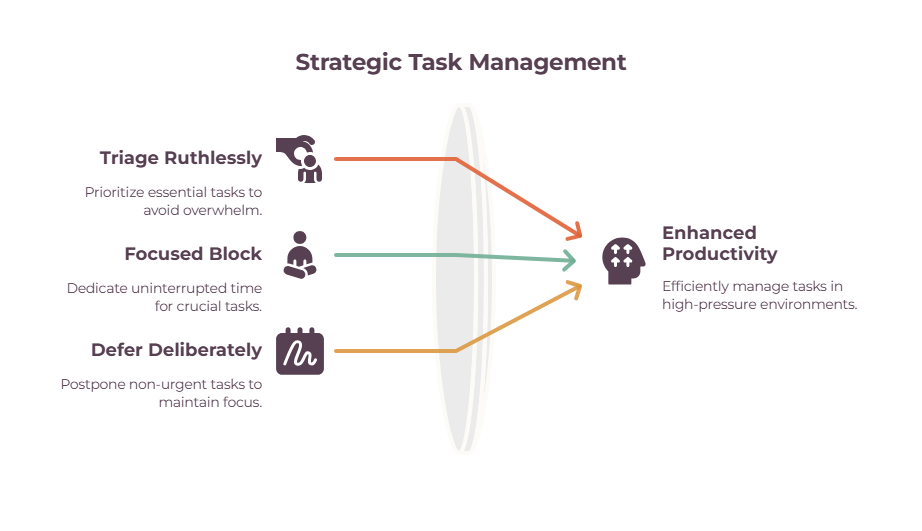
When the day’s on fire, the tips above compress into three moves.
First, pick the one must-do — if only one thing gets finished today, what has to be it?
Second, protect one focused block for that task, notifications off, before you touch anything reactive.
Third, defer the rest deliberately — a quick “I’ll get to this tomorrow” on the non-urgent stuff, rather than half-doing ten things at once.
A fast-paced environment doesn’t reward doing more; it rewards doing the right one thing while everyone else scrambles.
How to make these productivity tips for work stick
Don’t try to adopt all fifteen at once — pick the three that fix your biggest problem, run them until they’re automatic, then add more. A couple of habits you actually keep beat a dozen you drop by Friday.
That’s the difference between reading productivity tips and being more productive.
Diagnose where you’re losing time and start there.
Can’t get going in the morning? Start with tips 1 and 4.
Busy all day but nothing important done? Tips 2 and 3.
Drowning in small stuff? Tips 5 and 6.
Once those are second nature, layer in a few more. The same goes for your tool stack: choose productivity tools that support the habits you’ve already decided to build, rather than adding apps and hoping the habits follow.And if you want the deeper reasoning behind why these work — the shift from busy to actually productive — read how to be more productive, then build your chosen tips into a repeatable productivity recipe.
Putting these productivity tips for work into practice
Productivity at work isn’t about doing more things — it’s about protecting your focus and doing the important ones first. You don’t need all fifteen of these tips; you need three you’ll actually keep.
Pick the ones that fix your biggest time-sink, do your most important task before you open your inbox, and cut the distractions that steal the rest.
Do that consistently and you’ll get more of what matters done in a focused morning than you used to manage in a scattered day.
Frequently Asked Questions
What are the best productivity tips for work?
The highest-leverage ones are: do your most important task first before email, pick a short list of daily priorities, block your calendar, and kill notifications during focus time.
Those four protect the time that actually matters. Everything else — batching, deadlines, single-tasking — builds on that foundation.
How can I be more productive in a fast-paced work environment?
Triage hard. Decide the one thing that must get done, protect a single focused block for it with notifications off, and deliberately defer or delegate everything non-urgent.
In a chaotic day, doing the right one thing well beats half-doing ten, so resist the urge to keep every plate spinning.
How do I stop getting distracted at work?
Turn off notifications on your computer and put your phone in another room — not just face-down — during focus blocks, and check email only at set times.
Work from one consistent, tidy space so it cues your brain to focus. Removing the distraction beats trying to resist it with willpower.
What’s the single best productivity tip?
Do your most important task first, before you check anything. It’s the change most likely to protect the work that matters, because it happens before the day’s interruptions have a chance to arrive.
If you only adopt one tip here, make it this one.
Protect that first focused hour and the rest follows.
How do I get more done in less time?
Give your tasks specific, realistic deadlines (work expands to fill the time you allow it), single-task rather than splitting your attention, and batch similar jobs to cut context-switching.
Combined with doing your key task first and protecting focus time, these help you finish more in fewer, more focused hours rather than longer ones.
Related guides: how to be more productive · the 1-3-5 rule · time blocking app · the 2-minute rule · productivity recipe · productivity tools for freelancers