The 1-3-5 Rule: A Simple Way to Actually Finish Your To-Do List

The 1-3-5 rule is built for a version of the to-do list that looks like productivity and functions like anxiety. Forty items long. Rewritten every morning.
The same five tasks carried over for two weeks straight, sliding down the page but never getting crossed off.
You end the day having touched a dozen things, cleared your inbox, answered every notification — and somehow nothing that actually mattered moved an inch.
The problem isn’t that you’re lazy or disorganized. The problem is the list. A bottomless to-do list can’t be finished by design, so it never gives you the one thing a list is supposed to: the feeling of done.
The fix is smaller than you’d think.
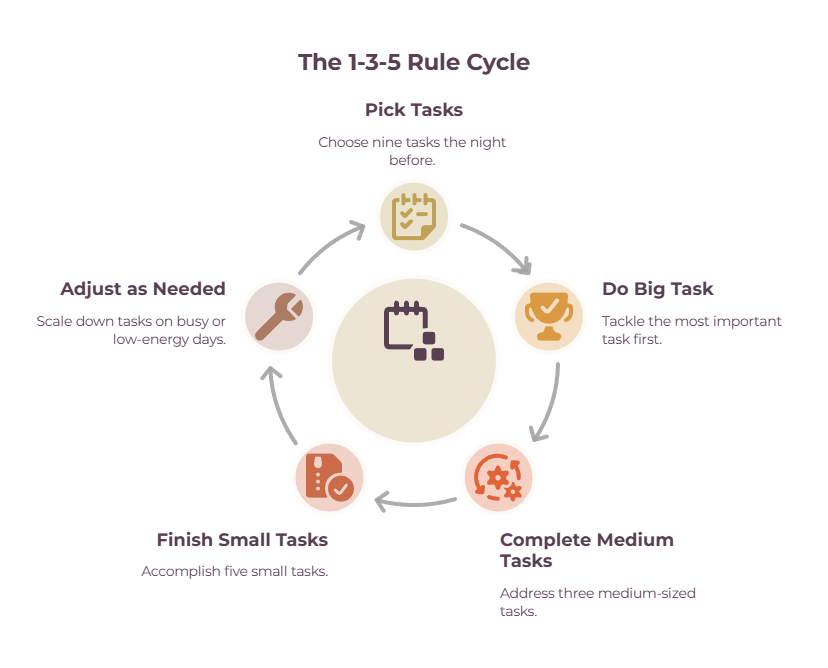
You don’t need a longer list or a better app — you need a shorter, smarter one. Nine tasks a day, chosen on purpose: one big, three medium, five small.
That’s the 1-3-5 rule, and it’s one of the simplest ways to end most days having genuinely finished your work. Here’s what it is, why it works, exactly how to run it, and a full worked example of a freelancer’s 1-3-5 day.
Quick Takeaways
- The 1-3-5 rule means planning each day around one big task, three medium, and five small — nine tasks in total.
- The cap is the whole point — you can’t do everything, so a fixed number of slots forces you to choose what actually matters. Note that if several tasks take an hour or more, you won’t hit nine tasks, but recognize that’s okay!
- Pick your nine the night before so you start the day doing the work, not deciding what to do.
- Do the big task first, in your best energy window, before the day fills up with everything else.
- The rule bends: on meeting-heavy or low-energy days, scale it down rather than abandon it.
What is the 1-3-5 rule?
The 1-3-5 rule is a daily planning method where you commit to just nine tasks — one big, three medium, and five small — instead of an endless list.
Capping the day at nine forces you to prioritize, and choosing those nine in advance means you start work already knowing exactly what matters.
One plus three plus five is the shape of your whole day.
The method was popularized by The Muse’s co-founder Alexandra Cavoulacos and has since become a staple of productivity guides — the clearest modern walkthrough is Todoist’s.
The appeal is that it’s almost too simple to need explaining: instead of asking “what’s on my list?” (answer: everything), you ask “what are my nine for today?” That single constraint changes how the whole day feels.
Why the 1-3-5 rule works
It works because it removes the two things that quietly wreck most days: an impossible list and endless in-the-moment decisions.
Nine chosen tasks is a target you can actually hit, and deciding them ahead of time means your energy goes into doing the work rather than into figuring out what to do next. A few forces are doing the heavy lifting here.
A realistic cap
A list you can finish feels completely different from one you can’t. Nine tasks is usually achievable on an ordinary day — as long as you keep them toward the lighter end of those time ranges rather than the top of every one — so crossing off the last one gives you a real finish line — the thing a 40-item list can never offer. You end the day closed rather than owing.
Less decision fatigue
Every “what should I do now?” is a small tax on your attention, and by mid-afternoon those little decisions add up to a foggy, tired brain. When your nine are chosen the night before, you’ve paid that tax once, in advance. You wake up and execute.
Forced prioritization
There are only nine slots, and only one for the big task.
That scarcity does the prioritizing for you: the important client work has to earn its place, and the busywork that would otherwise eat the day gets left off. You’re choosing what matters instead of letting whatever’s loudest win.
Momentum
Finishing the one big thing early gives the rest of the day a tailwind. You’ve already done what counts, so the mediums and smalls feel like a downhill coast rather than a climb.
Big, medium, and small tasks: what goes in each slot

The big task is your single most important, highest-impact job of the day — roughly two to four hours of real work. The three medium tasks take about 30 to 90 minutes each. The five small ones are quick jobs of five to 20 minutes.
The sizes are what keep the day honest and finishable. Here’s how that maps onto a freelancer’s week.
One big task (about 2–4 hours): the client deliverable that moves your business forward — building the website, writing the article, finishing the design, preparing the pitch. This is the “if I only get one thing done today, let it be this” task. It’s the reason the rule exists.
Three medium tasks (about 30–90 minutes): the real but smaller jobs — writing a proposal for a new lead, a discovery call, a round of edits, sorting your monthly bookkeeping. Needed, moderately important, but not the centerpiece.
Five small tasks (about 5–20 minutes): the admin that otherwise expands to fill the entire day — send an invoice, reply to a client, book a call, update your tracker, order the thing you keep forgetting. Individually trivial, collectively the stuff that clogs your head.
To clarify, however, a task’s size is about the time and effort it takes, not how important it is. Sending a single make-or-break invoice might be a five-minute “small,” even though it matters enormously.
Size sorts the day; importance decides which tasks earn a slot in the first place.
How to use the 1-3-5 rule, step by step
Plan tomorrow’s nine tonight, put the big task in your best hours, do it first, leave some buffer, and roll unfinished items forward instead of piling nine fresh ones on top. The whole method runs on six habits.
- End each day by choosing tomorrow’s 1-3-5. Before you close the laptop, write down tomorrow’s one big, three medium, and five small. It takes five minutes and means you start the next morning already knowing your plan. If you prefer to plan digitally, AI to-do list apps can help capture and break down your tasks before you choose which ones deserve a 1-3-5 slot.
- Schedule the big task in your peak-energy window. Most people have a two- or three-hour stretch when they think clearly — often the morning. Guard it for the big task and nothing else.
- Do the big one first. Eat the frog. Getting the hardest, most important task done before the day’s interruptions arrive is the single most reliable way to make sure it actually happens.
- Batch the smalls. Don’t scatter five little admin jobs across the day, where each one breaks your focus. Knock them out in one or two short sessions — a mid-morning and an end-of-day sweep. If interruptions are still derailing your big task, these strategies for staying focused when working from home can help protect that focus block.
- Leave buffer for the unexpected. Nine tasks should fit comfortably inside your working hours, not pack them wall to wall. A client emergency, a longer-than-planned call — the day needs slack to absorb them.
- Roll over, don’t pile on. If you don’t finish a task, move it to tomorrow’s list rather than adding nine brand-new ones on top of it. The cap only works if you respect it.
What a 1-3-5 day looks like for a freelancer

The method clicks once you see it run. Here’s an ordinary Tuesday for a freelance web designer.
Last night, before closing the laptop, she wrote tomorrow’s nine:
- 1 big: finish and hand over the client’s homepage build.
- 3 medium: write a proposal for a new lead, make the edits a second client asked for, and take a 30-minute discovery call at 2 p.m.
- 5 small: send two overdue invoices, reply to a client’s email, book next week’s project call, and update her project tracker.
Morning
She doesn’t open her inbox. From 9 to 11:30, her sharpest window, she does nothing but the homepage — the big task. By 11:30, it’s built and sent. The most important thing on today’s list is already done, and it’s not even lunch.
Late morning
A 20-minute admin sweep clears four of the five smalls: both invoices out, the email answered, the project call booked. Quick, batched, done.
Afternoon
The 2pm discovery call (medium one). Afterwards, the client edits (medium two), then the proposal for the new lead (medium three). The last small — updating the tracker — takes two minutes at the end.
End of day
Nine tasks, all closed. The big one shipped before lunch. Before shutting down, she spends five minutes writing tomorrow’s 1-3-5 and steps away genuinely finished — not because she ran out of hours, but because she’d decided in advance what “finished” meant.
How to adapt the 1-3-5 rule to real days
Freelance days are rarely tidy, and the rule is built to bend. The nine-task shape is a guide, not a law.
Meeting-heavy days
When your calendar is stacked with calls, count the meetings toward your slots — a client call is a medium task, a quick check-in is a small one. Or scale the whole day down to a 1-2-3.
Trying to fit a full 1-3-5 around six hours of meetings just rebuilds the impossible list you were escaping.
Big multi-day projects
When the “big” thing is a two-week project, today’s big task is one chunk of it, not the whole mountain — “design the pricing page,” not “build the entire site.”
A big task you can actually finish today is the point; a big task you can’t is just the old overwhelm wearing a new label.
Low-energy days
Some days you’re running on empty. Rather than abandon the method and drift, shrink it — a 1-2-2, or even just the one big task. Doing the single most important thing and calling it a day beats doing nothing while feeling guilty about a full list.
Flexing the ratio
The numbers aren’t sacred. Some people run a 3-3-3 or a 1-2-5 depending on their work. The principle underneath — a small, fixed, finishable set of tasks chosen in advance — is what matters, not the exact count.
Combine the 1-3-5 rule with time blocking and the 2-minute rule

The 1-3-5 rule decides what you’ll do each day. It pairs neatly with a few other methods that handle the parts it doesn’t.
Time blocking decides when. Once you’ve picked your nine, drop them onto your calendar as actual blocks — the big task in your peak window, the smalls in a batch. The 1-3-5 rule chooses the work; time blocking gives each piece a home.
The 2-minute rule keeps the smalls from breeding. If something takes under two minutes, do it the moment it appears instead of writing it onto tomorrow’s list. That stops your five small slots from filling up with things that never needed to be tasks at all.
Eat the frog sets the order. It’s the same instinct as “do the big one first” — tackle the hardest, most important task before anything else gets a chance to derail it.
You don’t need all of these — the 1-3-5 rule works fine on its own.
But a freelancer who picks nine tasks, blocks them onto the calendar, and does the big one first has a genuinely reliable system. For more on building that, see our guide to productivity tools for freelancers and time management for freelancers.
Common 1-3-5 rule mistakes to avoid
The rule is simple, which makes it easy to quietly break. The usual slip-ups:
- Making the “big” too big. “Launch the whole website” isn’t a task; it’s a project. If your big task can’t be finished in a day, break off a chunk that can.
- A day of all smalls. Nine tasks that are all quick admin will feel productive and move nothing important. Every day needs its one real, meaningful big task.
- Treating the nine as rigid law. It’s a guide. If a genuine emergency blows up your list, handle it — don’t cling to the plan out of principle.
- Not planning the night before. Choosing your nine at 9 am, cold, throws away half the benefit. The magic is starting the day already knowing.
- Piling on instead of rolling over. Adding nine fresh tasks on top of yesterday’s unfinished ones rebuilds the endless list. Carry the leftovers forward and count them.
- Ignoring meetings. Four hours of calls is four hours you can’t spend on tasks. Count meetings toward your day, or your 1-3-5 becomes fiction by noon.
Try the 1-3-5 rule today
The easiest way to start is a simple daily note with three headings — Big, Medium, Small — that you fill in tonight for tomorrow.
Our free note-taking template includes a daily note already laid out as a 1-3-5, so you can drop it into any notes app and start tonight.
Write your one big task, your three mediums, and your five smalls, close the laptop, and tomorrow you’ll begin the day doing instead of deciding.
The bottom line
Swap the endless list for nine tasks chosen on purpose — one big, three medium, five small — do the big one first, and you’ll end most days having actually moved something that matters.
The endless to-do list promises everything and delivers a permanent feeling of being behind; a finishable nine gives you the one thing that keeps you going: the feeling of done. Start tonight by writing tomorrow’s 1-3-5.
Frequently Asked Questions
What is the 1-3-5 rule?
The 1-3-5 rule is a daily planning method where you plan your day around nine tasks: one big, three medium, and five small. Capping the day at nine forces you to prioritize, so you spend your time on what matters instead of chipping away at an endless list.
How do you use the 1-3-5 rule?
Choose your nine tasks the night before — one big (2–4 hours), three medium (30–90 minutes each), and five small (5–20 minutes each).
Schedule the big task in your best-energy window, do it first, batch the small tasks together, and roll any unfinished items to the next day rather than piling on new ones.
Why does the 1-3-5 rule work?
It works because it sets a realistic, finishable cap and front-loads your decisions.
You can’t do everything, so nine slots force you to choose what’s important, and picking them in advance means you start the day executing instead of deciding — which cuts decision fatigue and builds momentum.
What counts as a big, medium, or small task?
The big task is your most important, highest-impact job of the day, roughly two to four hours of work.
Medium tasks take about 30 to 90 minutes each. Small tasks are quick five-to-20-minute jobs like sending an invoice or replying to an email. Size is about time and effort, not importance.
How do you use the 1-3-5 rule on a busy day?
On a meeting-heavy day, count your meetings toward your medium and small slots, or scale down to a smaller ratio like 1-2-3.
The goal is a realistic, finishable day, so it’s better to shrink the list than to stack a full 1-3-5 on top of hours of calls.
What if I don’t finish my 1-3-5 list?
Roll the unfinished tasks onto the next day’s list rather than adding nine brand-new ones on top.
If you regularly don’t finish, your big task is probably too big or your day has less free time than you think — shrink the tasks or the ratio until the day is realistically finishable.
Related guides: productivity tools for freelancers · the best AI to-do list apps · how to stay focused when working from home · note-taking template