
Productivity Recipe: A Simple System for Better Results

You’ve tried the hacks, but you haven’t built a productivity recipe yet. You did Pomodoro for three days, kept a bullet journal for a fortnight, downloaded four different to-do apps, and somewhere in a drawer is a planner you filled in twice.
Each one worked for a little while, then quietly fell away — and you went looking for the next trick.
Here’s the reframe: productivity isn’t a single trick you’re missing. It’s a recipe. A good cook doesn’t hunt for the one magic ingredient; they combine a handful of ingredients that work together, in a method they can repeat, and adjust it to their taste.
A productivity recipe is the same — a few components that suit how you work, combined into a system you’ll actually keep using.
This guide walks through the ingredients worth choosing from, how they combine into a working day, and how to build a recipe that’s yours rather than a copy of someone else’s.
Freelancers especially need this because with no manager or company system, you’re the one who has to build the structure.
Quick Takeaways
- A productivity recipe is a personal system built from a few components — not a single hack you keep swapping.
- The six core ingredients: a start-of-day routine, a way to pick priorities, a focus technique, a rule for small tasks, a capture system, and a weekly review.
- The method is how they run together: routine → set priorities → protect focus → clear the small stuff → review.
- Start with three ingredients, not ten — a recipe you’ll follow beats a perfect one you abandon.
- Make it yours. Test each ingredient, keep what works, and drop what doesn’t; there’s no single correct recipe.
What is a productivity recipe?
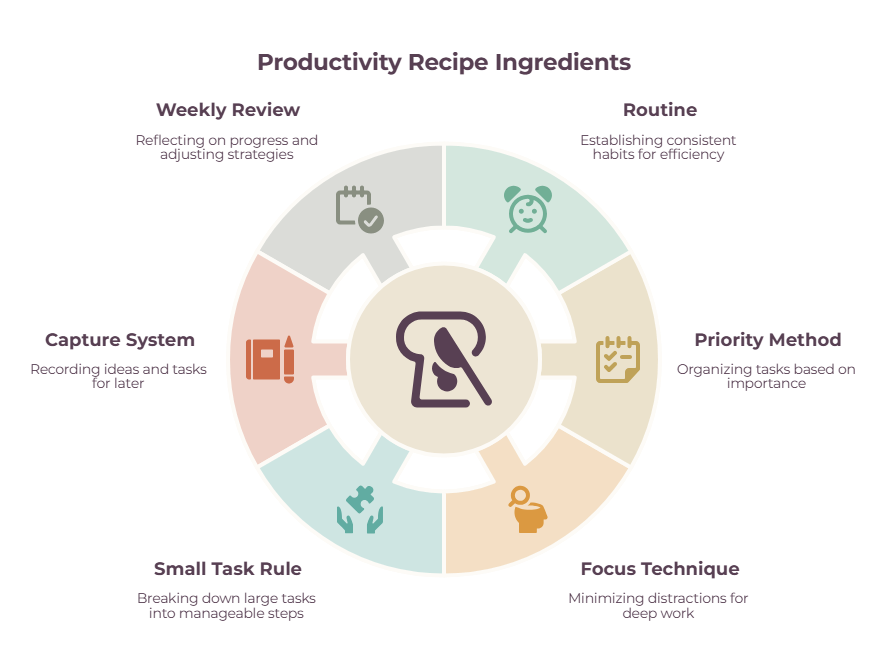
A productivity recipe is a personal, repeatable system built from a handful of productivity components — a routine, a priority method, a focus technique, a rule for small tasks, a capture system, and a weekly review — combined in a way that suits how you work. It’s the opposite of chasing one hack at a time.
The point is to build something that lasts instead of restarting every few weeks.
The reason single methods fail isn’t that they’re bad — it’s that no one method covers a whole working day.
The 1-3-5 rule tells you what to do but not when; time blocking tells you when but not how to start; the 2-minute rule gets you started but won’t run your week.
Combine the right few, though, and each covers the others’ gaps.
That combination is your recipe, and once it’s built, productivity stops being a daily battle of willpower and becomes something closer to routine.
The ingredients of a productivity recipe for freelancers

A productivity recipe is built from six core ingredients: a start-of-day routine, a priority method, a focus technique, a rule for small tasks, a capture system, and a weekly review. You don’t need all six — pick the ones that fix your particular problem, and add supporting pieces later.
Here’s each one and where to go deeper.
- A start-of-day routine. A consistent on-ramp — coffee, then plan the day — so you begin on purpose instead of drifting into your inbox. It matters most if you struggle to get going (see how to stay focused when working from home).
- A priority method. A way to decide what actually matters each day. The 1-3-5 rule — one big task, three medium, five small — is a simple, freelancer-friendly choice.
- A focus technique. A way to protect deep work. Time blocking puts your priorities on the calendar, which is the part that does the work — a meta-analysis of 94 tests found that spelling out the when, where and how of a task in advance had a medium-to-large effect on actually getting it done. Pomodoro (25 minutes on, 5 off) suits shorter bursts. Pick whichever keeps you off your phone.
Add rules for tasks, capture, and review
- A rule for small tasks. The 2-minute rule — do sub-two-minute jobs immediately, and start big ones with a two-minute opener — keeps admin from piling up and gets you past the resistance of starting.
- A capture system. Somewhere to put every idea, brief, and detail so nothing lives only in your head — unfinished tasks keep intruding on your attention until you make a plan for them, at which point the intrusions stop. A note-taking template gives you one findable home per client, project, and meeting.
- A weekly review. A fifteen-minute check to see what worked, what slipped, and what to adjust. This is the ingredient that keeps the recipe improving.
Two supporting pieces, once the core is running
These aren’t ingredients in their own right — they’re what the six sit inside.
- A tamed inbox. Email is most freelancers’ biggest distraction, so batching it into set times rather than living in it protects every other ingredient. Part of the cost isn’t the time spent reading it — attention stays stuck on the task you just left, so the next hour is worse too. See email management systems.
- The tools to hold it together. Your recipe needs a home — a to-do app, calendar, or all-in-one. Our roundups of productivity tools for freelancers and the best AI to-do list apps cover the options.
The method: how a productivity recipe runs in a day
The ingredients combine into a simple daily flow: run your start routine, set your priorities, protect a focus block for the big task, clear the small stuff around it, then shut down and review. The method is what turns a pile of techniques into an actual day.
A recipe is only as good as the order you cook it in.

A typical day on a freelancer’s recipe looks like this.
You start with your routine — a coffee and five minutes choosing your 1-3-5 priorities for the day.
You block your peak-energy hours for the one big task and start it with a two-minute opener so resistance doesn’t win.
The small admin gets batched into a slot rather than scattered through the morning, and email is checked at set times, not constantly.
Anything that comes up gets captured in your notes instead of derailing you.
At the end of the day, you shut down, note tomorrow’s priorities, and once a week you review what’s working. None of the individual pieces is complicated — the value is in having them run together, every day, without you having to decide from scratch.
Make it your own
There’s no single correct productivity recipe. Start with three ingredients that fix your biggest problem, run them for a couple of weeks, then keep what works and swap what doesn’t. A recipe you’ll actually follow beats a perfect one you abandon.
The customizing is the point, not a compromise.
The mistake most people make is trying to adopt an entire system overnight — someone’s elaborate morning ritual, five apps, three methods — and burning out on it within a week. Instead, diagnose your actual bottleneck.
If you can’t get started, begin with a routine and the 2-minute rule. If you’re busy but nothing important gets done, start with the 1-3-5 rule and time blocking. If things slip through the cracks, start with a capture system.
Add ingredients only once the first ones are automatic — and give that longer than you think. In a study tracking 96 people forming a new daily habit, the time to reach near-full automaticity ranged from 18 to 254 days.
Use your weekly review to notice what genuinely moves the needle for you rather than what looks impressive.
Your recipe should get simpler and more personal over time, not heavier.
Common productivity-recipe mistakes
The same few errors stop a productivity system from ever setting:
- Chasing hacks instead of building a system. Jumping to the next trend means you never let anything become a habit. Pick a few ingredients and stick with them long enough to judge.
- Adding too much at once. Ten new habits on Monday is a recipe for quitting by Friday. Start with three.
- Copying someone else’s recipe wholesale. What works for a 5am-rising YouTuber may not fit your energy, your clients, or your life. Steal ingredients, not the whole meal.
- Skipping the review. Without a weekly check, you can’t tell what’s working, so you keep doing things out of habit that aren’t helping. The review is what makes the recipe improve.
The takeaway
You were never one hack away from being productive — you were one system away. Treat productivity like a recipe: choose a few ingredients that suit how you work, combine them into a daily method, and adjust it over time with a weekly review.
Start with three, keep what earns its place, and you’ll finally have something that lasts longer than two weeks — a way of working that’s genuinely yours.
Frequently Asked Questions
What is a productivity recipe?
It’s a personal productivity system built from a handful of components — a routine, a way to set priorities, a focus technique, a rule for small tasks, a capture system, and a review — combined to suit how you work.
Rather than relying on one method, you mix the few that fix your specific problems into a system you can repeat.
How do I build my own productivity system?
Start by diagnosing your biggest bottleneck — starting, prioritizing, focusing, or losing track of things — and pick two or three ingredients that address it.
Run them for a couple of weeks, review what’s working, then keep the useful ones and swap the rest. Build up slowly rather than adopting a huge system overnight.
What should a freelancer’s daily routine include?
At minimum: a consistent start that gets you working on purpose, a moment to set the day’s priorities, a protected block for your most important task, set times for email and admin, and a short shutdown to plan tomorrow.
Add a weekly review to keep improving. Those pieces cover the whole day without being complicated.
What are the best productivity methods to combine?
A common, effective combination for freelancers is the 1-3-5 rule for priorities, time blocking to protect focus, and the 2-minute rule for small tasks and starting big ones — held together by a capture system and a weekly review.
They complement each other, covering what to do, when, and how to begin.
How do I make a productivity system that sticks?
Keep it small and personal. Start with three ingredients, attach them to routines you already have, and don’t add more until they’re automatic. Use a weekly review to cut anything that isn’t helping.
Systems fail when they’re too big or copied wholesale from someone else, so build the simplest version that fixes your problem and grow it slowly.
Related guides: the 1-3-5 rule · time blocking app · the 2-minute rule · note-taking template · productivity tools for freelancers