
The Ultimate Guide to Freelance Tax Deductions


Picture two freelancers who each earned $80,000 this year. One hands over thousands more to the IRS than the other — and it’s not because anyone cheated. It’s because one understood freelance tax deductions.
One tracked their deductions all year and claimed the home office, every business mile, and half of their self-employment tax. The other, spooked by vague audit fear and a shoebox of faded receipts, left most of it on the table.
That’s the quiet truth about freelance tax deductions: most freelancers don’t overpay because they deduct too aggressively. They overpay because they deduct too little.
Time for a reframe.
Tax deductions aren’t loopholes or grey-area tricks. They’re the tax code is working exactly as designed — the IRS fully expects you to subtract the cost of running your business before it taxes what’s left.
You just have to know which costs qualify and keep the paperwork to prove them.
This guide covers every tax deduction a US freelancer can legally claim in 2026, the freelancer-specific traps, what changed under the new tax law, and how to actually claim each one — with every figure sourced straight from the IRS.
Quick Takeaways
- A tax deduction lowers your taxable income. Freelancers claim most of theirs on Schedule C, plus a few valuable “above the line” ones.
- The deductions freelancers miss most: the home office, full mileage, the 50% self-employment tax deduction, QBI, and 100% of health insurance premiums.
- The rule behind all of them: an expense must be “ordinary and necessary” for your business, and you need records to back it up.
- New for 2026: the QBI deduction is now permanent at 20% (with a new $400 minimum), and the 1099 reporting threshold jumped from $600 to $2,000 — but untracked income is still fully taxable.
- Track your write-offs all year, not in a panic every April. A shoebox at filing time is where deductions go to die.
What can freelancers write off — and what makes an expense deductible?
Freelancers can deduct any expense that’s ordinary (common in your line of work) and necessary (helpful and appropriate for running the business) — from software to mileage to health insurance. Personal costs don’t qualify, and every deduction needs a record to back it up.
That “ordinary and necessary” standard is the IRS’s own language, and it’s the test every write-off has to pass.
Quick distinction: a deduction lowers the income you’re taxed on, while a credit lowers your tax bill directly. This guide is about deductions, which is where the bulk of freelancer savings live.
Most freelance deductions go on Schedule C, the form where you report your business income and expenses.
A few of the best ones — half of your self-employment tax, health insurance, and retirement contributions — are “above the line” adjustments that lower your income whether or not you itemize.
One habit makes all of this work: track expenses as they happen. Solid bookkeeping for the self-employed turns tax season from an archaeology dig into a five-minute export.
The biggest tax deductions for freelancers

The deductions with the most money in them — and the ones freelancers most often miss — are the self-employment tax deduction, the home office deduction, mileage, QBI, health insurance, and retirement contributions. Get these six right, and you’ve captured the majority of what you’re owed.
The self-employment tax deduction
You pay self-employment tax of 15.3% on your net earnings — 12.4% for Social Security and 2.9% for Medicare — because you’re both the employer and the employee.
The upside: you deduct half of that self-employment tax (the employer-equivalent portion) from your taxable income.
You don’t have to do anything clever to get it — it’s a built-in adjustment, calculated on Schedule SE and carried to Schedule 1. It won’t cut the self-employment tax itself, but it lowers your income tax, and it’s automatic once you file correctly.
The home office deduction
If you use part of your home regularly and exclusively for business, you can claim the home office deduction — and renters qualify just as much as homeowners. There are two ways to calculate it:
- Simplified method: $5 per square foot of office space, up to 300 square feet, for a maximum of $1,500. No math beyond measuring the room.
- Regular method: deduct the business-use percentage of your actual home costs — rent or mortgage interest, utilities, insurance, repairs — using Form 8829.
The trap freelancers fall into is “exclusive use.”
The space has to be used only for business — the kitchen table you also eat dinner at doesn’t count, but a spare room set up as your office does.
This is a legitimate, IRS-sanctioned deduction, not an audit magnet, so if you qualify, claim it. The details are in Publication 587.
Vehicle and mileage deductions

Business driving is deductible in one of two ways: the standard mileage rate, which is 72.5 cents per mile for 2026, or the actual expense method (gas, insurance, repairs, depreciation, apportioned to business use). Run both and take the bigger number.
Two rules matter.
Your commute doesn’t count — driving from home to a regular workplace is personal. And you need a contemporaneous log: date, miles, destination, and business purpose for each trip.
Mileage is one of the most valuable freelance tax deductions because it reduces both your income tax and your self-employment tax.
The QBI deduction (updated for 2026)
Most freelancers can deduct up to 20% of their qualified business income (QBI) on top of their other deductions — and for 2026, this deduction is now permanent.
The One Big Beautiful Bill Act made the QBI deduction permanent at 20% (despite a proposal to raise it to 23%, which didn’t become law) and added a new $400 minimum deduction from 2026 for active freelancers with at least $1,000 of qualified business income.
For most freelancers, the math is simple.
20% of your business profit comes from your taxable income. Above roughly $75,000 in taxable income if you’re single (or $150,000 married filing jointly), “specified service” rules can start to limit it for consultants, creatives, and similar fields — but below those thresholds, you generally get the full 20%.
You claim it on Form 8995.
Self-employed health insurance
If you’re self-employed and not eligible for coverage through an employer or a spouse’s plan, you can deduct 100% of the health, dental, and qualifying long-term-care insurance premiums you pay for yourself, your spouse, and your dependents.

It’s an above-the-line deduction on Schedule 1, so you get it even without itemizing.
The main limit is that the deduction can’t exceed your business’s net profit — you can’t use it to create a loss.
For many freelancers buying their own marketplace coverage, this is one of the single largest write-offs available. (See the Self-Employed Individuals Tax Center for the current rules.)
Retirement contributions
Saving for retirement is one of the few ways to lower this year’s tax bill while paying for your future self. A SEP-IRA lets you contribute up to 25% of your net self-employment earnings, up to $72,000 for 2026, and every dollar is deductible.
A solo 401(k) is the other main option and can let you contribute more at lower income levels, thanks to the employee deferral of $24,500 for 2026 on top of the employer share.
Both reduce your taxable income now, which makes them a rare deduction that also builds real wealth. Pick based on how much you want to contribute and how simple you need it to be.
Common freelance business expenses you can deduct
Beyond the big six, the everyday costs of running your business are deductible on Schedule C — software, supplies, marketing, a business-use share of your phone and internet, professional services, and more. Here’s the working list freelancers use most.
| Deduction | What it covers | Notes / where to claim |
| Software & subscriptions | Design, accounting, hosting, and other SaaS tools | 100% if business-use |
| Office supplies & equipment | Supplies; gear is often expensed in full | Schedule C / Section 179 |
| Advertising & marketing | Ads, website, portfolio, email tools | 100% |
| Phone & internet | The business-use percentage only | Split personal vs business |
| Professional services | Legal, accounting, and contractors you hire | 100% |
| Business insurance | Liability, professional indemnity | 100% |
| Bank & merchant fees | Business account fees, Stripe/PayPal cuts | 100% |
| Education & training | Courses that maintain or improve current skills | Not new-career training |
| Business travel | Flights, lodging, and ground transport | 100% (travel) |
| Business meals | Meals with a genuine business purpose | 50% (Pub 463) |
| Startup costs | Costs before you launched | Up to $5,000 in year one |
| Home office | See the section above | Simplified or regular method |
A note on startup costs: you can deduct up to $5,000 in your first year of business, with the rest amortized over 180 months (that first-year amount phases out if your startup costs top $50,000).
And the fastest way to keep this whole table organized is accounting software for freelancers, which maps each expense to the right Schedule C line as you go.
What the new tax law (2026) changed for freelancers
The One Big Beautiful Bill Act, signed in July 2025, made three changes freelancers should know about for 2026: the QBI deduction is now permanent at 20% with a $400 minimum, 100% first-year bonus depreciation is back for equipment, and the 1099-NEC reporting threshold rose from $600 to $2,000.
- QBI is permanent. No more wondering if the 20% deduction expires — it’s locked in, with a guaranteed $400 minimum for active freelancers.
- 100% bonus depreciation returned. Qualifying equipment placed in service after January 19, 2025, can be fully deducted in year one instead of being spread over several years.
- The 1099 threshold jumped to $2,000. Clients now only have to issue a 1099-NEC for payments of $2,000 or more (up from $600).
Myth-buster: that higher 1099 threshold means you may receive fewer 1099 forms — but it does not make that income tax-free. You still owe tax on every dollar you earn, and you’re still required to report it, 1099 or not. Fewer forms, same obligation.
What you can’t deduct as a freelancer
The fastest way to invite an audit is to deduct personal costs as business ones. You can’t write off your commute, everyday clothing, personal meals, the personal share of a mixed-use phone or car, or a “home office” that isn’t used exclusively for work. Knowing the limits protects you as much as knowing the deductions.

- Commuting — driving between home and a regular work location is personal, not deductible.
- Everyday clothing — even if you bought it specifically for client meetings, if you can wear it in normal life, it’s not deductible. (Genuine uniforms or protective gear are different.)
- The personal portion of your phone, internet, or vehicle — only the business-use percentage counts.
- Personal meals — and even qualifying business meals are only 50% deductible, not 100%.
- A non-exclusive home office — if the space doubles as your dining room or guest bedroom, it doesn’t qualify.
- Anything you can’t document — no receipt, no log, no deduction if you’re ever asked to prove it.
The honest rule of thumb: if you couldn’t explain the expense to an IRS agent with a straight face and a receipt in hand, don’t deduct it.
How to claim freelance tax deductions (forms and records)
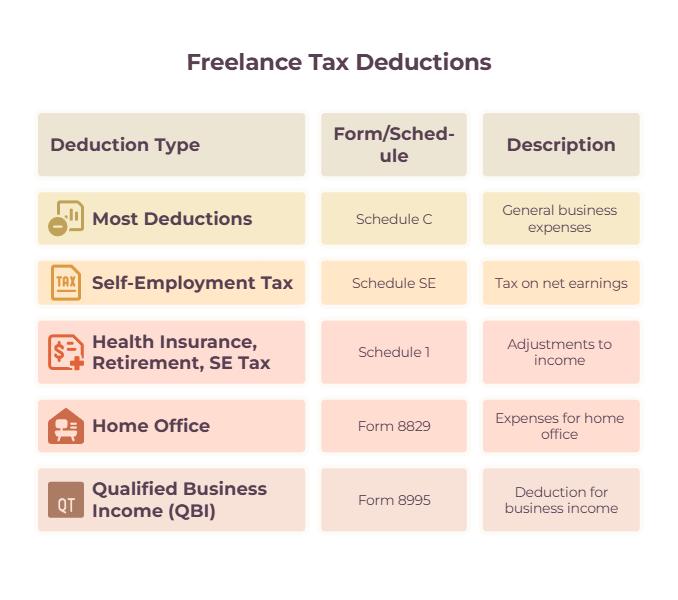
Most freelance deductions go on Schedule C; self-employment tax on Schedule SE; health insurance, retirement, and half your SE tax as adjustments on Schedule 1; the home office on Form 8829; and QBI on Form 8995. Keep the receipts and mileage logs that back every one of them.
The workflow that makes this painless is year-round, not April-only: track income and expenses as they happen with bookkeeping for self-employed habits and accounting software for freelancers, and hold onto your records for at least three years, which is the IRS’s general guideline.
One last piece: deductions lower what you owe, but they don’t erase it. Because no one withholds tax for you, pair your deductions with a disciplined 25–30% tax set-aside so quarterly estimated taxes never blindside you — our guides to cash flow management tools for freelancers and freelance cash flow problems cover exactly how to build that habit.
Get the deductions right and the set-aside right, and you stop overpaying and stop getting surprised — which is the whole game.
Frequently Asked Questions
What can freelancers write off on their taxes?
Freelancers can write off ordinary and necessary business costs: home office, business mileage, software and subscriptions, a business-use share of phone and internet, professional services, business insurance, advertising, travel, half of their self-employment tax, health insurance premiums, and retirement contributions.
Most go on Schedule C; a few are above-the-line adjustments.
How much can I deduct for a home office?
Two ways. The simplified method gives you $5 per square foot up to 300 square feet, for a maximum of $1,500.
The regular method lets you deduct the business-use percentage of your actual home costs (rent or mortgage interest, utilities, insurance, repairs) using Form 8829. The space must be used regularly and exclusively for business.
Can I deduct my phone, internet, and laptop?
Yes, but only the business-use portion. If your phone is 70% business, you deduct 70% of the bill. A laptop used entirely for work is fully deductible (and often expensed in the year you buy it); one you also use personally is deductible only for the business share.
Do freelancers qualify for the QBI deduction in 2026?
Most do. The qualified business income (QBI) deduction lets eligible freelancers deduct up to 20% of their business profit, and for 2026, it’s permanent with a guaranteed $400 minimum for active freelancers.
Above about $75,000 taxable income (single) or $150,000 (married filing jointly), limits can apply to certain service businesses.
Are business meals 50% or 100% deductible?
Business meals with a genuine business purpose are 50% deductible. The temporary 100% deduction for restaurant meals expired after 2022, so it’s back to 50%. Keep a note of who you met and why, and hold onto the receipt.
Do I still owe tax if I didn’t get a 1099?
Yes. Starting in 2026, clients only have to send a 1099-NEC for payments of $2,000 or more, so you may get fewer forms — but all of your income is still taxable, and you’re still required to report it.
Whether or not a 1099 arrives has no effect on what you owe.
Can I deduct health insurance if I’m self-employed?
Yes. If you’re self-employed and not eligible for an employer or spouse’s plan, you can generally deduct 100% of your health, dental, and qualifying long-term-care premiums for yourself, your spouse, and dependents as an above-the-line deduction, up to your business’s net profit.
Related guides: accounting software for freelancers · bookkeeping for self employed · cash flow management tools · cash flow problems