
How to Best Solve Cash Flow Problems (8 Causes & Fixes)

Not sure whether you’re facing cash flow problems or simply not earning enough?
You had three solid projects this quarter. You’ve barely closed the laptop. And somehow, it’s the 28th and the account is nearly empty again — so you’re sitting there quietly wondering whether you’re just bad with money.
You’re not. You have a cash flow problem, and that’s a completely different thing.
A cash flow problem is a handful of specific, nameable leaks between the money you’re owed and the money actually in your hand — and every one of them has a fix.
It usually has very little to do with how much you earn; plenty of broke freelancers out-earn comfortable ones. It comes down to timing and a few predictable holes in the bucket.
This guide names every common freelance cash flow problem, shows you the warning signs, and hands you the exact fix for each — so you can figure out which one is yours and stop it.
Quick Takeaways
- A cash flow problem isn’t about how much you earn — it’s about timing: money you’re owed versus money in the account the day a bill is due.
- Profit and cash are not the same thing. You can finish a great month on paper and still not make rent, because a Net-60 invoice is “earned” but not paid.
- The freelance-specific causes are a short list: late-paying clients, irregular income, the tax surprise, no cash reserve, underpricing, over-reliance on one client, and scope creep.
- The tell that you already have one: paying regular bills on a credit card, dipping into savings, or spending money you know belongs to next month.
- Every cause has a fix. Diagnose yours with the triage table below, then take the single next step for it.
What are cash flow problems — and why can you be profitable but broke?

A cash flow problem is a timing gap: your outgoings — rent, tax, software, subcontractors — fall due before your income actually lands, so you come up short even when the work itself is profitable. Profit is a number on paper. Cash flow is what’s in the bank today.
Here’s the trap.
You finish a $9,000 project in June with $3,500 of costs, so on paper, you made $5,500.
But the client pays on Net 60, so the cash doesn’t arrive until August — and in June, your balance actually drops while your profit-and-loss statement says you’re winning.
Busy, profitable, and broke, all at once.
That’s the difference between profit and cash, and it’s the root of nearly every problem below.
If you want the deeper breakdown plus the account system that fixes it, our guide to cash flow management tools for freelancers covers it in full. This guide is about diagnosing which leak is draining you. Here, we’ll keep talking about the problems and how to fix them.
What are the warning signs of cash flow problems?
The clearest signs aren’t in a spreadsheet — they’re in your behavior: paying regular bills on a credit card, dipping into personal savings to cover business costs, being unable to set aside anything for tax, or routinely spending money you know is meant for next month.
If any of these are familiar, you don’t have a discipline problem — you have a cash flow problem.
Run down this list honestly:
- You’re always broke right after a good month. The profit is real, but it never reaches the account when you need it.
- Bills get paid with credit that you’d normally cover from cash on hand.
- Tax money never gets set aside, so the quarterly bill becomes a mini-crisis every time.
- Savings — or next month’s money — keeps getting raided just to get through this one.
- Invoices turn into a waiting game, and your ability to pay your own bills depends on a client’s accounts team.
- You genuinely don’t know what’ll be in the account four weeks from now.
If two or more of those land, you have a cash flow problem, or more importantly, a fixable cash flow problem.
What causes cash flow problems for freelancers?

Most freelance cash flow problems trace back to one of eight causes — late-paying clients, irregular income, unfunded taxes, no cash reserve, underpricing, one-client dependency, scope creep, and mixed personal and business finances — and each has a concrete fix.
Find yours below.
Late-paying clients
This is the obvious one, and it’s nearly universal. Remote’s 2025 late payment report found 85% of freelancers are paid late at least some of the time, and just over 1 in 5 are paid late more than half the time.
A 2026 Jobbers report put the average gap from invoice to money-in-hand at 39 days.
The fix is to make late payment harder and less costly: take a deposit before you start, bill on Net 15 instead of Net 30, turn on automatic reminders, and put a late fee in the contract. Our guide on how to invoice as a freelancer walks through the whole setup.
Irregular, feast-or-famine income
When income swings wildly month to month, budgeting on your average month quietly assumes the busy ones keep coming. They don’t.
The fix is to budget on your lowest reliable month and treat feast months as a chance to top up your buffer, not raise your baseline. A simple forecast makes the lean months visible in advance — our cash flow projection template is built for exactly this.
The quarterly tax surprise
Nobody withholds tax for you, and self-employment tax alone is 15.3% of your net earnings — 12.4% Social Security plus 2.9% Medicare — before income tax even enters the picture. Spend that money during the year, and the quarterly bill feels like a mugging.
The fix is pretty boring, but bulletproof: move 25–30% of every payment into a separate tax account the moment it lands (push toward 30–35% if you earn above roughly $80,000 or live in a high-tax state).
If it’s not in your spending account, you can’t accidentally spend it.
No cash reserve or buffer
With no cushion, a single late invoice or slow month turns straight into a crisis, because there’s nothing to absorb the shock.
The fix is a buffer built in stages: aim for one month of expenses first, then three, then six — plus a separate one- to two-month cushion earmarked specifically for late-paying clients.

Underpricing (the quiet root cause)
This is the one nobody wants to hear, and the one that fixes the most. If your rates are too low, even fully booked weeks won’t cover your real costs — and no amount of budgeting rescues a business that’s priced below what it costs to run.
The fix is to raise your rates and price for the whole cost of doing business: taxes, unpaid admin time, downtime between projects, software, and a profit margin on top.
If your numbers only work when every hour is billable and every client pays on time, they don’t actually work.
Over-reliance on one client
When one client accounts for most of your income, their single late payment — or their decision to pause the work — takes your whole month with it. That’s not a cash flow wobble; that’s your entire runway resting on someone else’s calendar.
The fix is to diversify. A common rule of thumb is to keep any one client under about 25–30% of your income, and to keep two to four active clients plus a live pipeline, so one gap never sinks the month.
Scope creep and unbilled work
The project quietly grows — “just one more tweak,” a few extra rounds, a favor that turns into a fortnight — and none of it makes it onto an invoice. You’re doing real work for free, which drains cash exactly like a discount you never agreed to.
The fix is to define scope clearly in the contract, cap revisions, charge for change requests, and capture every billable hour instead of eating the overflow. Good bookkeeping for self-employed habits makes the leak visible in the first place.
Mixing personal and business money
When your business and personal spending share one account, you can’t actually see your cash position — the buffer, the tax set-aside, and any forecast all become guesswork.
The fix is a separate business bank account and card. It’s the unglamorous move that makes every other fix on this list possible, and it takes an afternoon. Pair it with accounting software for freelancers, and you finally get a real-time picture.
Which cash flow problem do you have? (quick triage)
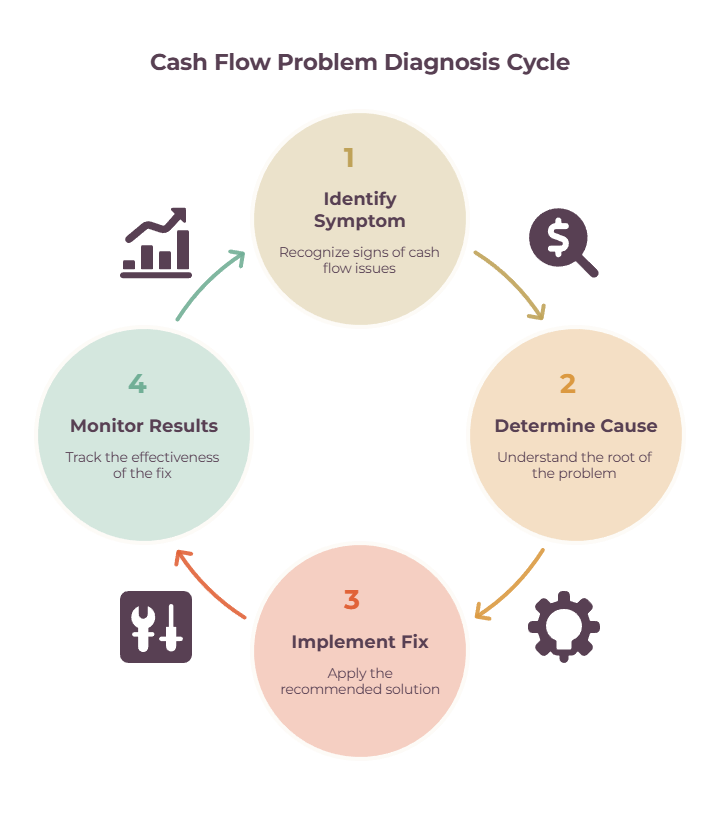
Match your symptom to its cause and take the first fix — you rarely have all eight cash flow problems at once, so start with the one that fits. Here’s the whole diagnostic on one page:
| If this is your situation… | The likely problem | The first fix | Start here |
| Busy, but always waiting on invoices | Late-paying clients | Deposits + Net 15 terms | Invoicing guide |
| Great months, then broke months | Irregular income | Budget on your lowest reliable month | Projection template |
| The tax bill blindsides you | Unfunded taxes | 25–30% set-aside line | Cash flow tools |
| One hiccup empties the month | No cash reserve | Build a 3-month buffer | Cash flow tools |
| Full weeks still don’t cover the bills | Underpricing | Raise your rates | — |
| One client is most of your income | Client concentration | Diversify the roster | — |
| Doing work you never billed for | Scope creep | Contract + change fees | Invoicing guide |
| No clear picture of your numbers | Mixed finances | Separate business account | Bookkeeping guide |
How do you fix cash flow problems fast when you’re short right now?
In an immediate crunch, pull all three levers at once: speed money in, slow money out, and get visibility on the gap. These buy you time — the causes above are the actual cure.
➡️ Speed money in.
Invoice everything you’ve done but haven’t billed — today, not on your usual billing day. Chase every overdue invoice with a direct, friendly nudge.
For a client who can pay now, a small early-payment discount (say, 2% for paying within a week) can pull cash forward when you need it most.
➡️ Slow money out.
Defer any non-essential spending — that software upgrade, the new gear — until the gap closes. Ask suppliers or subcontractors for a little more time; most would rather wait a week than chase you.
➡️ Get visibility.
Map the next four weeks: what’s coming in, when it’ll realistically land, and what’s due. You can’t manage a gap you can’t see, and mapping it usually shrinks the panic to a specific, solvable number.
A line of credit can bridge a genuine short-term gap, but treat it as a band-aid, not a cure — it’s easy to lean on, freelancers often struggle to qualify, and it does nothing about the leak that caused the crunch.
How to prevent cash flow problems as a freelancer
The durable fix is a simple system: separate accounts, tax set aside before you can touch it, a fixed salary paid to yourself from a buffer, and a rolling forecast so problems surface weeks early instead of on the due date.

Build it once, and most of the month-to-month panic just disappears.
You don’t have to set it all up at once.
Open the separate tax account this week and start moving 25–30% of every payment into it — that single habit kills the most common freelancer cash flow disaster.
From there, add the buffer, pick a salary number, and get a forecast going. If you want to automate that instead of updating a spreadsheet manually, cash flow forecasting software can keep those projections current as your income and expenses change.
For the automated version of the whole system, see our roundup of cash flow management tools for freelancers; to see the lean months coming before they arrive, grab the cash flow projection template.
Cash flow problems feel like a character flaw. They’re really just a missing system — and a system is a lot easier to build than a personality.
Frequently Asked Questions
What are the most common cash flow problems for freelancers?
The most common are late-paying clients, irregular feast-or-famine income, unfunded quarterly taxes, and having no cash reserve.
Underneath those, underpricing and over-reliance on a single client are frequent root causes — they make every other problem hit harder.
Why am I profitable but always broke?
Because profit and cash are different things. Profit is what you’ve earned on paper; cash flow is what’s actually in your account.
If a profitable project is invoiced on Net 30 or Net 60, the work is “done” and “earned” long before the money arrives — so you can be genuinely profitable and still unable to pay this month’s bills.
What are the warning signs of a cash flow problem?
Paying regular bills with a credit card, dipping into personal savings to cover business costs, being unable to set aside money for tax, chasing invoices to make rent, and not knowing what will be in your account a month from now.
Two or more of these usually mean a system problem, not a spending one.
How much cash reserve should a freelancer have?
Start with one month of expenses, then build toward three, and ideally six. On top of that, keep a separate one- to two-month buffer specifically to absorb late client payments, since those are the most predictable cause of a sudden shortfall.
Can too much work cause cash flow problems?
Yes. Taking on more work often means more upfront costs — subcontractors, tools, time — before the resulting invoices are paid, so a busy stretch can actually tighten your cash before it loosens it. Deposits and shorter payment terms help close that gap.
How do I fix cash flow problems fast?
Pull three levers at once: speed money in (invoice everything unbilled today and chase overdue payments), slow money out (defer non-urgent spending and ask suppliers for terms), and map the next four weeks, so you know the real size of the gap.
Then fix the underlying cause so it doesn’t come back.
Related guides: accounting software for freelancers · bookkeeping for self employed · how to invoice as a freelancer · cash flow projection template · cash flow forecasting software