How to Maintain a Steady Workflow as a Solo Freelancer

Last month, you were slammed. You said yes to everything, worked two weekends, and delivered late anyway. This month, your inbox is silent. You’re refreshing it every ten minutes, quietly doing the math on your savings, and wondering if you’re bad at this. If you’ve ever wondered how to maintain a steady workflow as a solo freelancer, you’ve probably lived both extremes.
Same freelancer. Opposite problems. Same root cause.
Solo freelancing swings between feast and famine because you’re the entire company — sales, delivery, and admin, all at once — and when delivery fills your week, sales quietly stop. So the pipeline dries up right as your current work wraps, and the cycle repeats.
However, a steady workflow isn’t luck, and it isn’t about being more disciplined than everyone else. It’s two systems running quietly in the background: one that keeps work coming in, and one that keeps you delivering it sustainably.
Build both, and the roller-coaster flattens into a rhythm.
To maintain a steady workflow as a solo freelancer, run those two systems. Keep work coming in — market about 10% of your week even when you’re busy, add retainers, and set project minimums.
And build a steady way of working — plan your real capacity, leave a weekly buffer, systemize the repeatable, and batch similar tasks. Here’s how to do both, with a real example for each.
Quick Takeaways
- A steady workflow needs two systems: work coming in (your pipeline) and a steady way of doing it (your execution).
- Never stop marketing — spend about 10% of your week on it even when booked, or today’s full calendar becomes next month’s empty one.
- Plan your real capacity — most freelancers count only the “doing the work” hours, forget the revisions, calls, and admin, then overcommit.
- Leave a buffer — keeping roughly 15% of your week unbooked makes you more reliable, not less.
- Systemize the repeatable — templates and batching turn chaos into a rhythm and free up hours every week.
Why solo freelance work swings between feast and famine

Solo work is lumpy because you’re the whole company — and when delivery fills your week, the selling stops, so the pipeline dries up exactly as your current projects end. No team absorbs the peaks, and no manager keeps the leads coming. It’s the cycle, not you.
And it isn’t in your head, either.
JPMorgan Chase Institute research, drawn from the real checking accounts of millions of families, found that self-employed workers experience monthly income swings roughly twice as large as salaried employees.
The volatility is baked into the model — which means the fix has to be structural too, not a matter of trying harder.
The trap is subtle, but it looks like this.
You land a big project, you go heads-down to deliver it, and pitching, follow-ups, and marketing fall off the calendar because there’s no time.
Three or four weeks later, the project ships — and you look up to an empty pipeline you stopped feeding a month ago. Then you scramble, land work, go heads-down again, and repeat.
There’s a second, quieter version of the same problem inside your week: you plan the hours you’ll spend doing the work and let everything else — the calls, the revisions, the admin — “fit in.”
It never fits in.
It expands, you overcommit, and a good month on paper becomes a burnout month in practice. Fixing both is what the rest of this guide is about, and it splits cleanly into two parts.
Part 1: Keep a steady stream of work coming in

The first system keeps your pipeline full, so you’re never staring at an empty inbox — mostly by refusing to stop selling just because you’re busy. These four habits do most of the work.
Never stop marketing (the 10% rule)
Spend about 10% of your weekly working time on marketing and outreach even when you’re fully booked — because today’s packed calendar creates next month’s empty one if you go dark.
A rough tenth of your week, protected no matter what, keeps the pipeline alive.
In practice, that’s a recurring weekly block — a few hours — for pitching, following up with past clients, posting something useful, or asking for referrals.
It feels unnecessary when you’re slammed, which is exactly when it matters most, because the leads you generate now are the work you’ll deliver a month from now.
The example: the freelancer who stops pitching the second they get busy, delivers a great project for four weeks, then falls off a cliff when it ends, and there’s nothing behind it. The 10% rule is the guardrail against that cliff.
Build recurring revenue with retainers
Monthly retainers turn lumpy, unpredictable project income into a steady baseline you can count on. A few clients paying a fixed amount each month are the closest a freelancer gets to a salary.
Offer your best, ongoing clients a set monthly scope — a number of hours, deliverables, or a support arrangement — for a fixed fee. Aim for a mix: a couple of retainers as your floor, with project work stacked on top. Even two or three modest retainers change how a slow month feels.
The example: the freelancer whose income lurches from £6,000 one month to £900 the next, versus the one with three £1,500 retainers who knows £4,500 is landing before a single project invoice goes out.
Set minimums and learn to say no
Small one-off rush jobs create busy weeks with no lasting stability, so set a project minimum and decline the work that fuels the chaos. Every yes to a bad-fit job is a no to the pipeline and the buffer that keep you steady.
Decide on a minimum project size, and get comfortable turning down the things that quietly wreck your rhythm: 24/7-access clients, unrealistic rush timelines, and budgets that demand impossible hours. Saying no isn’t arrogance — it’s the lever that keeps a solo business from collapsing under its own weight.
The example: the “quick favor” project — barely any money, endless little changes — that eats a whole week you needed for a proper client. A minimum would have filtered it out before it started.
Keep a buffer that lets you say no
A three-to-six-month cash buffer is what makes steady decisions possible — it lets you ride out slow spells and turn down bad-fit work without panic. Without one, every lull becomes an emergency, and you take any job at any price just to survive it, which keeps you stuck in the cycle.
Most people are nowhere near this. The JPMorgan Chase Institute found that most families lack even six weeks of income in liquid savings — enough to absorb one bad month where income dips and an unexpected expense lands at the same time.
Freelancers hit those months far more often than salaried workers do, which is exactly why the cushion matters more for us, not less.
You don’t need the full buffer overnight; build it in stages. The point here isn’t the money mechanics — it’s that a cushion buys you the leverage to hold your standards.
For how to build and protect that buffer, plus the whole money side of feast-or-famine, see our guide to cash flow problems for freelancers.
Part 2: Build a steady way of doing the work

The second system is how you actually execute — planning realistically, protecting slack, and systemizing the repeatable so a full week doesn’t become a burnout week. This is where most freelancers quietly break.
Plan your real capacity (the three buckets)
Split your week into three buckets — billable work, communication and revisions, and admin and everything else — and plan all three, because the middle bucket always expands and eats the last one.
Most freelancers plan only the billable hours and let the rest fit in; it doesn’t.
Before you commit to a project, honestly estimate all three: the hours actually delivering, the hours of calls, feedback rounds, and handoffs around it, and the ongoing admin, marketing, and rest that keep your business alive.
Only commit billable hours that fit alongside the other two. When the communication bucket balloons and you’ve planned nothing for it, the rest gets sacrificed — and you burn out even when revenue looks fine.
There’s a name for why your estimates keep coming up short: the planning fallacy.
In a series of studies, Buehler, Griffin and Ross found that people systematically underestimate how long their own tasks will take — and, crucially, keep doing it even when they can clearly remember the last time the same task overran.
You aren’t going to out-discipline that. The only reliable fix is to stop estimating the work in isolation and plan the other two buckets explicitly.
The example: quoting a “10-hour” website and forgetting the six hours of kickoff calls, three rounds of tweaks, and endless little emails wrapped around it — so a 10-hour job quietly becomes a 16-hour one you didn’t price or plan for.
Leave a buffer (about 15% of your week)
Keep roughly 15% of your week unbooked, so you can absorb a delay or an urgent change without a domino effect — counterintuitively, the slack makes you more reliable, not less. A calendar booked to 100% has no room to flex, and freelance work always needs room to flex.
Simply don’t schedule every hour. Leave a genuine gap, and treat it as protected, not as “extra capacity to fill.” When a client comes back late with feedback or something urgent lands, that buffer absorbs it instead of pushing three other deadlines off a cliff.
The example: the fully-booked week where one client delays their feedback by two days — and because there was no slack, everything behind it slips, and you end up apologizing to three clients for one client’s delay.
Block your anchors first

Put your non-negotiables — family time, exercise, a hard stop each day — into the calendar before any client work, so your business fits around your life instead of swallowing it. What you schedule first is what actually survives a busy week.
Identify the anchors that keep you functioning and block them first. Then fit client work into what’s left. It sounds backward, but freelancers who last do it this way, because “I’ll get to it when things calm down” is a promise that never comes due — things never calm down on their own.
The example: the freelancer who says “I’ll start exercising again once this busy patch ends” and, two years later, has never once had a patch quiet enough to start.
Systemize the repeatable (templates and SOPs)
Turn the things you do for every project — proposals, onboarding, invoicing, your core delivery steps — into reusable templates and simple checklists, so you’re not reinventing the wheel and mental energy every time.
Freelancers routinely reclaim several hours a week this way, and the work comes out more consistent, too.
Start with whatever you rebuild most often. Save a proposal template, a client welcome email, an invoice format, and a short checklist for your main workflow. Each one removes a decision and a chunk of admin from every future project, which is exactly the friction that makes a busy week feel chaotic.
The example: writing the same “here’s how we’ll work together” onboarding email and rebuilding the same proposal from scratch for every new client — versus filling in a template in five minutes and getting back to real work.
Batch similar tasks

Cluster similar work — admin, calls, deep focus — into dedicated blocks or days instead of scattering it across the week, so you’re not constantly paying the cost of switching between different kinds of work. A rhythm of themed blocks beats a day of fragments.
And it is a real cost, not a vibe.
Harvard Business Review’s study of 137 workers across three Fortune 500 companies found they toggled between apps and windows around 1,200 times a day, losing just under four hours a week — about 9% of their working time — purely to reorienting themselves after each switch.
Try an admin block (invoices, email, expenses) rather than doing those things reactively all day, a calls window instead of meetings sprinkled everywhere, and protected deep-work mornings for the demanding creative work.
Batching keeps each type of task in its lane and your brain in one mode at a time.
The example: handling invoices and email five separate times a day, never fully in either mode, versus one focused admin hour that clears the lot.
Pace to your energy
Match your hardest work to your best hours and accept that you have a finite number of good ones each day — a steady, sustainable pace beats heroic bursts that leave you wrecked. Fighting your own rhythm is a losing game.
Notice when you’re sharpest — for many people, it’s the morning — and guard that window for demanding work, leaving admin and email for the low-energy troughs. Don’t try to grind a 10-hour day; the last few hours are slow, error-prone, and borrow against tomorrow.
Guarding that window matters more than it sounds, because getting knocked out of it is expensive. Gloria Mark’s research at UC Irvine found that it takes an average of 23 minutes to fully return to a task after an interruption.
A protected deep-work morning isn’t a luxury — it’s the only condition under which your best hours actually produce your best work.
For the focus side of this, see how to stay focused when working from home.
The example: forcing yourself to tackle the big creative task at 4 pm when your focus checked out at 2 — and doing in three miserable hours what your morning brain would have done in one.
What a steady freelance week actually looks like

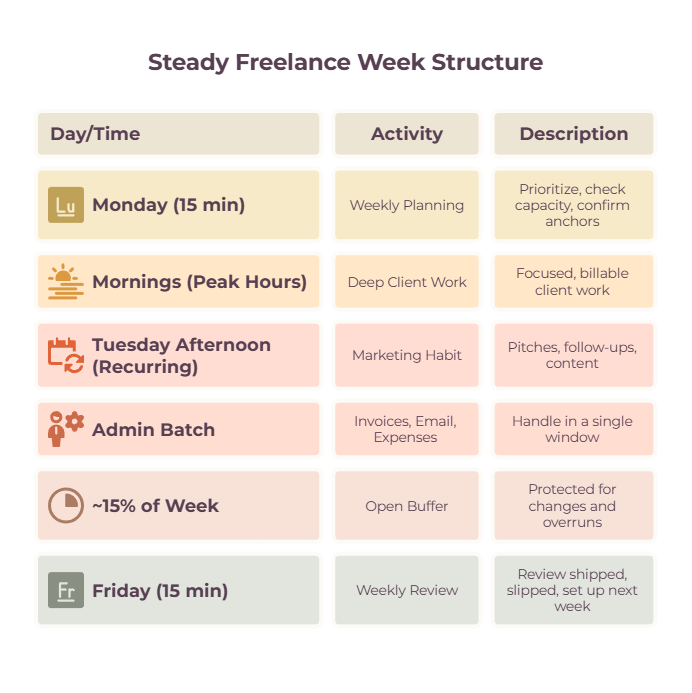
Put the two systems together, and a steady week has a clear shape: anchors blocked first, deep work in your peak hours, a recurring marketing block, an admin batch, and about 15% left open — bookended by a short weekly plan and review. Here’s one version.
🔵 Monday, 15 minutes: plan the week. Pick your priorities, check your capacity across the three buckets, and confirm your anchors are in.
🟢 Mornings (peak hours): deep, billable client work in focused blocks.
🟡 A recurring block (say, Tuesday afternoon): the 10% marketing habit — pitches, follow-ups, referrals, content.
🟠 One admin batch: invoices, email, and expenses handled in a single window rather than all day.
🔴 ~15% of the week is left open: the buffer, protected for changes and overruns.
➡️ Friday, 15 minutes: review what shipped, what slipped, and set up next week.
You don’t need to build all of this at once. Add one piece — start with the Monday plan and the marketing block — and layer the rest in over a few weeks.
What to do when your workflow slips
You’ll still have slow weeks and slammed ones — the systems are what pull you back to steady, so treat a slow week as pipeline-and-rest time, and a slammed week as a signal to protect your buffer, not torch it. The goal was never a perfectly flat line; it’s a rhythm you can recover.
When it’s slow, don’t spiral. A quiet week is exactly what the 10% marketing habit is for — pour the extra time into filling the pipeline, building the templates you’ve been meaning to make, and actually resting, guilt-free. Slow weeks are when next month’s steady work gets planted.
When it’s slammed, don’t rescue this week by wrecking next week. Protect your anchors and your buffer, communicate timelines with clients early and honestly rather than silently working weekends, and resist raiding the pipeline time and rest that keep you steady. The busy week ends; the systems that carry you through it shouldn’t.
The bottom line
You can’t control every high and low of freelance life, but you can build the two systems that flatten them: one that keeps work flowing in, and one that protects how you work. Start this week with the 10% marketing habit and a fifteen-minute Monday plan, add capacity planning next, and layer in the rest. Do that, and the roller-coaster slowly becomes a rhythm you can actually sustain.
Frequently Asked Questions
How do I keep a consistent workflow as a freelancer?
Run two systems: keep work coming in by marketing about 10% of your week even when busy, adding retainers, and setting minimums; and keep a steady way of working by planning your real capacity, leaving a weekly buffer, and systemizing repeatable tasks with templates. Consistency comes from the systems, not from willpower.
How do freelancers avoid the feast or famine cycle?
By never stopping marketing when they’re busy — the feast phase is exactly when the next famine gets created if you go dark. Adding recurring revenue through retainers, diversifying clients, setting project minimums, and keeping a cash buffer all smooth the peaks and troughs into a steadier baseline.
How much of my week should I spend on marketing?
A common rule of thumb is about 10% of your working time, kept up consistently even when you’re fully booked. That’s roughly a half-day a week on pitching, follow-ups, referrals, and visibility — enough to keep the pipeline alive so today’s full calendar doesn’t become next month’s empty one.
How do I plan my capacity as a solo freelancer?
Split your week into three buckets — billable work, communication and revisions, and admin and everything else — and plan all three, not just the billable hours. The communication bucket is chronically underestimated, so only commit the client hours you can genuinely fit alongside the other two, and leave some slack.
How do I stop overcommitting and burning out?
Plan your real capacity (all three buckets), leave about 15% of your week unbooked as a buffer, block your personal anchors before client work, and get comfortable saying no to bad-fit projects. Burnout usually comes from planning only the work hours and letting everything else pile on top.
What systems should a solo freelancer have?
At minimum: a recurring marketing habit to keep the pipeline full, capacity planning so you don’t overcommit, reusable templates for proposals, onboarding, and invoices, and a simple weekly plan-and-review. These four turn the chaos of doing everything yourself into a repeatable rhythm.
Related guides: productivity tools for freelancers · how to stay focused when working from home · cash flow problems for freelancers · time management for freelancers · freelance workflow management tools