How to Invoice as a Freelancer: Actually Get Paid on Time
The Quick Version on How to Invoice as a Freelancer
Want the gist before the full guide? How to invoice as a freelancer?
- Send the invoice the same day you deliver the work — every day’s delay is another day unpaid
- Use a specific due date (“Due by April 22, 2026”), not “Net 30”
- Default to 14-day terms for established clients, 7-day or Due on Receipt for new ones
- Require a 25–50% deposit on any project over $1,000
- Send via an online payment link, not a PDF — link recipients pay up to 2x faster
- Add a 1.5%/month late fee clause to your contract (you may never charge it; it still works)
- Set automated reminders before the due date, on it, and a few days after
Sending your first invoice feels weirdly stressful.
You did the work. You earned the money. But somehow, typing a number into a document and emailing it to a client feels like you’re asking for a favor. You’re not. You’re billing for services you delivered, and learning how to invoice as a freelancer properly gets you paid faster and with less friction.
Most invoicing guides stop at the mechanics. What to include, how to format it, and which numbering system to use. That’s useful, but it’s not the part freelancers actually struggle with.
Getting paid on time is the hardest part.
85% of freelancers have experienced late payments. This guide covers both the mechanics of a professional invoice and the strategies that turn invoicing from a source of anxiety into a system that reliably puts money in your account.
What to Include When Learning How to Invoice as a Freelancer?
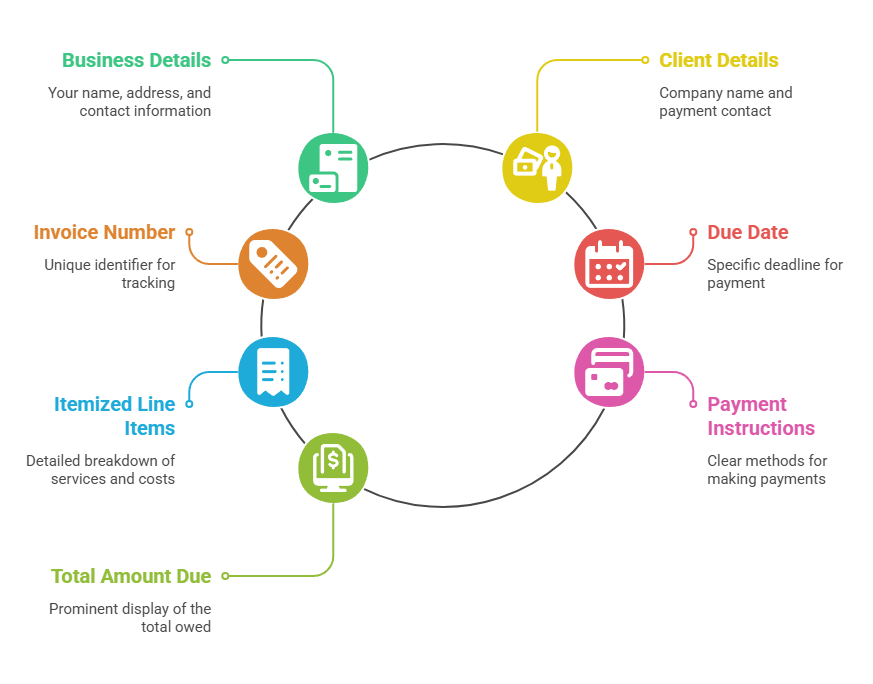
Understanding how to invoice as a freelancer starts with knowing exactly what every professional invoice should include.
Your name and contact info, the client’s billing details, a unique invoice number, a specific due date, itemized line items with descriptions and amounts, the total due, and clear payment instructions. Miss any of these, and you’re slowing down your own payment.
Essential Invoice Elements Every Freelancer Needs
Your Business and Client Information
- Your business details — full name or business name, address, email, phone number. Add your logo if you have one. Never include your Social Security number on an invoice. If a client needs your tax ID, provide it through a W-9 form separately. Get a free EIN from IRS.gov even as a sole proprietor — it takes five minutes and protects your identity.
- Client details — company name, billing address, and the name of the person who actually handles payments. This is often someone in accounts payable, not your project contact. Sending the invoice to the wrong person is one of the most common reasons freelancers wait weeks for payment that’s already been approved.
Invoice Numbers, Dates, and Line Items
- A unique, sequential invoice number — start at 1001 rather than 001 if you’d rather not signal that you’re brand new. Sequential (1001, 1002, 1003) works for most freelancers. Date-based (2026-04-001) works well at higher volumes. Never skip or reuse numbers — gaps raise questions during audits.
- The invoice date and a specific due date — not “Net 30,” a specific calendar date like “Due by April 22, 2026.” FreshBooks’ analysis of over a million invoices shows that specific dates get paid faster than vague terms. People act on concrete deadlines.
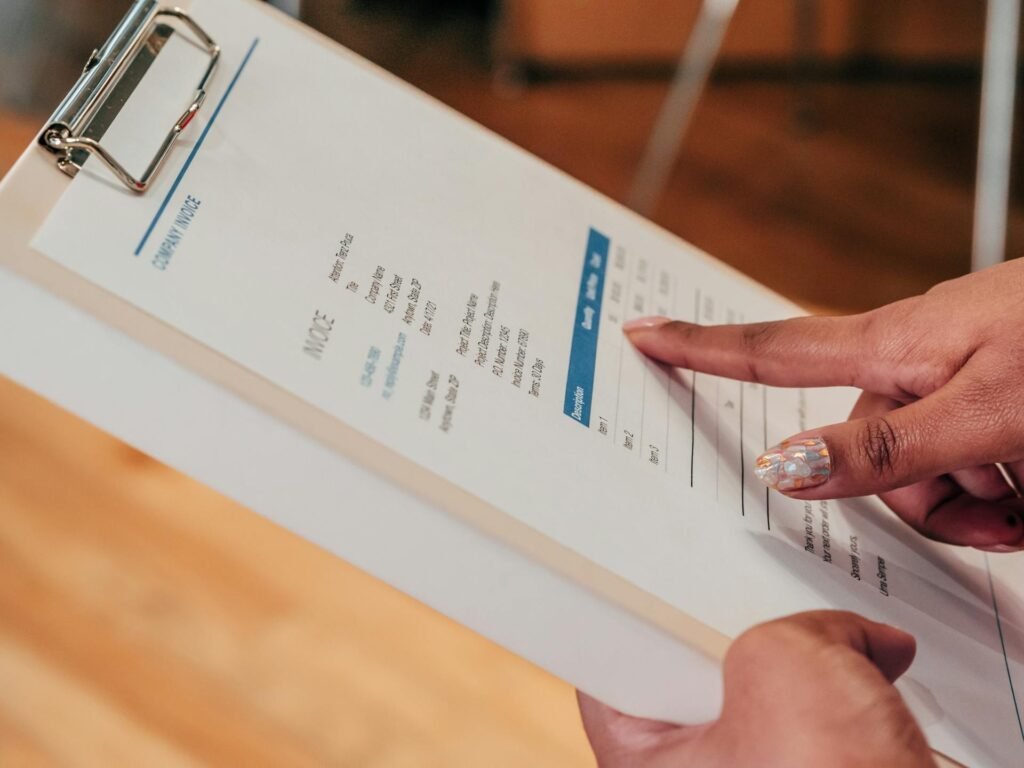
- Itemized line items — detailed enough that the client can match every charge to a deliverable they received. “Website copywriting: 5 product pages, 300 words each, delivered April 8” is good. “Writing services” is not. Include the rate, quantity, or hours, and line item total for each entry. Itemize expenses (travel, software, materials) separately.
Payment Instructions and Total Amount Due
- Clear payment instructions — your accepted methods (ACH, credit card, PayPal, cheque), the relevant details for each, and a clickable payment link if your invoicing tool provides one. Clients pay invoices with a “Pay Now” button up to twice as fast as PDFs with bank transfer details. If you’re choosing an invoicing tool, online payment acceptance is the feature that matters most.
- A prominent total amount due — make it the most visible number on the page, 20–30% larger than your body text. If the client’s eyes land anywhere, it should be on what they owe and how to pay it.
These are the essentials of a standard invoice. A pro forma invoice serves a different purpose by giving a client preliminary billing details before the final invoice is issued.
Once you know which document you need, a software tool can do much of the heavy lifting for you. Make sure to check out our guide to the best invoicing tool for freelancers.
How to Invoice as a Freelancer and Send Invoices Professionally?
One of the biggest lessons in how to invoice as a freelancer is that speed matters just as much as invoice accuracy. Every day you delay invoicing is another day unpaid.
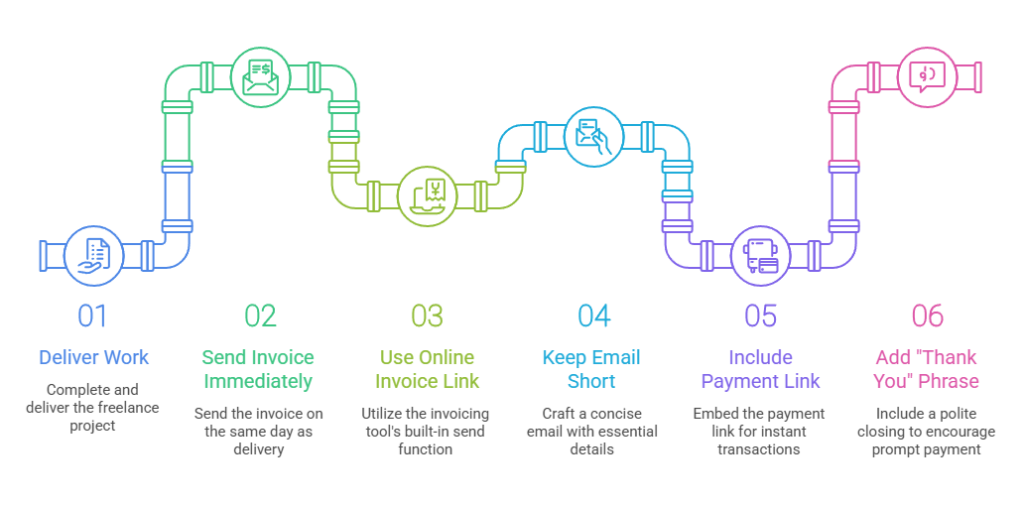
Send the day you deliver the work.
For recurring clients on monthly retainers, the 1st of the month is optimal.
An analysis of 300,000 invoices found that those sent on the 1st were paid an average of 8 days faster than those sent at month-end. If your client is a corporation, Tuesday mornings during business hours tend to land best.
Use your invoicing tool’s built-in send function rather than attaching a PDF to a regular email. The online invoice link lets clients click a button and pay instantly by card or bank transfer. For the complete sending process, see our guide on how to send an invoice, including delivery methods, what to include in the message, and what to do after sending.
About 40% of payment link recipients pay within 24 hours. If you do attach a PDF as backup, always export from your template rather than sending an editable Word or Excel file. Editable documents can be altered and display differently across devices.
Keep your email short. Three or four sentences. Reference the completed work, state the amount and due date, include the payment link, and close with “Thank you for your prompt payment.”
That phrase isn’t just polite. FreshBooks’ data shows that clients pay invoices with “Thank you” roughly 2 days faster than average.
Want word-for-word email templates?
Our guide to freelance invoice email templates covers exactly what to write for first invoices, recurring billing, and overdue follow-ups — including the polite-but-firm chase email that gets clients to pay without burning the relationship.
How to Invoice as a Freelancer With Payment Terms That Get You Paid Faster?
Short terms, upfront deposits, and a late fee clause in your contract. Invoices with 7-day terms get paid within a week 58% of the time. With 30-day terms, that drops to 40%.
Shorter payment terms
Stop using Net 30. It’s the default most freelancers start with because it sounds professional. But in practice, US small businesses pay an average of 8 days past the deadline.
So Net 30 becomes Net 38. Set your terms to Due in 14 Days for most clients.
Start brand new clients on Due in 7 Days or Due on Receipt, then extend to 14 days after they’ve paid on time three times in a row. Most clients won’t push back. Those who do will negotiate, and that’s fine.
But you should start from a position that protects your cash flow.
Upfront deposits
Require 25 to 50% before starting any project over $1,000. The most common structure among experienced freelancers is 50/50: half at signing, half on delivery. For larger projects, thirds work well (one-third at signing, one-third at midpoint, one-third on delivery).
Best way to approach this is to tie your final payment to the first draft, not final approval. Clients who drag their feet on revisions can hold up your last payment for months if the final milestone is “approved deliverable.”
A late fee clause
Add one to your contract and your invoice terms. “Interest of 1.5% per month charged on overdue balances” is the standard language.
Invoices with the word “Interest” in their terms show a 92% payment rate, the highest of any term FreshBooks tested across their 1M+ invoice data set.
You may never actually charge the fee. Most freelancers don’t. But having it there changes how clients prioritize your invoice when they’re deciding which vendor to pay first.
Online payment acceptance
The roughly 2.9% credit card fee or 1% ACH fee pays for itself when you get paid in days instead of weeks. On $100,000 in annual revenue, the difference between all-credit-card and mostly-ACH payments saves $1,400 to $2,000 a year in fees.
That trade-off is worth it every time.
How to Invoice as a Freelancer When Clients Pay Late?
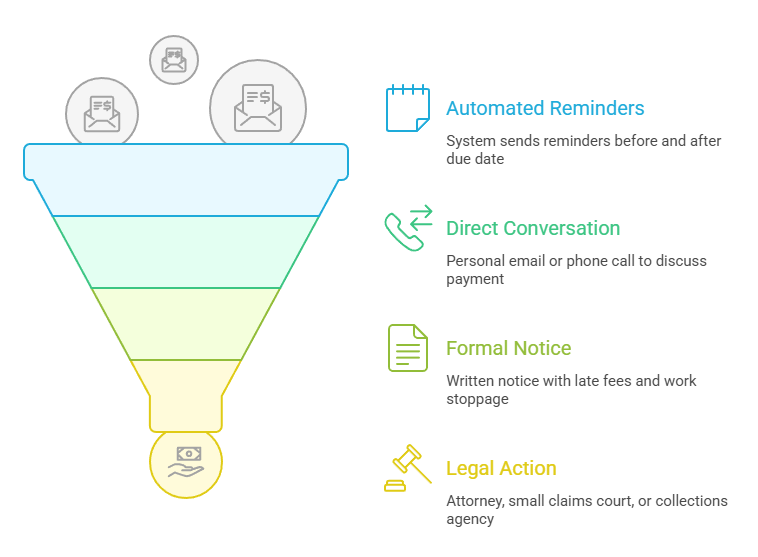
Follow a structured escalation: automated reminders first, then a direct conversation, then a formal notice with late fees applied. A big part of learning how to invoice as a freelancer is knowing what to do after the invoice is sent — especially when clients pay late.
Most late payments are due to oversight, not refusal. A polite system handles the majority.
Start With Automated Payment Reminders
Set up automated reminders in your invoicing tool before you send your first invoice. Three reminders work well: 3 days before the due date (a friendly heads-up), on the due date (a professional notification), and 3 to 7 days after (a polite nudge).
Automated reminders reduce overdue invoices by 25 to 40% because they remove the emotional weight of chasing. The client doesn’t know it’s automated. It just looks like you run a tight operation.
Follow Up Personally Before Escalating
If the invoice is 14 days past due and reminders haven’t worked, send a personal email or pick up the phone. Reference the specific invoice number, the amount, and the original due date. Mention your contract terms.
For example, “Just checking in on Invoice #1042, which was due on March 15. I haven’t applied the late fee from our agreement yet, but I wanted to make sure this didn’t slip through the cracks.”
The word “yet” does the heavy lifting.
What to Do With Seriously Overdue Freelance Invoices
At 30 days overdue, send a formal written notice.
Apply the late fee per your contract. Stop any ongoing work for the client. If your contract includes a copyright retention clause (and it should), remind them that deliverables remain your intellectual property until final payment is received.
Freelancers who use this approach consistently report fast resolution.
Beyond 60 days, your options include a demand letter from an attorney ($150 to $300), small claims court (limits vary by state, typically $5,000 to $10,000), or a collections agency.
In New York, the Freelance Isn’t Free Act provides double damages plus attorney’s fees for engagements over $800. Illinois has similar protections. Know your state’s laws.
The Best Way to Prevent Late Payments
But the best late payment strategy is prevention.
Contracts with clear terms, upfront deposits, online payments, and automated reminders solve most problems before they start. By the time you’re chasing a 60-day overdue invoice, something went wrong much earlier in the process.
How Do Your Invoices Connect to Your Taxes?
Every invoice you send becomes part of your tax record. Your invoiced income goes on Schedule C, your self-employment tax is 15.3% of net profit, and you need quarterly estimated payments to avoid IRS penalties.
All freelance income must be reported on Schedule C (Form 1040), even income that doesn’t show up on a 1099. Clients are required to send you a 1099-NEC if they paid you $600 or more in a calendar year.
But you owe taxes on all freelance income, regardless of whether a 1099 arrives.
Self-employment tax is 15.3% of net earnings on top of income tax. On $80,000 in net profit, that’s roughly $11,300 in SE tax alone.
Quarterly estimated payments (due April 15, June 15, September 15, January 15) are required if you expect to owe $1,000 or more. Skip them, and you’ll face penalties on top of the tax bill.
Keep digital copies of every invoice for at least three years, six if you want to be safe. Your accounting software can track invoice totals by client and month automatically. If your bookkeeping is current, tax filing takes hours instead of the panicked weekend most freelancers describe.
Set Up the System, Then Let It Work
Learning how to invoice as a freelancer is all about building a system that consistently turns your work into income. Get the mechanics right (detailed line items, specific due dates, payment links) and pair them with a smart strategy (short terms, deposits, automated reminders), and you’ll spend less time chasing payments and more time doing the work you actually want to do.
Your first invoice will feel awkward. Your fiftieth won’t. The system matters more than the feeling.
Set it up, let it run, and stop chasing.
Frequently Asked Questions
How do freelancers bill clients?
Most freelancers bill clients by sending a professional invoice that includes their business details, an invoice number, itemized services, the total amount due, payment instructions, and a specific due date. Many freelancers also use invoicing software to automate reminders and accept online payments.
What should a freelance invoice look like?
A freelance invoice should clearly display your business and client information, a unique invoice number, the invoice and due dates, a detailed breakdown of services provided, the total amount due, and payment instructions. The goal is to make it easy for the client to understand exactly what they owe and how to pay.
What are common invoicing mistakes to avoid?
Common mistakes include sending invoices late, using vague service descriptions, omitting payment instructions, failing to include a due date, not requiring deposits for larger projects, and waiting too long to follow up on overdue invoices. Small errors like these can significantly delay payment.
Can ChatGPT generate an invoice?
Yes. ChatGPT can help create invoice templates, invoice emails, and itemized invoice drafts based on the information you provide. However, you’ll still need to verify the details, add payment information, and ensure the invoice meets any legal or tax requirements in your country.
How can freelancers get paid faster?
Freelancers can improve payment speed by invoicing immediately after completing work, using specific due dates instead of vague payment terms, accepting online payments, requiring upfront deposits if necessary, and setting up automated payment reminders.
Related guides: best invoicing tool for freelancers · invoice email sample · accounting software for freelancers · bookkeeping for self employed · how to send an invoice · pro forma invoice