
The 2 Minute Rule: How to Stop Procrastinating (Two Ways)

Two things quietly wreck a freelancer’s week — and the 2 Minute Rule tackles both.
One is the swarm of tiny jobs — reply to that client, log the expense, send the file — that each take about ninety seconds and somehow never get done until they’ve bred into a low-grade dread you carry around all day.
The other is the big task you keep circling but can’t make yourself start: the tax return, the proposal, the invoicing you’ve dodged for a week.
That’s where the rule gets interesting: there are actually two versions, from two different people, doing two opposite jobs. One says finish the small stuff now. The other says start the big stuff tiny.
Used together, they’re a genuinely powerful antidote to procrastination.
Here’s what each rule is, who came up with it, the difference that matters, and exactly how a freelancer puts both to work.
Quick Takeaways
- There are two 2-minute rules: David Allen’s (“if it takes under two minutes, do it now”) and James Clear’s (“shrink a new habit to a two-minute version so starting is easy”).
- Allen’s rule clears your admin pile — do the tiny tasks the moment they appear so they never stack up.
- Clear’s rule starts the scary tasks — “do your invoicing” becomes “open the invoicing app for two minutes,” and starting is the hard part.
- They share a threshold but flip the purpose: one finishes small tasks, the other starts big habits.
- Watch the trap: doing endless two-minute jobs to avoid the important one is procrastination in disguise.
What is the 2-minute rule?
The 2-minute rule is a productivity principle for beating procrastination — but it comes in two versions. David Allen’s original says that if a task takes less than two minutes, you should do it immediately.
James Clear’s later version says any new habit should be scaled down to something you can do in under two minutes, so starting feels effortless.
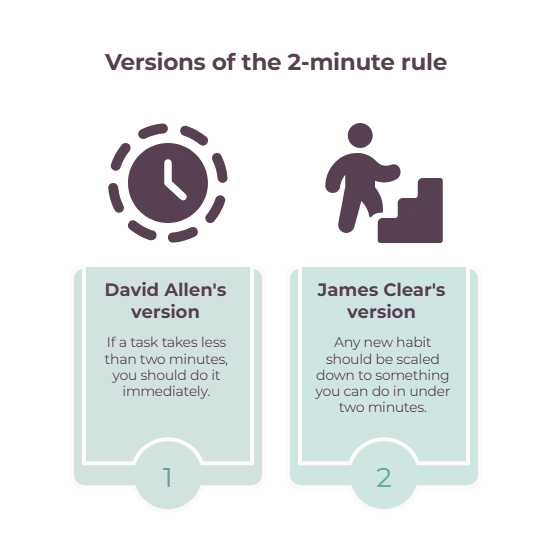
Same two-minute mark, two different jobs.
Most people have only met one of them — usually James Clear’s, because it’s the one that went viral through Atomic Habits.
But the two work best as a pair: Allen’s rule keeps small tasks from piling up, and Clear’s rule gets you moving on the big ones. Understanding both is what turns “a neat trick” into a system you can actually run your week on.
Version 1: David Allen’s rule (do it now)
David Allen’s 2-minute rule, from his book Getting Things Done, states that if an action takes less than two minutes, you should do it the moment it comes up rather than filing it away for later.
The logic is almost too simple: writing the task down, scheduling it, or adding it to a list takes longer than just doing the thing.
Allen built the rule into the way he processes incoming tasks.
When something lands on your plate, you ask one question — can I finish this in under two minutes?
If yes, you do it right then, because deferring it costs more time and mental energy than completing it. Answer the email, approve the file, book the slot.
The point is to stop small tasks from accumulating into a backlog, because it’s rarely the individual two-minute job that drains you — it’s the forty of them sitting unfinished in the back of your mind.
(You can read Allen’s own explanation at Getting Things Done.)
Version 2: James Clear’s rule (start tiny)
James Clear’s 2-minute rule, from Atomic Habits, states that when you start a new habit, it should take less than two minutes to do. You shrink the habit down to a laughably small entry point so that starting is effortless.
The goal isn’t to do two minutes of work — it’s to master the art of showing up.
Clear’s examples make it click: “read before bed” becomes “open the book,” “run three miles” becomes “tie my running shoes,” “study for class” becomes “open my notes.”
The idea is that a habit has to be established before it can be improved, and you can’t improve a habit that doesn’t exist.
By making the first step so small you can’t talk yourself out of it, you get past the only part that really stops you — starting. Once you’ve started, continuing is usually easy, but even if you stop at two minutes, you’ve reinforced the habit of beginning.
(Clear’s full write-up is at jamesclear.com.)
The difference (and why it matters)

Allen’s rule is about finishing tasks; Clear’s rule is about starting habits. Allen says do the tiny things now so they don’t pile up; Clear says shrink the big things down so you’ll actually begin them. Same two-minute threshold, opposite purpose. Knowing which one you’re reaching for is what makes them useful.
Reach for Allen’s rule when you’re processing small, one-off jobs — the admin, the email, the quick replies.
Reach for Clear’s rule when you’re facing something big and important that you keep avoiding, and you need a way in.
Confuse them, and you’ll either try to “just do” a task that genuinely takes an hour, or endlessly shrink a task that you could have finished in ninety seconds.
Matched to the right situation, one keeps your day clear, and the other keeps your goals moving.
How freelancers use the 2-minute rule
Freelancers get the most from the 2-minute rule by using Allen’s version to clear the constant drip of admin, and Clear’s version to start the big tasks they dread — especially the money jobs like invoicing and expenses.
With no team to hand things to, you’re the one who has to both keep the small stuff moving and force yourself into the big stuff.
The rule works best as part of a simple setup, with the right productivity tools for freelancers handling tasks, time, notes, email, and focus around it.
Put the two to work like this:
- Use Allen’s rule on your admin pile. When a two-minute job appears — a client asks a quick question, an expense needs logging, a file needs sending — do it there and then instead of adding it to a mental list that never shrinks. Applied to your inbox, it stops email from becoming a backlog (there’s more on that in email management systems), and applied to invoices, it keeps your records current (see how to keep track of invoices).
- Use Clear’s rule to start the scary tasks. The tax return, the proposal, the overdue invoicing — shrink each to a two-minute opener. “Do my invoicing” becomes “open the invoicing app and start one invoice.” More often than not, once you’ve started, you’ll keep going; the two minutes were never the point; getting past the resistance was.
- Attach it to a routine you never skip. Do your two-minute starter right after your morning coffee, or your admin sweep right after lunch. Borrowing the momentum of an existing habit makes the new one stick.
- Pair it with your daily priorities. The 2-minute rule is a brilliant way to start the one big task in the 1-3-5 rule — two minutes to begin, then let momentum carry the rest.
When the 2-minute rule backfires

The 2-minute rule turns against you when you use the “do it now” version to fill your day with tiny tasks while quietly avoiding the important one. Clearing forty small jobs can feel productive while your actual priority sits untouched — which is procrastination wearing a very convincing disguise.
The rule is a tool for triage, not for your focus hours.
The fix is to be deliberate about when you apply it.
Use Allen’s “do it now” rule while you’re processing your inbox or triaging tasks, not while you’re meant to be deep in your big task of the day — otherwise every little ping becomes a reason to break focus.
If the small jobs are multiplying, batch them into a block rather than doing them the instant they appear (our guide to a time blocking app covers this).
Do the important work first, then let the two-minute rule mop up the small stuff around it.
The takeaway
The 2-minute rule isn’t one trick; it’s two — and freelancers need both. Do the small stuff the moment it appears so it never becomes a dreaded pile, and start the big stuff tiny so “I’ll do it later” turns into “I’ve already begun.”
Pick the right version for the moment, keep it out of your deep-work hours, and the tasks you’ve been avoiding stop feeling like a wall and start feeling like two minutes.
Frequently Asked Questions
What is the 2-minute rule?
It’s a productivity principle with two versions. David Allen’s says that if a task takes less than two minutes, do it immediately instead of deferring it.
James Clear’s says a new habit should be scaled down to a two-minute version so it’s easy to start. One finishes small tasks; the other starts big habits.
Who came up with the 2-minute rule?
David Allen coined the original in his book Getting Things Done — the “if it takes under two minutes, do it now” version.
James Clear later popularized a different version in Atomic Habits, using the two-minute idea to make starting new habits effortless. They’re two distinct rules that happen to share a name.
What’s the 2-minute rule in Atomic Habits?
In Atomic Habits, James Clear’s 2-minute rule says any new habit should take less than two minutes to begin. You shrink it to a tiny entry point — “read before bed” becomes “open the book” — so starting is so easy you can’t refuse.
The aim is to master showing up before you worry about doing more.
How does the 2-minute rule stop procrastination?
It removes the two things that cause procrastination: small tasks piling up, and big tasks feeling too hard to start.
Doing sub-two-minute jobs immediately stops the backlog from forming, and shrinking a big task to a two-minute opener gets you past the resistance of starting, which is usually the only hard part.
Does the 2-minute rule actually work?
Yes, for what each version is designed to do. Allen’s keeps small admin from snowballing, and Clear’s can help get you started on tasks you’d otherwise avoid.
It won’t finish big projects for you, and it can backfire if you use small tasks to dodge important ones — but as a way to beat starting-resistance and backlog, it works.
How do I use the 2-minute rule as a freelancer?
Use Allen’s version on your admin — reply, log, send, and file two-minute jobs the moment they appear so they don’t stack up.
Use Clear’s version to start the big tasks you dread, like invoicing or your tax return, by shrinking them to a two-minute opener. Keep the “do it now” habit to triage time, not your focus hours.
Related guides: the 1-3-5 rule · time blocking app · email management systems · how to stay focused when working from home · productivity tools for freelancers