Pro Forma Invoice: How to Use One With Confidence

A promising new client replies to your quote with a small request: “Great — can you send a pro forma invoice first?”
And if you’ve never been asked that before, it’s a slightly unnerving moment, because it sounds official and you’re not sure how it’s different from a normal invoice.
A pro forma invoice sounds far more complicated than it is. It’s one of the simplest documents in freelancing.
The pro forma is a preliminary, no-obligation version of an invoice — a formal estimate you send before the work, so both sides agree on the price and terms before any real bill (or payment) exists.
Below is what it is, how it differs from a regular invoice, when a freelancer would send one, and exactly what to put on it.
Quick Takeaways
- A pro forma invoice is a preliminary, estimated invoice sent before the work is done.
- It is not a demand for payment and not legally binding — the client doesn’t have to pay it, and it doesn’t go in your books.
- Its job is to agree the price and terms up front, often so a client can approve a budget or raise a purchase order.
- Freelancers use them for new clients, deposits, budget sign-off, and international clients.
- Once the work is approved or delivered, you send the real (final) invoice, usually mirroring the pro forma.
What is a pro forma invoice?

A pro forma invoice is a preliminary bill of sale that a freelancer sends before the work is delivered, laying out what the client will receive and what it will cost, in the format of an invoice.
It sets expectations and helps both sides agree terms — but it is not a demand for payment, it isn’t legally binding, and it isn’t recorded for accounting or tax.
In plain terms, it’s a formal preview of the invoice to come.
The name comes from the Latin for “for the sake of form” — it’s a formality, a document that looks like an invoice so everyone can see exactly what’s being agreed, without any of an invoice’s obligations.
You’ll also see it written as one word, “proforma invoice”; both mean the same thing.
According to Investopedia, its purpose is to give the buyer a good-faith estimate to review before committing, which is exactly how a freelancer should think about it.
Pro Forma vs. Regular Invoice: What’s the Difference?
The difference comes down to timing and status: the pro forma is a preliminary estimate sent before the work, with no accounting weight, while a regular invoice is the official demand for payment sent after the work, recorded in your books as income. One opens the conversation; the other closes it.
(A regular invoice is your formal request for payment and an accounting record; what makes the payment itself enforceable is the underlying agreement or contract, not the invoice on its own.)
| Pro forma invoice | Regular (commercial) invoice | |
| When it’s sent | Before the work or delivery | After the work or delivery |
| Purpose | Estimate and agree terms | Request payment |
| A demand for payment? | No | Yes |
| A formal accounting record? | No | Yes |
| Recorded in your books? | No | Yes |
| Reference number | Marked “pro forma” | An official invoice number |
| What the client does with it | Reviews, approves, raises a PO | Pays it |
The key thing to remember is that you can’t chase a client for payment based on the pro forma, and you don’t record it as income. It becomes real money only when you send the final invoice.
When Should Freelancers Send One?

Freelancers send a pro forma invoice when a client needs a formal cost breakdown before committing — to approve a budget, raise a purchase order, agree a deposit and terms, or satisfy a finance or customs process, especially with new or international clients.
It’s the professional way to say “here’s exactly what this will cost” before anyone is on the hook.
- Budget approval or a purchase order. Corporate clients often can’t commission you until finance approves the spend, and their system needs an invoice-format document to raise a purchase order. That’s exactly what the pro forma provides.
- New clients. For a first project with someone who doesn’t know you yet, a pro forma looks more formal and reassuring than a casual emailed quote — it signals you run a real business.
- Agreeing a deposit and terms. Sending a pro forma up front puts the scope, price, and payment terms in writing so there’s no “I thought it included that” later, and it’s the natural basis for requesting a deposit — which can also help prevent cash flow problems when projects run for weeks before final payment.
- International clients and customs. Overseas clients whose finance or import processes require a formal document will often specifically ask for a pro forma invoice.
What Should You Include?
A pro forma invoice includes everything a normal invoice does, clearly labeled as “pro forma”: your and the client’s details, a date and validity period, itemized services with quantities and prices, the estimated total plus any tax or fees, payment and delivery terms, and a note that it’s not a demand for payment.
Get these right, and the client can approve it with confidence.
- “Pro Forma Invoice” clearly at the top, so there’s no confusion with a real invoice.
- Your details and the client’s — names, addresses, contact info.
- A date and a validity/expiry date (estimates shouldn’t be open-ended).
- Itemized line items — a description of each service, quantity, and unit price.
- The estimated total, plus any tax, fees, or shipping if relevant.
- Payment and delivery terms — how and when you expect to be paid, and the timeline.
- A reference number marked as pro forma.
- A short note that it’s for information and not a request for payment.
Most freelance billing software can generate a one for you, so you rarely have to build one from scratch.
If you haven’t chosen a platform yet, compare the best invoicing tools for freelancers to find one that fits your workflow.
Pro forma invoice vs a quote or estimate

A quote and a pro forma both come before the work, and neither demands payment, but a pro forma is formatted like a formal invoice and is usually what a client’s finance system needs to approve a budget or raise a purchase order — where a quote is often a looser, earlier document.
They serve similar goals at different levels of formality.
Send a quote early, when a client is still deciding and wants a ballpark. Send the pro forma once you’re both fairly committed, and they need something official to process internally.
For many small freelance jobs, a quote is all you’ll ever need; the pro forma comes into play with bigger, corporate, or international clients.
How to Turn It Into a Final Invoice
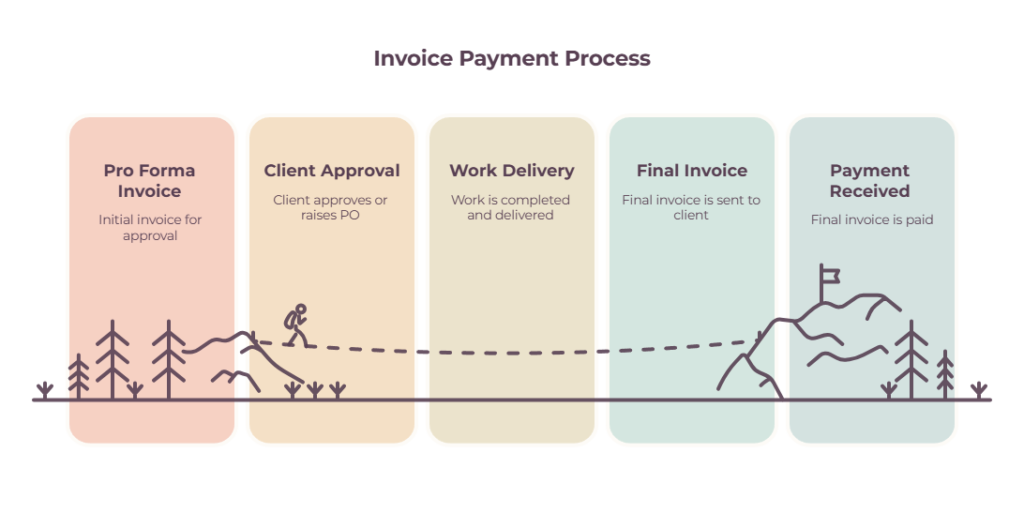
Once the client approves the pro forma and the work is delivered, you send the final invoice — usually the same document with the amounts confirmed, a proper invoice number, and a request for payment.
That final invoice is the one that goes in your books and gets paid. The pro forma did its job; now the real bill takes over.
The whole flow is simple: send the pro forma → the client agrees and (if relevant) raises a PO → you do the work → you send the final invoice → you get paid.
Because the final invoice usually mirrors the pro forma, it takes seconds to produce.
For creating that real invoice, see how to invoice as a freelancer, and to track it from sent to paid, our guide to building an invoice management system.
The bottom line
A pro forma invoice is simply a formal “here’s what it will cost” that you send before the work begins.
Use it to get new, corporate, or international clients agreed and approved without committing anyone to payment, then send the real invoice once the job is done.
It’s a small, professional step that makes bigger projects run smoothly.
Frequently Asked Questions
What is a pro forma invoice in simple terms?
It’s a preliminary invoice — a formal estimate you send a client before doing the work, showing what they’ll get and what it will cost.
It looks like an invoice but isn’t a bill: the client doesn’t have to pay it, and it isn’t recorded in your accounts. Its job is to agree the price and terms up front.
Is a pro forma invoice legally binding?
No. It isn’t a demand for payment — it’s a good-faith estimate that helps both sides agree on price and terms before any work or payment happens. The document that actually requests payment is the final invoice you send afterward.
Bear in mind that even a regular invoice isn’t a contract in itself; what makes payment enforceable is the agreement behind it, which is why a signed contract matters.
Do you have to pay a pro forma invoice?
No. A client isn’t obligated to pay a pro forma invoice, because it’s an estimate rather than a request for payment.
Payment falls due once you deliver the work and send the final (commercial) invoice, which is the official, recorded bill — with the terms you agreed up front setting when it must be paid.
What’s the difference between a pro forma invoice and a regular invoice?
The pro forma is sent before the work as a preliminary estimate and isn’t recorded in your books. A regular invoice is sent after the work as the actual demand for payment — it has an official invoice number and is recorded as income.
The regular invoice is the formal, payable document; the pro forma is just a preview of it.
When should a freelancer use a pro forma invoice?
Send one when a client needs a formal cost breakdown before committing: to approve a budget, raise a purchase order, agree a deposit and terms, or meet a finance or customs requirement.
They’re most common with new, corporate, or international clients; for small everyday jobs, a simple quote is usually enough.
What’s the difference between a pro forma invoice and a quote?
Both come before the work, and neither requires payment. A quote is usually a looser, earlier document for when a client is still deciding, while a pro forma invoice is more formal and invoice-shaped — the version a client’s finance team often needs to approve spending or raise a purchase order.
Related guides: best invoicing tool for freelancers · how to invoice as a freelancer · purchase order vs invoice · invoice management system · freelance billing software · cash flow problems for freelancers